jeudi 6 février 2014

HUMAN RIGHTS WATCH - Iraq: Security Forces Abusing Women in Detention


Iraq: Security Forces Abusing Women in Detention
Torture Allegations Underscore Urgent Need for Criminal Justice Reform
FEBRUARY 6, 2014

What Iraq Should Do
Investigate alleged abuse of women in detention
Prosecute those found responsible for abusing detained women
Repeal provisions that allow arrests based on secret testimony and coerced confessions
What Other Governments Should Do
Condition aid to Iraq, especially weapons and security assistance, on compliance with treaty obligations


Enlarge

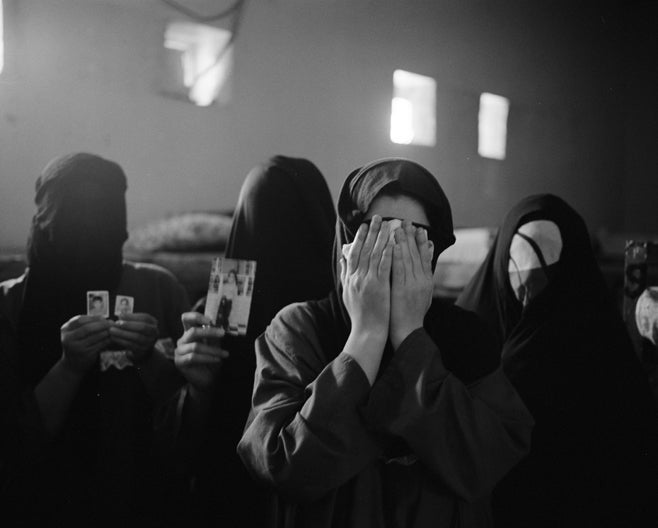
Women incarcerated in the Kadhimiyya women’s prison in 2006. Prior to 2009, Kadhimiyya was the only place in Baghdad where women charged with crimes were incarcerated. Security forces now detain women in prisons and other detention facilities across the country; many remain in detention for months and even years without trial.
© 2006 Yuri Kozyrev / Noor /Redux
OUR REPORT:


“No One is Safe”
The Abuse of Women in Iraq’s Criminal Justice System
FEBRUARY 6, 2014
GET THE REPORT:
Download the full report
GO TO REPORT HOME »


(Baghdad) – Iraqi authorities are detaining thousands of Iraqi women illegally and subjecting many to torture and ill-treatment, including the threat of sexual abuse. Iraq’s weak judiciary, plagued by corruption, frequently bases convictions on coerced confessions, and trial proceedings fall far short of international standards. Many women were detained for months or even years without charge before seeing a judge.

The 105-page report, “‘No One Is Safe’: Abuses of Women in Iraq’s Criminal Justice System,”documents abuses of women in detention based on interviews with women and girls, Sunni and Shia, in prison; their families and lawyers; and medical service providers in the prisons at a time of escalating violence involving security forces and armed groups. Human Rights Watch also reviewed court documents and extensive information received in meetings with Iraqi authorities including Justice, Interior, Defense, and Human Rights ministry officials, and two deputy prime ministers.

“Iraqi security forces and officials act as if brutally abusing women will make the country safer,” said Joe Stork, deputy Middle East and North Africa director at Human Rights Watch. “In fact, these women and their relatives have told us that as long as security forces abuse people with impunity, we can only expect security conditions to worsen.”

In January 2013, Prime Minister Nuri al-Maliki promised to reform the criminal justice system, beginning with releasing detained women who had judicial orders of release. A year later, the brutal tactics of security forces remain essentially the same and hundreds of women remain in detention illegally.

As fighting raged between a multitude of Sunni insurgent groups and government security forces in Anbar province in January 2014, Anbar residents expressed their frustration to Human Rights Watch over Maliki’s failure to carry out promised reforms. Residents’ lack of trust in security forces, caused by their policy of attacking residents in Sunni areas, including the abuses of women Human Rights Watch documented, is undermining the government’s military efforts against Al-Qaeda in Anbar, they said.

Many of the 27 women who spoke with Human Rights Watch described being beaten, kicked, slapped, hung upside-down and beaten on their feet (falaqa), given electric shocks, and raped or threatened with sexual assault by security forces during their interrogation. They said security forces questioned them about their male relatives’ activities rather than crimes in which they themselves were implicated. Security forces forced them to sign statements, many with fingerprints, which they were not allowed to read and that they later repudiated in court, they said.

One woman entered her meeting with Human Rights Watch in Iraq’s death row facility in Baghdad’s Kadhimiyya neighborhood on crutches. She said nine days of beatings, electric shocks, and falaqa in March 2012 had left her permanently disabled. The split nose, back scars, and burns on her breast that Human Rights Watch observed were consistent with the abuse she alleged. She was executed in September 2013, seven months after Human Rights Watch interviewed her, despite lower court rulings that dismissed charges against her following a medical report that supported her alleged torture.

Human Rights Watch found that Iraqi security forces regularly arrest women illegally and commit other due process violations against women at every stage of the justice system. Women are subjected to threats of, or actual, sexual assault, sometimes in front of husbands, brothers, and children. Failure by the courts to investigate allegations of abuse and hold the abusers responsible encourages the police to falsify confessions and use torture, Human Rights Watch said.

The vast majority of the more than 4,200 women detained in Interior and Defense ministry facilities are Sunni, but the abuses Human Rights Watch documents affect women of all sects and classes throughout Iraqi society.

Both men and women suffer from the severe flaws of the criminal justice system. But women suffer a double burden due to their second-class status in Iraqi society. Human Rights Watch found that women are frequently targeted not only for crimes they themselves are said to have committed, but to harass male family or members of their communities. Once they have been detained, and even if they are released unharmed, women are frequently stigmatized by their family or community, who perceive them to have been dishonored.

Iraq’s broken criminal justice system fails to achieve justice for victims either of security force abuses or of criminal attacks by armed groups, Human Rights Watch said. Arrests and convictions Human Rights Watch documented appeared often to have been predicated on information provided by secret informants and confessions coerced under torture.

“We don’t know who we fear more, Al-Qaeda or SWAT,” said one Fallujah resident, referring to the special forces unit that carries out counterterrorism operations. “Why would we help them fight Al-Qaeda when they’ll just come for us as soon as they’re done with them?”

Human Rights Watch reviewed a video in which a man representing himself as a leader of Al-Qaeda asks a crowd of onlookers in Ramadi, “What are we supposed to do when the army is raping our women? What are we supposed to do when they’re imprisoning our women and children?” Peaceful protesters posed these same questions to Iraqi authorities in mass demonstrations that began over a year ago, but Maliki’s promises to address these issues remain unfulfilled.

Women detainees, their families, and lawyers told Human Rights Watch that security forces conduct random and mass arrests of women that amount to collective punishment for alleged terrorist activities by male family members. Authorities have exploited vague provisions in the Anti-Terrorism Law of 2005 to settle personal or political scores – detaining, charging, and trying women based on their association to a particular individual, tribe, or sect, Human Rights Watch said.

In the vast majority of cases Human Rights Watch examined, women had no access to a lawyer before or during their interrogation, contrary to Iraqi law when security forces presented them with statements to sign, or at trial, either because they could not afford one or because lawyers feared taking on politically sensitive cases.

In every case Human Rights Watch documented in which women told the investigating or trial judge about abuse, the judges did not open an inquiry. Some dismissed the allegations, saying that they observed no marks on the defendant’s body or that the woman should have made the allegations earlier.

Iraqi authorities should acknowledge the prevalence of abuse of female detainees, promptly investigate allegations of torture and ill-treatment, prosecute guards and interrogators responsible for abuse, and disallow coerced confessions, Human Rights Watch said. They should make judicial and security sector reform an urgent priority as a prerequisite for stemming violence that increasingly threatens the country’s stability.

“The abuses of women we documented are in many ways at the heart of the current crisis in Iraq,” Stork said. “These abuses have caused a deep-seated anger and lack of trust between Iraq’s diverse communities and security forces, and all Iraqis are paying the price.”

This chart shows just how bad things are getting in Iraq


This chart shows just how bad things are getting in Iraq

BY ANUP KAPHLE

February 5 at 11:13 am


A senior member of the al-Qaeda-linked ISIS group stands next to a burning police vehicle in Iraq's Anbar Province. (Militant Web site via AP)

This happened in Baghdad today:
Two car bombs went off simultaneously in two parking lots, across the street from the Foreign Affairs Ministry. Twelve people were killed.
A suicide bomber walked into a falafel restaurant and set off his explosives-laden belt. Five people were killed.
A bomb inside a parked car went off in a commercial center. Five people were killed.

A total of 22 people were killed and 45 wounded in three separate attacks in the Iraqi capital, which came just days after one of its bloodiest months. But the rise in violence goes back even further, as this chart shows:


(Washington Post Graphics)

mercredi 5 février 2014

Syrie : La communauté turkmène prise pour cible


Syrie : La communauté turkmène prise pour cible


mercredi 5 février 2014

http://www.turquie-news.com/rubriques/international/19608-quatre-commandants-turkmenes-tues.html

Un kamikaze de l’organisation de l’Etat islamique en Irak et au Levant (EIIL) a visé la sous-préfecture Cobanbey d’Alep, en Syrie, où vit une forte population de Turkmènes.

Quatre commandants turkmènes sont décédés dans l’attaque.

L’organisation EIIL avait proposé des négociations aux turkmènes syriens qui s’apprêtaient à contre-attaquer en vue de s’emparer de la commune.

Hakem Ahmad Fayad, représentant de la Brigade Mohammad al-Fatah, avait fait la médiation entre les Turkmènes et les autorités de l’EIIL qui réclamaient certaines garanties pour leur retrait de Cobanbey.

Quatre militants de l’organisation EIIL avaient assisté à la réunion réalisée au fief de la Brigade turkmène. A cet instant, un militant de l’EIIL a fait exploser les bombes qu’il portait. Abdulmunim Kalendir Ebou Islam, commandant turkmène, Imad Diman, commandant des opérations de la Brigade Fatah ainsi que deux autres commandants ont perdu la vie lors de l’attaque.

Les forces turkmènes qui ont appris l’attaque ont suspendu quelques temps leur assaut pour s’emparer de Cobanbey.

mardi 4 février 2014

We Need To End the Disastrous Failure Of The War On Terror By Nicolas J.S. Davies

AlterNet / By Nicolas J.S. Davies

We Need To End the Disastrous Failure Of The War On Terror
America's military adventures have fueled a global explosion of terrorism and a historic breakdown of law and order.


Global War on Terrorism Memorial at the Colorado State Welcome Center/Rest Area in Trinidad, Colorado.
Photo Credit: Matt Lemmon/Flickr
February 3, 2014 |

Twelve years into America's "war on terror," it is time to admit that it has failed catastrophically, unleashing violence, war and instability in an "arc of terror" stretching from West Africa to the Himalayas and beyond. If we examine the pretext for all this chaos, that it could possibly be a legitimate or effective response to terrorism, it quickly becomes clear that it has been the exact opposite, fueling a global explosion of terrorism and a historic breakdown of law and order.

The U.S. State Department's "terrorism" reports present a searing indictment of the "war on terror" on its own terms. From 1987 to 2001, the State Department's "Patterns of Global Terrorism" reports had documented asteady decline in terrorism around the world, from 665 incidents in 1987 to only 355 incidents in 2001. But since 2001, the U.S. "war on terror" has succeeded in fueling the most dramatic and dangerous rise in terrorism ever seen.

The State Department reports seem, at first glance, to show some short-term success, with total terrorist incidents continuing to decline, to 205 incidents in 2002 and 208 in 2003. But the number of more serious or "significant" incidents (involving death, serious injury, abduction, kidnapping, major property damage or the likelihood of such results) was already on the rise, from 123 incidents in 2001 to 172 in 2003.

But then the 2004 report, due to be published in March 2005, revealed that the number of incidents had spiked to an incredible 2,177, including 625 "significant" incidents, even though the report excluded attacks on U.S. occupation forces in Iraq. Secretary of State Condoleeza Rice took decisive action, not to urgently review this dangerous failure of U.S. policy, but to suppress the report. We only know what it said thanks to whistleblowers who leaked it to the media, and toLarry Johnson, an ex-CIA and State Department terrorism expert and a member of Ray McGovern's Veteran Intelligence Professionals for Sanity.

Rice eventually released a reformatted version of the 2004 report, ostensibly replacing "Patterns of Global Terrorism" with a new report titled "Country Reports on Terrorism" that excluded all statistical data. The State Department has continued to publish "Country Reports on Terrorism" every year, and was forced to include a "statistical annex" beginning with the report for 2005. The reports also include disclaimers that this data should not be used to compare patterns of terrorism from one year to the next because of the "evolution in data collection methodology". In other words, a report that used to be called "Patterns in Global Terrorism" should not be used to study patterns in global terrorism!

So, what is the State Department afraid we might find if we used it to do just that? Let's take a look. The politicization of these reports certainly undermines their reliability, but, as Secretary Rice understood verywell, the dramatic rise in global terrorism that they reveal is undeniable.

The numbers obviously spiked in Iraq and Afghanistan while under U.S. occupation, so we'll exclude the figures for those periods in those countries. The rationale for the "war on terror" was always that, by "fighting them there", we wouldn't have to "fight them here", so we'll just look at the effect "here" and everywhere else.

On that limited basis, the State Department reports nonetheless document an explosion of terrorism, from 208 incidents in 2003 to 2,177 in 2004 to 7,103 incidents in 2005. Since then, the total has fluctuated between a high of 7,251 incidents in 2008 and a low of 5,029 incidents in 2009, after President Obama's election temporarily raised hopes of a change in U.S. policy. The State Department has not issued a report for 2013 yet, but the number of "terrorist" incidents in 2012 remained at 5,748, documenting an intractable crisis that is the direct result of U.S. policy.

The ineffectiveness of the war on terror is intricately entwined with its illegitimacy. In my book,Blood On Our Hands: the American Invasion and Destruction of Iraq, I argued that the illegitimacy of the hostile U.S. military occupation of Iraq was at the root of all its other problems. The U.S. forces who illegally invaded the country lacked any real authority to restore the rule of law and order that they themselves had destroyed. Even today, two years after expelling U.S. forces, the Iraqi government installed by the U.S. occupation remains crippled by fundamental illegitimacy in the eyes of its people.

The United States' "war on terror" faces the same problem on a global scale. The notion of fighting "terror with terror" or a "war on terror" was always fundamentally flawed, both legally and in its prospects for success. As Ben Ferencz, the only surviving prosecutor from the Nuremberg war crimes trials, explained to NPR on September 19th 2001, a week after the mass murders of 2,753 people in his hometown, New York City:

"It is never a legitimate response to punish people who are not responsible for the wrong done. We must make a distinction between punishing the guilty and punishing others. If you simply retaliate en masse by bombing Afghanistan, let us say, or the Taliban, you will kill many people who don't approve of what has happened. I wouldn't say there is no appropriate role (for the military), but the role should be consistent with our ideals… our principles are respect for the rule of law, not charging in blindly and killing people because we are blinded by our tears and our rage. We must first draw up an indictment and specify what the crimes were, calling upon all states to arrest and detain the persons named in the indictment so they can be interrogated by U.S. examiners… I realize that (the judicial process) is slow and cumbersome, but it is not inadequate… We don't have to rewrite any rules. We have to apply the existing rules."

Ferencz took issue with the use of terms like "war", "war crimes" and "terrorism."

"What has happened here is not war in its traditional sense… War crimes are crimes that happen in wartime. There is confusion there… Don't use the term "war" crimes, because that suggests there is a war going on and it's a violation of the rules of war. This is not in that category. We are getting confused with our terminology in our determination to put a stop to these terrible crimes… To call them "terrorists" is also a misleading term. There's no agreement on what terrorism is. One man's terrorism is another man's heroism... We try them for mass murder. That's a crime under every jurisdiction and that's what's happened here and that is a crime against humanity."

British military historian Michael Howard told NPR that U.S. leaders were making "a very natural but a terrible and irrevocable error" in declaring a "war on terrorism." He elaborated in a lecture in London a few weeks later:

"…to use, or rather to misuse the term "war" is not simply a matter of legality, or pedantic semantics. It has deeper and more dangerous consequences. To declare that one is "at war" is immediately to create a war psychosis that may be totally counter-productive for the objective that we seek. It will arouse an immediate expectation, and demand, for spectacular military action against some easily identifiable adversary, preferably a hostile state…"

In the U.S. Congress in 2001, Barbara Lee stood alone against a sweeping Authorization for the Use of Military Force (AUMF), giving the president the authority to use "all necessary and appropriate force against those nations, organizations, or persons" whom he judged to have "planned, authorized, committed or aided" the mass murders of September 11th.

Barbara Lee implored her colleagues not to "become the evil we deplore," but she was the only Member with the clarity and courage to vote "No" to the AUMF. Twelve years later, she has 31 co-sponsors forH.R. 198, a bill to finally repeal the 2001 AUMF. They include former civil rights leader John Lewis, who said recently, "If I had to do it all over again, I would have voted with Barbara Lee. It was raw courage on her part. So, because of that, I don’t vote for funding for war. I vote against preparation for the military. I will never again go down that road."

From the outset, few Americans understood that the "war on terror" was not legally a real war in which the civilian rule of law was suspended. Elizabeth Wilmshurst resigned as Deputy Legal Advisor to the British Foreign Office in protest at the U.K.'s "crime of aggression"against Iraq in 2003. A year later, she told theIndependent, "This rather extraordinary war on terror, which is a phrase that all lawyers hate… is not really a war, a conflict against terror, any more than the war on obesity means that you can detain people."

As the Obama administration took office in 2009, an Eminent Jurists Panel convened by the International Commission of Jurists, and headed by former President of Ireland Mary Robinson issued a report on the U.S. response to terrorism since 2001. The report concluded that the U.S. government had confused the public by framing its counter-terrorism activities within a "war paradigm." It explained,

"The U.S.' war paradigm has created fundamental problems. Among the most serious is that the U.S. has applied war rules to persons not involved in situations of armed conflict, and, in genuine situations of warfare, it has distorted, selectively applied and ignored otherwise binding rules, including fundamental guarantees of human rights laws."

Like Ben Ferencz, the ICJ panel insisted that established principles of law "were intended to withstand crises, and they provide a robust and effective framework from which to tackle terrorism."

But Barack Obama was an unlikely candidate to restore the rule of law to U.S. policy, to demilitarize the "war on terror" or to derail the gravy train of the largest military budget since World War II. His long-term ties to General Dynamics CEO Lester Crown and his thorough vetting by Crown and other military-industrial power-brokers ensured that the 2008 election was the first in 14 years in which Democrats raised more campaign cash from the weapons industry than Republicans, even after the Republicans almost doubled the military budget in 8 years and nominated industry darling John McCain for president.

A persistent part of the Obama myth is his description of himself as a "constitutional law professor." While serving as an Illinois State Senator, Mr. Obama did have a part-time job as a lecturer teaching 3 two-hour seminars per year at the University of Chicago in a program that brought politicians and other prominent people into the law school to give students a taste of the "real world." Most of the seminars were on public interest law or racism, not constitutional law, but in the looking-glass world of Obama mythology, this has transformed him into a "constitutional law professor" for political purposes.

Obama has failed to close Guantanamo, escalated the longest and most unpopular war in U.S. history in Afghanistan, maintained the largest military budget since World War II, conducted23,000 air strikes (mostly in Afghanistan), launched or expanded covert and proxy wars in Pakistan, Yemen, Somalia, Libya and Syria, and deployed U.S. special forces to 120 countries.

But perhaps the signature initiative of Obama's war policy has been the expansion of assassination operations using unmanned drones and JSOC death squads. These operations violate still-standing executive orders by previous presidents that prohibit assassination by U.S. forces or officials. They are not legally covered by the 2001 AUMF, because very few of the people he is killing were involved in the crimes ofSeptember 11th, as former State Department Legal Adviser John Bellinger pointed out to the Washington Post in 2010.

Just as Bush administration lawyers wrote memos claiming that torture was not torture, Obama's have reportedly written memos claiming that assassination is not assassination and that innocent civilians in half-a-dozen countries are somehow implicated in September 11th and therefore legitimate targets under the 2001 AUMF. But after Bush's torture memos were widely ridiculed as legal fig-leaves to justify war crimes, the Obama administration has drawn a veil of secrecy over its assassination memos. If Obama's legal training has taught him nothing else, it's that he can't afford to expose his illegitimate cover for war crimes to public scrutiny and global outrage.

As the U.N.'s Special Rapporteur for Extrajudicial Executions Philip Alston wrote in June 2010,

"Targeted killings pose a rapidly growing challenge to the international rule of law, as they are increasingly used in circumstances which violate the rules of international law… The most prolific user of targeted killings today is the United States, which primarily uses drones for attacks… the United States has put forward a novel theory that there is a "law of 9/11" that enables it to legally use force in the territory of other states as part of its inherent right to self-defense on the basis that it is in an armed conflict with Al-Qaeda, the Taliban and "associated forces," although the latter group is fluid and undefined. This expansive and open-ended interpretation of the right to self-defense goes a long way towards destroying the prohibition on the use of armed force contained in the UN Charter."

The prohibition against the threat or use of force in Article 2.4 of the UN Charter is the foundation of peace in the modern world. As Alston implied, it is either an unintended victim or an intended target of the "war on terror." The history of U.S. war policy since the end of the Cold War suggests the latter. U.S. officials came to see the Charter's prohibition on the threat or use of force as a constraint on their ability to exploit the "power dividend" they gained from the collapse of the Soviet Union. For ten years, they struggled to sell the world on new interventionist doctrines of "reassurance", "humanitarian intervention", "responsibility to protect" and "information warfare." In the Clinton administration's 1997 Quadrennial Defense Review (QDR), itclaimed the right to use unilateral military force to "defend vital national interests," including "preventing the emergence of a hostile regional coalition…(and) ensuring uninhibited access to key markets, energy supplies and strategic resources."

As the British Foreign Office's top Legal Adviser told his government during the Suez Crisis in 1956, "The plea of vital interest, which has been one of the main justifications for wars in the past, is indeed the very one which the U.N. Charter was intended to exclude." So the implicit threat in Clinton's QDR was a violation the U.N. Charter, and his attack on Yugoslavia in 1999 was a flagrant violation and a crime of aggression. When British Foreign Secretary Robin Cook told Secretary Albright the U.K. was having difficulty "with its lawyers" over the plan to attack Yugoslavia, she told him the U.K. should "get new lawyers."

When planes crashed into the World Trade Center and the Pentagon on September 11th, counter-terrorism still seemed an unlikely pretext for overturning the U.N. Charter. But, within hours, according to Under-secretary Cambone's notes obtained by CBS News, Defense Secretary Rumsfeld told a meeting at the Pentagon, "Judge whether good enough hit S.H. (Saddam Hussein) at same time - not only UBL (Usama Bin Laden)… Go massive. Sweep it all up. Things related and not."

Twelve years later, as Michael Howard predicted, it is much harder to unscramble the consequences of America's "natural but terrible" embrace of open-ended aggression and militarism. But underlying all the crimes and atrocities committed in our names is the fiction that we are at "war" with "terror", whatever that can possibly mean. What it means in practice is that the U.S. government has applied an opportunistic soup of peacetime and wartime rules to justify whatever it wants to do, to use force anywhere in the world, to kill or maim anybody, to spy on anybody, to violate any treaty or human rights law and to project power anywhere, to effectively place itself beyond the rule of law. To paraphrase Richard Nixon, "When the United States does it, that means that it is not illegal."

The analysis of international lawyers like Ben Ferencz and other experts gives us a clear road-map to ending the war on terror and starting to undo its terrible consequences. There is a surprisingly clear consensus across the political spectrum on what needs to be done.

On the one hand, we have Noam Chomsky saying, on October 18th 2001, that, "The only way we can put a permanent end to terrorism is to stop participating in it." On the other hand we have Eliza Manningham-Buller, the first woman to head MI5, the U.K.'s domestic intelligence agency, describing a meeting at the British Embassy in Washington on September 12th 2001, where "there was one thing we all agreed on: terrorism is resolved through politics and economics, not through arms and intelligence… I call it a crime, not an act of war… I have never thought it helpful to refer to a "war" on terror any more than a war on drugs."

Ending the failed war on terror means restoring the rule of law to U.S. policy - not by secret interpretations of extraordinary laws granting unconstitutional emergency powers, but by genuine compliance with U.S. law and international treaties like the U.N. Charter and the Geneva Conventions. If we allow our government to persist in this failed and disastrous policy, it will continue to corrupt and erode its own authority, it will destabilize the entire world and it will leave us defenseless in the face of real existential dangers like climate change and nuclear war.

Nothing could be more urgent than ending the failed war on terror (FWOT). These are the practical steps we must demand of the President and Congress:

1) Pass Barbara Lee's bill, H.R.198, to repeal the 2001 Authorization for the Use of Military Force.

2) Close the concentration camp at Guantanamo Bay. Transfer accused criminals to stand trial in legitimate courts under fair trial standards, and release and compensate people wrongly imprisoned and/or tortured.

3) Halt all drone strikes, assassinations and military or paramilitary operations that violate the U.N. Charter, the Geneva Conventions or other established principles of international law.

4) Substantially cut the U.S. military budget to end the most expensive and destabilizing unilateral arms build-up in the history of the world.

5) Acknowledge that the U.S. has committed aggression, torture and other war crimes during the past 12 years. Restore legal accountability and compensate victims.

6) Make a new commitment to good faith diplomacy and cooperation with other countries to deal with the world's pressing political, economic, social and environmental problems, including the explosion of terrorism caused by the war on terror.


Nicolas J. S. Davies is author of Blood On Our Hands: The American Invasion and Destruction of Iraq. He wrote the chapter on "Obama At War" for the just released book, Grading the 44th President: A Report Card on Barack Obama's First Term as a Progressive Leader.
The Seven Sisters (Videos)


The first part of a four-part series that reveals how a secret pact formed a cartel that controls the world's oil.
Throughout the region's modern history, since the discovery of oil, the Seven Sisters have sought to control the balance of power.

They have supported monarchies in Iran and Saudi Arabia, opposed the creation of OPEC, profiting from the Iran-Iraq war, leading to the ultimate destruction of Saddam Hussein and Iraq.

The Seven Sisters were always present, and almost always came out on top.

Since that notorious meeting at Achnacarry Castle on August 28, 1928, they have never ceased to plot, to plan and to scheme.

 For the other EPISODES please see:

http://www.youtube.com/watch?v=BCv8LFzNbzA&list=PLuxaAGqgOlXSQmz4bYFynwF0X6btUUI9x


Minister Torhan al-Mufti announces that the Iraqi government has agreed to transform Talafar and Tuz Khurmatu into provinces


The Iraqi parliament in session in Baghdad, Nov. 11, 2010. (photo by REUTERS/Thaier al-Sudani)

Statements on forming new Iraqi provinces cause uproar


Iraqi Minister of State for Provincial Affairs Torhan al-Mufti caused confusion among the media and the public when he announced on Jan. 21 that the Iraqi government had agreed to transform two districts — Talafar in the Ninevah province and Tuz Khurmato in the Salahuddin province — into provinces. Both of these districts have a Turkmen majority.

Summary: Iraq’s Minister of State for Provincial Affairs Torhan al-Mufti caused an uproar when he made statements that the government had decided to transform two Turkmen-majority districts into provinces, yet the actual governmental decisions left the matter open.

Author Mushreq Abbas Posted January 31, 2014
Translator(s)Tyler Huffman


Yet, Mufti, who belongs to the Turkmen minority himself, only mentioned the parts that related specifically to Turkmen when speaking about these decisions. In fact, the decisions — issued in a statement on the same day — referred to two points:

First: "[The Iraqi government] has agreed, in principle, to turn the districts of Tuz Khurmato, Fallujah and the Ninevah Plains into provinces, and the cabinet will decide on this after the fulfillment of the necessary requirements. A committee will be formed that is headed by the concerned minister of state [Mufti], and includes representatives from the Ministry of Justice, the Ministry of Municipalities and the General Secretariat of the Council of Ministers. This committee will develop the controls and standards to support transforming the districts into provinces."

Second: "[The Iraqi government] has agreed on a draft law to create the province of Talafar in the Iraqi Republic, and it will be referred to the parliament based on the provisions of Article 61 (Item I) and Article 80 (Item II) of the constitution."

Articles 61 (Item I) and Article 80 (Item II), which the government decision referenced, stipulate that the government has the right to propose draft laws to parliament, and that parliament has the right to ratify these laws. Meanwhile, the other clauses of Article 80 specify the government's jurisdictions.

The constitution does not stipulate the mechanisms for transforming an administrative unit into a province, but a part of Article 120 does describe the provinces and their administration. The article notes:

"First: The provinces shall be made up of a number of districts, subdistricts and villages.

"Second: Provinces that are not incorporated in a region shall be granted broad administrative and financial authorities to enable it to manage its affairs in accordance with the principle of decentralized administration. This will be organized by law.

"Third: The governor, who is elected by the Provincial Council, is the highest executive official in the province to practice his powers authorized by the council.

"Fourth: A law shall regulate the election of the Provincial Council, the governor and their powers."

It's strange that Law No. 21 of 2008, which organized the work of the provinces, did not specify the mechanisms and controls to convert districts into provinces. These mechanisms and controls were also not included in the amendments to some of the paragraphs of this law that were ratified in 2013.

Furthermore, the 1969 Provinces Law (No. 159), which was canceled after the ratification of the 2008 Provinces Law, gave the executive branch the absolute right to create new provinces. Article 4 of this law noted: "When a new province is created, the provincial center should be specified, its name should be changed, its borders established and it is no longer affiliated with districts and subdistricts of [the old province it belonged to]. It will be [a new province or join another province] as per a presidential decree issued upon the proposal of the [concerned] minister, with the approval of the cabinet and ratification by the Revolution Command Council."

Such precision regarding terminology was necessary to prevent the confusion in understanding this issue, which has continued to this day. The reactions that accompanied the government's most recent announcement were characterized by misunderstanding. For its part, the official Al-Iraqiyya news channel reported on Mufti’s statements without providing the wider context. Other media outlets then spread this report.

The truth is that the only district that [the government] has approved turning into a province is Talafar. The proposals to transform the Ninevah Plains, Fallujah and Tuz Khurmatu into provinces are being studied. These proposals are awaiting the relevant committee's completion of the preparation of conditions and mechanisms for turning these districts into provinces, which are not specified in the Provincial Powers Law of 2008. These conditions and mechanisms are also not listed in the amendments made to the same law on June 23, 2013.

It is necessary that there be legal controls, mechanisms and clear conditions for converting districts into provinces. This prevents the issue from being politicized and from being used in the framework of demographic changes, or to provoke new conflicts.

Unlike the Iraqi government's decision in December 2013 to convert the district of Halabja into a province — which was met with wide popular support — this recent decision has sparked a chain of negative reactions and threats.

On Jan. 21, the Ninevah Provincial Council threatened to declare the province a [federal] region as soon as the decisions to convert Talafar and the Ninevah Plains into provinces are implemented.

Meanwhile, on the same day, the Salahuddin Provincial government to transforming Tuz Khurmato into a province, claiming that political motives were behind this move. Statements released by the provincial government insinuated [that they may declare Salahuddin a federal] region as well.

The same applies to the Anbar province, which objected to applying this decision to the Fallujah district.

In turn, the Kurdistan Alliance bloc, strongly protested this decision. Especially since the Ninevah Plains, Talafar and Tuz districts are located in the areas that are being disputed between Iraqi Kurdistan and the Baghdad government.

In addition, the decision prompted various other Iraqi districts to call for being turned into provinces. Calls that had been made previously to turn the district of Zubair in south Basra into its own province re-emerged and escalated. There were also calls to turn some districts of Baghdad into provinces, including Sadr City.

Transforming any administrative unit into a province involves several fundamental changes in terms of the administrative structure of these units. This includes forming local governments, obtaining an independent share of the general budget, and gaining access to legal provisions that allow [the province] to declare itself a federal region, or representation in parliament.

One could speak at length about the fact that most of the administrative units that have proposed turning into provinces do not possess the infrastructure nor the adequate administrative cadres for such a shift. There are also ethnic and sectarian sensitivities that such steps could provoke.

But the foundation of any administrative structure is its legal basis. The latter should be based on a law with clearly defined articles, which relies on the Iraqi constitution. Moreover, it should be consistent with the form and direction of the Iraqi state post-2013, not with those prior to this date. The absence of such a legal structure opens the door for a period of crises and disputes that precedes a parliamentary vote on whether to accept or reject the Council of Ministers' decisions.

From a legal perspective, the Iraqi parliament must first pass the law on "the demarcation of administrative borders of the provinces," which to this day is still under study. It is not expected that this law will be passed any time soon, because of the disputes that could result from redrawing borders and restoring them to what they were in 1968.

It was understandable that these governmental decisions about forming new provinces caused confusion. Before announcing the names of those districts may be turned into provinces, it would have been better had the government finished determining legal controls and conditions, as well as geographic, demographic, economic and service-based standards that would frame such a step.


Read more: http://www.al-monitor.com/pulse/originals/2014/01/iraq-statements-new-provinces-dispute.html#ixzz2sNCdn1QK

jeudi 30 janvier 2014

The Energy Triangle between Turkey – Iraq's central government – KRG


The Energy Triangle between Turkey – Iraq's central government – KRG
Bilgay Duman, ORSAM Middle East Researcher


It appears that the relations between Turkey and Iraq have become tense again upon the news regarding the shipment and even storage of oil and gas from Iraq's Kurdistan Regional Government (KRG) to Turkey's Ceyhan Port following the talks on oil and gas held between Turkey an KRG. Turkey's Energy Minister Taner Yildiz' statements corroborate the KRG-Turkey oil flow. In his statements, Yildiz reiterated his position on Turkey's Iraq policy that there would not be any attempt to damage Iraq's integrity by also considering sensitivities of Iraq's central government as he reassured them. Turkey maintains its determined attitude in its relations with KRG and takes steps that could pave the way for KRG's oil export. However, here Turkey underlines that the oil received from KRG is the Iraqi oil, and clearly suggests that Turkey will act accordingly.

On the other hand, it is known that Turkey has been holding talks on oil and gas with Iraq's central government, and wants to cooperate with Baghdad on energy. At this point, Turkey's energy relations with KRG might disrupt the (potential) cooperation between Turkey and Iraq's central government. As a matter of fact, there were some news asserting that Iraq was thinking on various alternatives on oil trade last week.(1) It is alleged that Iraq's State Oil Marketing Organization (SOMO) is planning on building new pipelines, and even opening the oil pipeline to reach Israel's Haifa port by 2019. Although Iraq has not responded to this allegation, it is not possible to suggest at least for now that the pipelines which are said to be alternative and new are not rational and that they could be an alternative to Turkey. At this point, it would be helpful to study Iraq's oil export routes and to put forth the regional position in order to be more clear.

Iraq's crude oil export reached the highest level in late 2012 before the U.S. invasion of Iraq. The U.S. Energy Information Administration (EIA) states that Iraq which exported an average of 2,3 million bbl/d of crude oil towards the end of 2012 produced an average of 2,9 million bbl/d of crude oil by the end of 2012. It is said that 400 thousand barrels of this amount was produced in the areas under the control of KRG. Iraq aims at producing 9,5 million bbl/d in 2017.(2) Some 500 thousand barrels of oil is presented for domestic consumption. The most important oil export point of Iraq is the Mina al-Bakr/Al-Basra oil terminal. It is known that only Al-Basra terminal in Iraq operates in full capacity. Here, the strategic importance of Al-Basra, which is Iraq's only port opening to sea, comes to the forefront.

On the other hand, the Kirkuk-Ceyhan crude oil pipeline which is one of the 5 terminals in Iraq and passes through Turkey, is one of the biggest export pipelines of Iraq. The Kirkuk-Ceyhan pipeline which is composed of two lines does not operate in full capacity, and from time to time it is not preferred to pump oil via this pipeline for reasons such as lack of security, sabotage and plundering. The Kirkuk-Ceyhan pipeline of approximately thousand-km-long has the optimal capacity of exporting some 1.6 million bbl/d of oil. The capacity of the pipeline passing through Turkey is said to be 1.1 million bbl/d. But its maximum capacity was 900 thousand bbl/d of crude oil before the war. There are two other pipelines which are closed except for these two lines. One of them links Kirkuk to Israel's Haifa Port, and the other links Kirkuk to Syria's Banias Port. The Kirkuk-Banias pipeline between Iraq and Syria which was completed in early 1950s is some 552 miles long (888 km). (3) The pipeline which was closed during the Iran-Iraq war (1980-1988) was reopened in 2001; but it was closed again after the U.S. invasion of Iraq in 2003. The pipeline with capacity of 300,000 bbl/d made it possible to export crude oil as high as 150,000-200,000 bbl/d when it was open. It was brought forward to repair and reopen the pipeline greatly damaged during the U.S. invasion of Iraq which has not been active since 2003. The issue which was firstly brought up to the agenda during Iraq's Prime Minister Nouri al-Maliki's visit to Syria in August 2007, was discussed during Iraq's Foreign Minister Hosyar Zebari's visit to Syria in late 2007 and it was declared that it was agreed to reopen the pipeline. Knowing that the parts of pipeline in the Iraqi border had been damaged to a large extent, there is no certain information about the opening date of the pipeline. But it might be suggested that it is not likely the pipeline will be opened in the short term after the crisis in Syria in 2011. Even if the crisis in Syria was solved before long, continuation of instability would not make it possible to revise the pipeline.

On the other hand, it is frequently mentioned in the international public opinion that the 1000-km-long Kirkuk-Haifa Oil Pipeline, completed and opened in 1935; but closed upon the establishment of the State of Israel in 1948, will be reopened. It is known that there are two different projects on reopening the pipeline. One of them envisages to repair and the other one to reconstruct the pipeline. The experts assert that the pipeline will be repaired in a short period of time like in 5-6 months, and it will cost 200 million dollars. However, it is known that the pipeline which has not been operating for 60 years is completely damaged, and its extension in Jordan was sold as a scrap, while the current state of the Israeli extension of the pipeline is not known. On the other hand, reconstruction of the pipeline is on the agenda as well. According to the U.S. Ministry of National Infrastructure, the new pipeline projected to size 105 cm will cost 400 million dollars. However, considering that the great majority of this pipeline will pass through Iraqi territories, the security of this pipeline appears as a significant problem. As is known, many attacks were carried out against the Kirkuk-Ceyhan Oil Pipeline, and export came to a standstill. Furthermore, it might be suggested that it is not likely for Iraq's central government to bring up such a pipeline to the agenda due to the lack of diplomatic relations between Iraq and Israel and due to Iran's influence in Iraq even if an agreement was reached on reconstructing or repairing the pipeline between Iraq and Jordan. But indirect diplomatic relations between KRG and Israel might be taken into consideration. Even if there was an energy link between KRG and Israel at this point, it seems quite difficult in terms of geographical conditions to transfer oil from the regions under KRG control to Israel. Because the oil to be transferred from KRG must reach Israel either through Jordan or through Lebanon via Syria. This being the case, it is highly unlikely for KRG to transfer the oil to Israel via the pipeline.

Even if not on the agenda, it is also possible that Iraq could transfer oil via Iran. According to unofficial records, 2000 tankers of oil per day is sold from KRG via Iran. Also it is known that there have been attempts to improve the cooperation on energy between Iraq's central government and Iran. Considering this mutuality, it is possible to suggest that the Iranian government turned a blind eye on the oil sale from KRG in line with the national interests, and that it kept its relations with Iraq's central government and KRG separately. In this regard, it might be said that Iran acted in accordance with the conjuncture and put forward rational policies.

In that sense, Turkey considers its relations with Iraq's central government and KRG independently from one another. Nevertheless, for Turkey the relationships established with both Iraq's central government and KRG correspond to main dynamics of Turkey's Iraq policy, and the relations are maintained within the framework of Iraq's integrity. From this point forth, it is possible to suggest that Turkey assesses its relations with KRG and Iraq's central government separately from one another, and that it avoids interfering in the crisis of authority between KRG and Iraq's central government. Hence, it can be said that Turkey regards the relations between KRG and Iraq's central government as “Iraq's domestic political issue”. As a result, we can suggest that Turkey has been pursuing a policy of balance by staying out of political, administrative and economic problems between the central government and KRG, and it will continue to pursue this policy. On the other hand, it is also seen that under current conditions, the projects put forward cannot be an alternative to Turkey. It appears that Turkey is also the best alternative for Iraq which desires to take major steps on energy in the short term. In this respect, there is a mutuality between Turkey and Iraq. Therefore, it is obvious that it would be to the benefit of both countries if they did not ruin the strong and lasting cooperation for temporary political interests.

(1) Yeni Şafak Gazetesi, “Petrolde By-pass Hamlesi”, http://yenisafak.com.tr/ekonomi-haber/petrolde-by-pass-hamlesi-14.01.2014-606592, Access: 20 January 2014.
(2) http://www.eia.gov/countries/analysisbriefs/Iraq/iraq.pdf, Access: 20 January 2014.
(3) http://www.mafhoum.com/press2/65E13.htm, Amerikan Enerji Enformasyon Dairesi Irak Ülke Analizi 2001, Access: 20 January 2014.


27 January 2014

lundi 27 janvier 2014

Martina Anderson MEP announces Hearing in the European Parliament in Brussels on Tuesday January 28th, entitled "Britain's War In Ireland".


Martina Anderson MEP announces Hearing in the European Parliament in Brussels on Tuesday January 28th, entitled "Britain's War In Ireland".

“This will be part of the schedule for the delegation I am hosting of relatives bereaved due to British State actions and also representatives of organisations campaigning on their behalf. These organisations include "Justice for the Forgotten" (concerning justice for the victims of the Dublin-Monaghan Bombings), the "Pat Finucane Centre for Human Rights" and "Relatives for Justice."

At this hearing relatives and campaigners will outline their experiences and explore the policies behind British actions and their collusion with unionist gangs.

Journalist Anne Cadwallader whose recent book "Deadly Allies" brought more, new information into the public domain on Britain 's dirty war in Ireland, will be speaking about her research. Ms Cadwallader has worked for RTÉ, the BBC, The Irish Press, Independent Network News and Reuters, spending a large part of her time reporting from the North. She is currently working as an investigator and case worker with the Pat Finucane Centre.

At a time when the political parties in the North of Ireland are discussing how to deal with the legacy of our troubled past it is important to ensure that Britain’s role in the conflict and its consequences are not ignored.

Britain has used every means possible to hide information, obstruct enquires and protect their military personnel from prosecution for their role in the killings carried out by the State forces and for their collusion with pro-British unionist murder gangs.

The meeting will take place in ASP 1 C 047 at 9am-10.30am Tuesday 28th January.

Martina Anderson MEP