samedi 24 octobre 2015

Dr. Hassan Aydinli, ITF EU Representative and Mr. Niyazi Mimar Oğlu, Member of the Iraqi Council of Representatives at the European Parliament


Dr. Hassan Aydinli, Iraqi Turkmen Front EU Representative and Mr. Niyazi Mimar Oğlu, Member of the Iraqi Council of Representatives were invited as guest speakers at the Delegation for Relations with Iraq Meeting at the EU Parliament in Strasbourg.


Hereunder the official Minutes of the Meeting:

DELEGATION FOR RELATIONS WITH IRAQ MEETING AT THE EUROPEAN PARLIAMENT 

D-IQ_PV(2015)0610
MINUTES
of the meeting of 10 June 2015, 15.00-17.00
Strasbourg
The meeting opened at 15.00 on Wednesday, 10 June 2015, with David Campbell Bannerman (Chair) presiding.

1.         Chair’s announcements

Mr Brian Hayes (EPP - IRELAND), welcomed guest speakers from the Yazidi, Turkmen and Chaldean/Syriac/Assyrian communities in Iraq. He reminded the audience that the EU supports those actors who promote national reconciliation processes in Iraq, including Iraqi institutions promoting the creation of an inclusive Iraqi National Guard. In this regard, he announced that he recently met with the Speaker of the Iraqi Council of Representatives, Mr Al-Jabouri, at a joint AFET-DEVE meeting dedicated to the humanitarian response plan for Iraq. The outcome of this meeting was positive.

2.         Adoption of draft agenda (PE 553.741)

The agenda was adopted.

3.         Adoption of minutes of the Delegation meeting of 29 April 2015 (PE 553.735)

The minutes were adopted.

4.         Exchange of views with the Representatives of the 'Yazidi Democratic Movement' in Sinjar, created for the fight against Daesh:

Mr. Said Hassan, a representative of the 'Yazidi Democratic Movement', argued that the different peoples living under dictatorships in the MENA region were forced to protest against their respective regimes, a phenomenon commonly known as the Arab Spring. Unfortunately, this phenomenon, he explained, generated a situation in Iraq that threatens the survival of Iraqi minorities. Subsequently, he called upon EU institutions and the UN Security Council to focus on Iraqi minorities under risk of disappearing, particularly the Yazidi community.

In August 2014, DAESH killed thousands of Yazidi men in Sinjar. This massacre, among others, is part of DAESH' destruction of Iraqi heritage, an action that will result, in his opinion, in a major cultural loss. In this regard, he thanked the Kurdish people for helping the Yazidi community, which, he claimed, might face extinction. In order to avoid such extinction, a constituent assembly has been established to govern the Yazidi community in Mount Sinjar and the surrounding territories. Another governing body has been established outside of Iraq to support Yazidi efforts inside Iraqi territory, he explained.

Then, he argued that the Yazidi community has had to resort to the creation of its own forces, as Iraqi forces do not guarantee their security. In March 2015, the Yazidi community formed its own forces, which now operate in Sinjar. According to him, if they had had more weapons and military backup, they could have hired more people to fight against DAESH. He called upon the international community and the EU to support the Yazidi forces, as it is not acceptable to permit the extinction of ancient minorities such as the Yazidi community.

Mr. Nouri Mirza, a member of the 'Yazidi Democratic Movement', thanked the EU for inviting Yazidi representatives to speak about their current situation in Iraq. He argued that the international community is paying little attention to the Yazidi community, which is suffering DAESH' atrocities, among them the Sinjar massacre. As a board member of the Yazidi Democratic Movement, he stated that the conditions faced by the Yazidi community are severe. He explained how this community has been displaced through Iraq, Syria and Turkey. According to statistics, more than 5.000 Yazidi people have been kidnaped by DAESH; most of them women and children. Also, 11 massive graves have been found containing bodies of Yazidi people, and the holy places of this community have been destroyed by DAESH.

He then provided an example: in August and September 2014, DAESH militants in northern Iraq perpetrated a massacre in the village of Kocho, and abducted women and children. Before said event, there were 344 Yazidi families living in Kocho, that is 1738 Yazidi people. From this amount of people, over 450 were killed by DAESH militants.

He called upon the international community to help Yazidi refugees. He thanked the Iraqi Kurdistan for hosting the Yazidi community, which has been settled in camps. The conditions in these camps are not proper; he argued. Refugees lack access to medical health care, being diseases common. Also, over 10.000 people are hiding in the Sinjar Mountain receiving no help from the international community. They have no water, tents, weapons, nor clothing.


5.         Exchange of views with the representatives of minority communities in Iraq:

Mr David Campbell Bannerman (ECR-UK, Delegation Chair), resumed his role as Chair of the Delegation.

Dr. Hassan Tawfiq Aydinli, Iraqi Turkmen Front EU Representative, thanked the EU for inviting Iraqi representatives to speak for an EU audience. He focused his contribution on two of the main problems faced by Turkmen in Iraq. Turkmen have been twice internally displaced people: first under Saddam Hussein, and now under DAESH. This has led to the loss of property. Reclaiming this property is difficult. There is a Commission in charge of handling confiscations, properties and related topics. Nevertheless, due to administrative difficulties and the advance of DAESH, it has proven almost impossible for Turkmen to regain their property. The other problem is the following: 300.000 Shia people belonging to the Turkmen community have been forced to leave the community, as DAESH attacks the Shia community. Defending the Shia Turkmen community is causing the death of Turkmen, who receive no help from the Iraqi government nor the Peshmerga.

Mr. Niyazi  Mimar Oglu, a member Iraqi Council of Representatives who has been targeted 28 times, also thanked the EU for inviting Turkmen representatives to discuss the concerns of this community. This community, he explained, is composed of over 2 million people. It faces DAESH, and the differences between the government in Baghdad and that in the Kurdish region. Many people have been killed, and many others have been forced to flee. Others have been kidnapped.

The Turkmen believe in diplomacy, in formal negotiations, he argued. However, given the circumstances, the Turkmen have been forced to fight. The international community has ignored the difficulties faced by this community, he emphasised. Also, the rights of this community have been violated, and their territory -under the umbrella of the central government-, reduced.

He sought to obtain international support for the Turkmen community, and explained the need for stronger military action against DAESH. Also, he stated that, from the entire EU funding to Iraq, the Turkmen did not receive an euro.

Mr. David Campbell Bannerman (ECR-UK, Delegation Chair) thanked the Turkmen guests for travelling to EU and for their contributions. 


Above: with Mr. Brian HAYES, Fine Gael MEP for Dublin, Ireland.
Member of the European People's Party.


He then gave the floor to Assyrian representatives.

Mr. Sharbil Hanna Matty, General of the Assyrian "Nineveh Plain Forces", thanked the EU for the invitation to participate in the meeting. He referred to the Assyrian people as a Christian nation looking for co-existence in Iraq, partnership and equal rights. He thanked the Kurdistan region for hosting all types of refugees, and urged the EU to support the Kurdish government and to implement all the measures promised by the EU. They have received no military support. The Peshmerga is currently training Christian Assyrian forces, yet this is not enough. They need weapons; vehicles and clothing.

Furthermore, he stated that the Assyrian community seeks to become an independent administration within the Kurdistan region. Also, he expressed his support to other minorities and the willingness of the Assyrian community to work with other communities towards a common project, that is, a unified and democratic Iraq. In order to achieve this project, he explained, the support of the European Union is needed. The EU needs to be involved in the negotiations so that minorities are conceived of as equal partners, and so that displaced people feel like returning to their homes.


MPE Mr. Gérard Deprez (Group of the Alliance of Liberals and Democrats for Europe, Belgium) welcome the willingness of the different minorities to work together towards an end of the conflict. He then requested a clarification on whether these minorities are seeking any sort of political or territorial autonomy. Also, he noted that, despite the fact that all minorities feel part of Iraq, all the representatives thanked the Peshmerga or the Kurdistan region rather than the Iraqi forces or the central government. He asked what the Iraqi government could do for these minorities; and whether the Iraqi government can guarantee their security.

MPE Mr. Afzal Khan (Group of the Progressive Alliance of Socialists and Democrats in the European Parliament, United Kingdom) asked the representatives of these minorities about the emergence of DAESH.  Other MPE enquired about the deplorable situation in Kurdistan, and, in line to Mr. Khan's question, asked about the emergence and success of DAESH, which is seen as a protector of the Sunni people.

The representatives argued that their demand for autonomy was not new, but a demand that was formulated in 2004 following the fall of the Saddam regime. This autonomy is supported by the Iraqi constitution, they explained, and does not imply the division of Iraq, but the creation of autonomies within Iraq. The representatives of these minorities argued that minorities look forward to have their own administrations and to achieve equality, and that they support each other in their aspirations. They also asserted that, when it comes to autonomy, all the difficulties faced by the different communities in Iraq are rooted in the creation of Iraq following World War I. They argued that if one part of Iraq is allowed to have its own autonomy, so do other parts.

Furthermore, they argued that the Iraqi government does not have the capacity to rule the country, and that minorities do not receive help from the central government. These minorities are settled between DAESH and the Kurdish region. Consequently, following the fall of the Saddam regime, the Kurdish region became the ally of these minorities, who ask for equal access to help.

In regard to the emergence of DAESH, they argued that it is an organisation that rose in a space where it could expand itself. Also, there is a theory that DAESH has been created in order to design a new Middle East map. Anyway, they argued, the different parties in Iraq were not able to coordinate themselves, particularly with the Iraqi government, making it difficult to act cohesively against DAESH. Moreover, they underlined that people joining DAESH do so because they have not been able to find a place within their respective countries, from Saddam's former military heads in Iraq to European militants joining the ranks of DAESH.

Finally, the called upon the EU to support internally displaced people as well as the reconstruction of Iraq. They called for resolutions to be implemented. They argued that people is losing hope in the international community.

A representative from the Iraqi Embassy argued that Iraq is a democratic country, since all minorities do have representatives in the central government. He argued that these representatives should express their concerns to their elected members of parliament. Iraq has financial issues, and this has to be taken into consideration.

6.         Any other business

None.

7.         Date and place of next meeting


The meeting closed at 17.00.

The following MEPS attended the meeting:
David Campbell Bannerman, Brian Hayes, Javier Couso Permuy, Joëlle Bergeron, Gérard Deprez, Ana Gomes, Michel Reimon, Afzal Khan, Branislav Škripek, György Hölvényi, Bas Belder

mardi 11 août 2015

TURKMEN RESCUE FOUNDATION STATEMENT CONDEMNING THE SILENCE OF THE MEDIA AND THE INTERNATIONAL COMMUNITY ON THE MASSACRE OF TURKMEN IN IRAQ


TURKMENS ARE LOSING HOPE AS THE IRAQI GOVERNMENT AND THE INTERNATIONAL COMMUNITY REMAIN SILENT ABOUT THE EXECUTIONS AND DETENTIONS OF HUNDREDS OF TURKMENS (AMONG THEM WOMEN AND CHILDREN) BY ISIS IN IRAQ. WHILE THE INTERNATIONAL COMMUNITY SHOWS EMPATHY AND IS HELPING THE NON-TURKMEN COMPONENTS OF THE IRAQI PEOPLE, IT IS TURNING A DEAF EAR TO THE APPEALS OF THE TURKMENS.

LES TURKMENES EN IRAK PERDENT L’ESPOIR D’ETRE ENTENDUS PAR LE GOUVERNEMENT IRAKIEN ET PAR LA COMMUNAUTE INTERNATIONALE, CEUX-CI RESTENT SILENCIEUX ET INDIFFERENTS SUR LES EXECUTIONS ET LES DETENTIONS DE CENTAINES DE TURKMENES (PARMI LESQUELS DES FEMMES ET DES ENFANTS) PAR LE GROUPE TERRORISTE DAESH, ALORS QU’ILS SOUTIENNENT ET AIDENT TOUS LES AUTRES GROUPES RELIGIEUX ET ETHNIQUES EN IRAK QUI SONT EUX AUSSI VICTIMES DE DAESH. JUSQU'A QUAND CES DEUX POIDS DEUX MESURES ?


ON 8th AUGUST 2015 THE  TURKMEN RESCUE FOUNDATION ISSUED A STATEMENT STRONGLY CONDEMNING THE DEAFENING SILENCE OF THE IRAQI GOVERNMENT, OF THE INTERNATIONAL COMMUNITY AND OF THE MEDIA ON THE ONGOING MASSACRES COMMITTED AGAINST THE TURKMENS IN IRAQ, IT ACCUSES THE IRAQI GOVERNMENT, THE INTERNATIONAL ORGANIZATIONS AND THE MEDIA OF DOUBLE STANDARDS IN DEALING WITH THE TURKMEN AND NON-TURKMEN COMPONENTS OF THE IRAQI PEOPLE.

In December 2014 the Turkmen Rescue Foundation published a well documented report in Arabic, English and Turkish about the 450 Turkmen civilians, (among whom 50 women and 120 children) who were held captive by the ISIS terrorists.  This report was disseminated  far and wide, to all governmental and non-governmental organizations, to the media, to international organizations and institutions.

On 8th August 2015 the Turkmen Rescue Foundation informed the international community that the criminal ISIS organization had recently announced through social networking sites that they have executed over 2000 civilians from Mosul, including women and children, accusing them of being apostates because of their jobs in the police, the Electoral Commission, the media and for being candidates in the elections.The Turkmen Rescue Foundation confirmed that 700 among the victims were Turkmen (including women and children) ISIS terrorists carried out public executions of these innocent civilians by firing squads.

The Turkmen Rescue Foundation sends the following message to all inside and outside Iraq:

The deafening silence of everyone towards the ongoing massacres committed against the Turkmen and the violations of their human rights by ISIS terrorists and by other aggressors make us lose hope. Although we, Turkmen, are the third main ethnic component of the Iraqi people (over 2,5 million people) we continue to be discriminated simply for being Turkmen and this makes us feel we are not considered as Iraqi citizens.

The double standard in dealing with the Turkmen and non-Turkmen components of the Iraqi people by the Iraqi government and by the international community is unacceptable.

The Turkmen Rescue Foundation demands that the Iraqi government and the international community support the Turkmen fighters (over ten thousand) who have joined the army, the police and the popular mobilization forces and who are combatting ISIS on the front lines, they are fighting to liberate the Turkmen areas of Bashir in Kirkuk, Telafer, Shrikhan, Al Kubban and other areas in Mosul in order to put an end to the sufferings of the Turkmen and save as many lives as possible.
The Turkmen Rescue Foundation calls on the Iraqi Parliament to approve the Turkmen Rights Law which has remained frozen since the previous Parliament, together with the law for the establisment of the new provinces of Talafer and Tuz, as legal valves which can prevent a repeat of the massacres that we see on a daily basis.

jeudi 2 juillet 2015

Dr. Hassan Aydinli, ITF EU representative received an invitation from MEP Josef Weidenholzer to participate to the Conference on Human Rights in Iraq at the EU Parliament

Dr. Hassan Aydinli, Iraqi Turkmen Front EU representative was invited as speaker at the Conference on Human Rights and religious minorities in Iraq, which was hosted by MEP Josef Weidenholzer  at the European Parliament on 29th - 30th June and 1st July 2015. 


MEP Josef Weidenholzer, Chairman of the Conference and Dr. Hassan Aydinli, Iraqi Turkmen Front EU representative.

Were present at the conference opening:
H.E. Dr. Jawad Al-Chlaihawi, Designated Ambassador of Iraq in Belgium
Delavar Ajgely, Head of the Mission to European Union, KRG
Breen Tahseen,  Yazidi representative of the 'Mir' family, Iraqi Diplomat

Several Members of the European Parliament participated at the Conference.
Marietje Schaake (ALDE), Ana Gomes (S&D), Cornelia Ernst (GUE), Michèle Alliot-Marie Former State Minister (France), Ismail Ertug, Engel Frank,  Freund Eugen, Afzal Khan, Barabara Lochbihler, Martin Edouard, Piri Kali, Reimon Michel, Terricabras Josep-Maria, Zaborska Anna.
Alessia Corsini, European Commission
Thomas Schmidinger, Humanitarian Organisation LeEZA, University Vienna


Participants :
Hassan Aydinli, Iraqi Turkmen Front EU representative
Jamil Suleiman Haydar, Former Minister of Agriculture and Water Resources Iraq
Mirza Dinnayi, Head of "Air Bridge" Iraq & KRG Advisor for Disputed Areas in Iraq
Yonadam Yawsep Kanna, Iraqi Parliament, Assyrian Democratic Movement (ZOWAA)
Yousuf Muharam Salman, Shabak Democratic Gathering in Europe, Iraqi Minorities Council
Hasan Nagham, Gynaecologist and volunteer aid worker for an NGO in Iraq
Emanuel Youkhana, Archimandrite, Head of CAPNI (Christian Aid Program Northern Iraq)
Mato Naif, Mayor Kojo (village massacred by IS)
Salam Farhan, Director of Mandaean Human Rights Group
Hayder Shesho, HPS (Shingal's protection units)
Mamou Farhan Othman, Director of the European Studies Centre, Univesity of Duhok
Leyla Ferman, Co-President of the Yezidi Federation of Europe
Diya Butrus Sulaywa, Head of Independant Commission for Human Rights, Kurdistan
Naher Arslan, Assyrian Institute of Belgium
Lokman Khalil, Shabak, Netherlands
Goran Alkakay, Kakai-Intellectual, Nineveh Plains
Shuhaib G. Nashi, Mandaen Association Union, Morristown, NJ
Hagop Simonian, Armenian Community Arbil


Dr. Hassan Aydinli  spoke on the Political and Humanitarian Situation of Turkmens


The panel was chaired by Michiel Leezenberg, University Amsterdam


Dr. Hassan Aydinli speaking with Michèle Alliot-Marie, MEP, Former State Minister, Head of the Parliamentary Working Group 'Christians in the Middle East", France.


The conference was followed by 'Working Groups' during which the participants had a chance to discuss the following questions in smaller groups:
1. Which political solutions are there for the minorities in Iraq that are threatened by IS and other militias?
2. What can the European Union do to support such solutions?
3. Which humanitarian measures would you ask from the EU?


Dr. Hassan Aydinli with MEP Josef Weidenholzer


A Joint Press Meeting took place in the Glassroom at the EP on 1st July 2015.

Moderations and Introduction : MEP Josef Weidenholzer.
participants: 
Mirza Dinnayi, Head of "Air Bridge" Iraq & KRG Advisor for Disputed Areas in Iraq
Hassan Aydinli, Iraqi Turkmen Front EU representative
Yonadam Yawsep Kanna, Iraqi Parliament, Assyrian Democratic Movement (ZOWAA)
Yousuf Muharam Salman, Shabak Democratic Gathering in Europe, Iraqi Minorities Council
Hasan Nagham, Gynaecologist and volunteer aid worker for an NGO in Iraq
Emanuel Youkhana, Archimandrite, Head of CAPNI (Christian Aid Program Northern Iraq)
Mato Naif, Mayor Kojo (village massacred by IS)
Salam Farhan, Director of Mandaean Human Rights Group


This is the second time Dr. Hassan Aydinli, ITF EU representative was invited at the EU Parliament this month to speak about the Turkmens of Iraq, please see:
Two Iraqi Turkmen representatives, were invited as guest speakers at the EU Parliament in Strasbourg, at the Delegation for Relations with Iraq Meeting on 10th June 2015

http://turkmenfriendship.blogspot.be/2015/07/dr-hassan-aydinli-iraqi-turkmen-front.html


mercredi 1 juillet 2015

Dr. Hassan Aydinli, Iraqi Turkmen Front EU Representative and Mr. Niyazi Mimar Oğlu, Turkmen Member of the Iraqi Parliament were invited as guest speakers at the European Parliament


Dr. Hassan Aydinli, Iraqi Turkmen Front EU Representative and Mr. Niyazi Mimar Oğlu, Turkmen Member of the Iraqi Parliament were invited as guest speakers at the Delegation for Relations with Iraq Meeting at the European Parliament in Strasbourg, France on 10th June 2015.


Niyazi MIMAR OĞLU, Turkmen Member of the Iraqi Parliament.
Dr.Hassan Aydinli, ITF EU Representative
in Front of the EU Parliament in Strasbourg, France.


From left to right: Brian HAYES, Vice-Chairman Delegation for relations with Iraq
David CAMPBELL BANNERMAN, Chairman of Delegation for relations with Iraq
Niyazi MIMAR OĞLU, Turkmen Member of the Iraqi Parliament 
Dr. Hassan AYDINLI, Iraqi Turkmen Front EU representative


From left to right: Brian HAYES, Vice-Chairman Delegation for relations with Iraq
David CAMPBELL BANNERMAN, Chairman of Delegation for relations with Iraq
Niyazi MIMAR OĞLU, Turkmen Member of the Iraqi Parliament 
Dr. Hassan AYDINLI, Iraqi Turkmen Front EU representative


Brian HAYES, Vice-Chairman of the Delegation for relations with Iraq 
Dr.Hassan AYDINLI, Iraqi Turkmen Front EU representative
Niyazi MIMAR OĞLU, Turkmen Member of the Iraqi Parliament


From left to right: Branislav Skripek MEP.
Dr.Hassan Aydinli, ITF EU Representative.
David Campbell Bannerman, Chairman of the Delegation for relations with Iraq.
Niyazi MIMAR OĞLU, Turkmen Member of the Iraqi Parliament.
Javier Couso Permuy, Vice-Chairman of the Delegation for relations with Iraq
Afzal Khan, Member of the European Parliament


Dr. Hassan Aydinli, ITF EU Representative speaking to
Gérard Duprez, Member of the European Parliament


Javier Couso Permuy, Vice-Chairman of the Delegation for relations with Iraq
David Campbell Bannerman, Chairman of the Delegation for relations with Iraq.
Niyazi MIMAR OĞLU, Turkmen Member of the Iraqi Parliament.
Dr.Hassan Aydinli, ITF EU Representative


Rok KOZELJ, EU Parliament Directorate General External Policies
Brian HAYES, Vice-Chairman of the Delegation for relations with Iraq 
David Campbell Bannerman, Chairman of the Delegation for relations with Iraq.
Niyazi MIMAR OĞLU, Turkmen Member of the Iraqi Parliament.
Dr.Hassan Aydinli, ITF EU Representative


Several MEPs attending the conference put questions to
the guest speakers
from left to right MEPs Bas Belder, Branislav Skripek, Afzal Khan.


Representative of the Iraqi Embassy Brussels and Members of the EU Parliament and representatives of EEAS and ADLE attended the conference.
MEPs Michel Reimon, Ana Gomes, Gérard Deprez, J. Bergeron,
Branislave Skripek, Bas Belder, Afzal Khan.


Branislav Skripek, Member of the European Parliament
Dr. Hassan Aydinli, Iraqi Turkmen Front EU representative


Dr. Hassan Aydinli, Iraqi Turkmen Front EU representative
Afzal Khan, MEP


Afzal Khan, MEP, Dr. Hassan Aydinli ITF EU representative
Niyazi MIMAR OĞLU, Turkmen Member of the Iraqi Parliament.


Niyazi MIMAR OĞLU, Turkmen Member of the Iraqi Parliament.
Dr.Hassan Aydinli, ITF EU Representative
in Front of the Council of Europe in Strasbourg, France.


Niyazi MIMAR OĞLU, Turkmen Member of the Iraqi Parliament.
Dr.Hassan Aydinli, ITF EU Representative
in Front of the EU Parliament in Strasbourg, France.

vendredi 19 juin 2015

We are being forced out of Syria: Turkmen leader

We are being forced out of Syria: Turkmen leader

Uğur Ergan - ANKARA


REUTERS Photo
REUTERS Photo


The Kurdish People’s Protection Units (YPG), the armed wing of the Syrian Democratic Union Party (PYD), which is fighting against the Islamic State of Iraq and the Levant (ISIL), is working on a “secret plan” to rid the Syrian-Turkish border of Turkmens, said Ershad Salihi, a leading figure of the Iraqi Turkmen Front (ITF) during an interview with Hürriyet. 

“Tel Abyad is a Turkmen region in Syria. First, ISIL was placed here. Turkmens were forced to live under ISIL. Then, using ISIL as a pretext, these places are being handed over to Kurds, with Turkmens being forced out of their homeland,” he said.  “It is certain that this is part of a project to found a Kurdish state in the region,” he added. A similar thing is happening in Iraq’s Telafer, the Turkmen leader said, adding that he would not be surprised if Kurdish forces would attack the Iraqi city, which is under ISIL control, and Turkmens there would also be forced to migrate. “We live in concern,” he said asking for financial support to show their power to the central government in Baghdad.  

“We call on Turkmen business people in Turkey and other countries to support Turkmens in the region,” he said. 

His remarks came after the YPG, joined by some Free Syrian Army (FSA) forces and backed by U.S.-led airstrikes, drew ISIL from the key border town of Tel Abyad, triggering a new wave of refugees.
June/19/2015

http://www.hurriyetdailynews.com/we-are-being-forced-out-of-syria-turkmen-leader.aspx?pageID=238&nid=84210&NewsCatID=352

lundi 15 juin 2015

Ethnic cleansing charged as Kurds move on Islamic State town in Syria


Ethnic cleansing charged as Kurds move on Islamic State town in Syria

BY MOUSAB ALHAMADEE AND ROY GUTMAN

McClatchy Foreign StaffJune 13, 2015


Several members of the extended family of Jomah Ahmed, a member of the al Baggara tribe, share a small house a few kilometers from Akcakale, Turkey, after fleeing their home village of Al Fwaida. They were photographed on June 12, 2015. ALICE MARTINS — McClatchy


AKCAKALE, TURKEY — After receiving a crush of 13,000 Syrian refugees in less than a week, Turkey on Saturday closed a key border crossing to Syria and complained that a combined U.S.-Kurdish offensive against the Islamic State was driving Arabs and Turkmens out of Syria.

With Kurdish forces reported closing on Islamic State-controlled Tal Abyad, the Syrian town across from Akcakale, Turkey, the apparently successful offensive against the extremists has laid bare the clash of intereststhat has vexed the U.S.-led campaign against the Islamic State in Syria.

On Thursday, Turkish President Recep Tayyip Erdogan, in one of first public appearances since his party lost its majority in parliamentary elections, accused “the West” of killing Arabs and Turkmens in Syria, and replacing them with Kurdish militia affiliated with the banned Kurdistan Workers Party, or PKK by its initials in Kurdish.

“The West, which has shot Arabs and Turkmens, is unfortunately placing the PYD and PKK in lieu of them,” Erdogan said.

The PYD, or Democratic Union Party, is a Syrian Kurdish political party affiliated with the PKK, which has been declared a terrorist group by both Turkey and the United States. The PYD’s armed wing, the People’s Protection Unit, or YPG, is credited, along with an intensive U.S. bombing campaign, with holding off the Islamic State at Kobani after a four-month siege.

Arabs and Turkmen who’ve fled Syria use more caustic terms to condemn the Kurdish offensive, which also is backed by U.S. airstrikes. They charge that YPG militias have stolen their homes and livestock, burned their personal documents and claimed the land as theirs.

“They forced us from our village and said to us ‘this is Rojava’,” the term the YPG uses to describe a swath of territory it claims across northern Syria, said Jomah Ahmed, 35, a member of the al Baggara tribe. He arrived from the village of al Fwaida with dozens of members of his extended family before Turkey closed the border.

“They said ‘Go to the al Badiya desert, go to Tadmur, where you belong’.” Tadmur, captured last month by the Islamic State, is more than 100 miles to the southeast of Tal Abyad.

Tal Abyad won fame in recent months as one of the most important crossing between Turkey and the Islamic State, which is also referred to as ISIL and ISIS.


It was at Tal Abyad that Hayat Boumedienne, the wife of the shooter who killed four Jews in a Paris grocery in January, disappeared after fleeing France. It was also the place where the Islamic State delivered 46 Turkish diplomats and three Iraqi employees that its fighters had taken hostage during the capture of Mosul in Iraq a year ago.

Akcakale (pronounced ak-CHAK-ah-lee) and the surrounding area has become a key transit point for those seeking to join the Islamic State, despite claims by Turkish officials that they are trying to stanch the flow.

But the push on Tal Abyad by Kurdish forces with U.S. assistance is exacerbating long held ethnic resentments. Kurdish residents of northern Syria have long accused the government in Damascus of taking their land to accommodate Arab settlers. As long as two years ago, Kurdish activists who took power when the government of President Bashar Assad withdrew vowed to push the Arabs out.

Non-Kurdish Syrians say that campaign is now under way. They say that the Kurds are trying to create an autonomous state in northern Syria and that the United States is helping.


“They told us ‘We have been here 20,000 years. You came only recently from the desert. Go back to your desert,’ ” said Ibrahim al Khider, an Arab prince who leads a tribe of 16,000 in Deir el Zour province.

Equally bitter, Tarik Sulo, the spokesman for the Syrian Turkmen community in northern Syria, said the U.S. bombing support and the YPG ground forces “are changing the demography of the area in an ethnic cleansing.” He said Turkmen, an ethnic Turkish minority in Syria, “are losing lands where they have been living for centuries.”

The YPG captured two Turkmen villages on Thursday out of 20 with a total populaton of more than 40,000. On Saturday, its forces were reported to have advanced to the outskirts of Tal Abyad.

During in interview in Ankara, Sulo showed a McClatchy special correspondent a photograph now circulating on social media that shows uniformed YPG fighters forcing an Arab captive to kiss the YPG flag.

The Syrian Opposition Coalition, the exile grouping the United States once recognized as the leading anti-Assad political force, also has accused the YPG of “violations against civilians” in Syria’s Hasaka province. It said these included systematic displacement of civilians, compulsory military service for young residents, and kidnapping civilians “to spread terror among the population.”

The criticism by Arabs, Turkmens and the Syrian opposition points to the tactical nature of the U.S.-directed offensive in Syria. The U.S. has rejected working with moderate anti-Assad rebels and has begun training Syrians for a new force whose principal mission would be confronting the Islamic State.

In the meantime, it has found the YPG to be a willing partner whose success in fighting off the Islamic State at Kobani has become a model of sorts for combat operations in northeastern Syria.

But the U.S.-YPG alliance has triggered harsh criticism from those who say it shows little regard for the politics and history of the region or the sensitivities of NATO ally Turkey, which objected last year when the United States dropped weapons and ammunition to YPG fighters at Kobani.

It also has led to allegations that, with no U.S. troops on the ground to monitor developments, the YPG, which has its own political agenda, has been using the offensive to push an anti-Arab campaign. Local residents have accused the YPG of intentionally misleading American commanders about conditions at the Syrian town of Bir Mahalli in late April. A U.S. airstrike there may have killed more than 50 civilians, according to the Syrian Network for Human Rights.


The U.S. Central Command is looking into the allegations that the U.S. is unintentionally furthering ethnic cleansing.

“As a matter of course, we neither condone any form of ethnic cleansing nor would we willingly support any such activity,” Air Force Col. Patrick Ryder, a Centcom spokesman, said Friday. “But we take any such allegations seriously and will look into them.”


He said U.S. and other airstrikes in Syria are intended to help operations in Iraq. He called them “shaping operations, meant to degrade ISIL’s resources and effectiveness, limit their freedom of maneuver and buy Iraqi forces additional time and space to regenerate their combat capability.”


Shrfan Darwish, a YPG spokesman in Kobani, denied that the militia was conducting “ethnic cleansing.” He said Kurds in Kobani gave a warm reception to Arabs who’d fled Tal Abyad after the Islamic State captured the town a year ago.

Serdar Mullah Darwish, a Kurdish journalist in Hasaka province who is not related to Shrfan, told McClatchy that Kurdish forces fighting the Islamic State had been joined by some moderate rebels and some Arab tribal forces.

But he said most residents had left the area because of the fighting and implied that Arabs who stayed in Tal Abyad had supported the Islamic State.

“When Kurds fled the city in the summer of 2013, no one said this was the ethnic cleansing of the Kurds, despite the fact that all the fighters in the Islamic State were Arabs,” he said.


But refugees who’ve fled to mainly Arab Akcakale just across the border from Tal Abyad tell a different story.

Ahmed, the al Baggara tribal member from al Fwaida, said Kurdish forces arrested and beat him for two days and invited him to join them in the battle against the Islamic State. When he refused, they expelled him and his family from his village.

But the Salman al Fayyad family, a 14-member extended family, was allowed to stay when they agreed to join the YPG, he said. If the border were open, tens of thousands more would leave, said Abdulhamid al Jasem, 25, Ahmed’s cousin.

The situation is made more complex by the acknowledgment that some residents took part in Islamic State activities when their villages were captured.

“Many of our sons got involved with the Islamic State,” said Abu Khaled, 63, who arrived at Akcakale with his five sons and several dozen grandchildren. “Some joined Quran sessions, and others took up weapons.”

A top rebel military official said
 that if the YPG expulsions continue – some estimates put the number at 40,000 in Hasaka alone – they will become a recruiting tool for Islamic State.

“Until now we don’t know what the coalition wants. Does it intend to fight ISIS or empower ISIS?” said Gen. Ahmed Berri, the deputy chief of staff of moderate rebel forces, using an alternative name of the Islamic State.

MCCLATCHY SPECIAL CORRESPONDENT ALHAMADEE REPORTED FROM AKCAKALE, GUTMAN, FROM ISTANBUL. SPECIAL CORRESPONDENT DUYGU GUVENC REPORTED FROM ANKARA.
http://www.mcclatchydc.com/2015/06/13/269821/ethnic-cleansing-charged-as-kurds.html

Read more here: http://www.mcclatchydc.com/2015/06/13/269821/ethnic-cleansing-charged-as-kurds.html#storylink=cpy

samedi 13 juin 2015

Pissed Off Turkmen Want Their Town Back - Iraq’s Shia Turkmen militia counterattack in Bashir


Pissed Off Turkmen Want Their Town Back

Iraq’s Shia Turkmen militia counterattack in Bashir


by MATT CETTI-ROBERTS

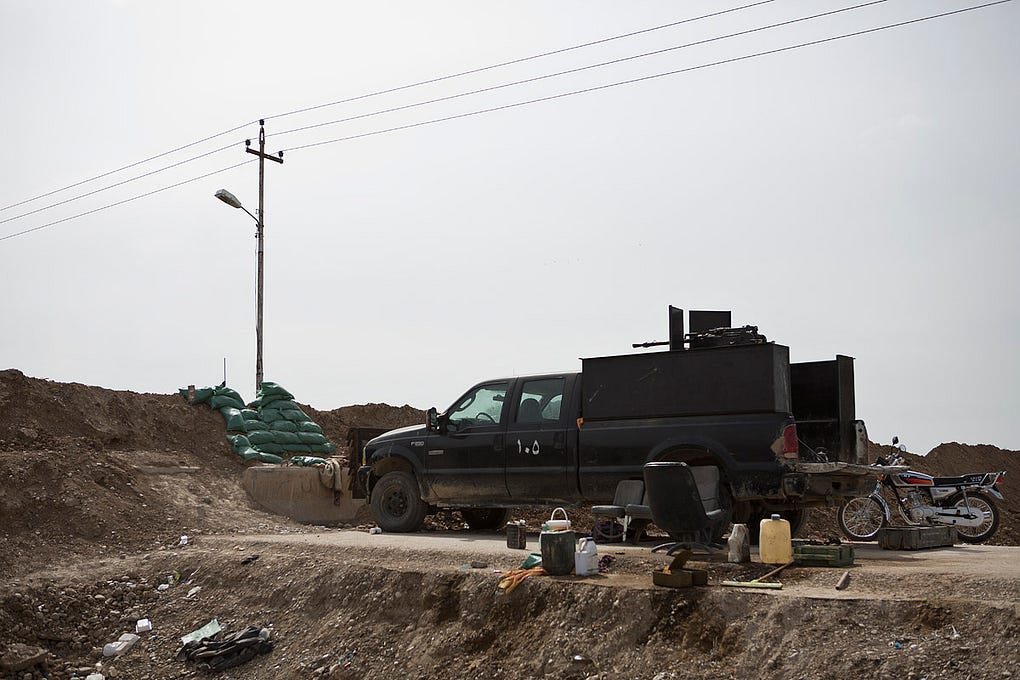
An Iraqi Turkmen militiaman stands on a black Ford F250 Super Duty and stares off into the distance. Above there’s the hazy midday sun. In front of him, there’s the front line in the war with Islamic State.

Three Islamic State fighters approach the front line — a sandy berm stretching into the distance on either side of the miltiaman’s position. IS is notorious for using teams of suicide bombers, so the Turkmen fighter cannotallow them to get close.

Reaching toward the truck’s mounted KPV 14.5-millimeter heavy machine gun, he racks back the cocking handle, swivels the weapon toward no-man’s land and fires three short bursts.

The militants scatter back the way they came.


It’s early April and beyond the earthen berm, less than a mile away, is the Islamic State-held town of Bashir. The town sits around 10 miles southwest of Kirkuk.

The fighters occupying the front line here are mainly Shia Turkmen from the local area working as part of Iraq’s predominantly Popular Mobilization Forces — also known as the Hashd Shaabi.

In a few days, they will carry out another attack to retake the town.


At top — a Shia Turkmen fighter of the Martyr Sadr Force stands on the roof of his unit’s base near Kirkuk. Above — a Badr Organisation position at the front line outside Bashir. Matt Cetti-Roberts photos


The Turkmen are one of Iraq’s largest minority groups, descended from various waves of migration dating back to the 7th century. Although they inhabit areas across central Iraq, many lived in villages to the south of Kirkuk before Islamic State came.

Bashir is widely considered the heart of the Iraqi Turkmen community. They once constituted 40 percent of its population.

But in 2014, Islamic State swept through Iraq. In June, Bashir fell. Iraqi army troops based at the nearby K-1 Airbase fled, and left their weapons and vehicles behind. The Kurdish Peshmerga rushed in to fill the security vacuum in and around oil-rich Kirkuk.
One of the Iraqi army troops who fled is now back. Maj. Abdul Hussein Abass sits behind a desk inside a base for the Hash Shaabi’s Martyr Sadr Force.

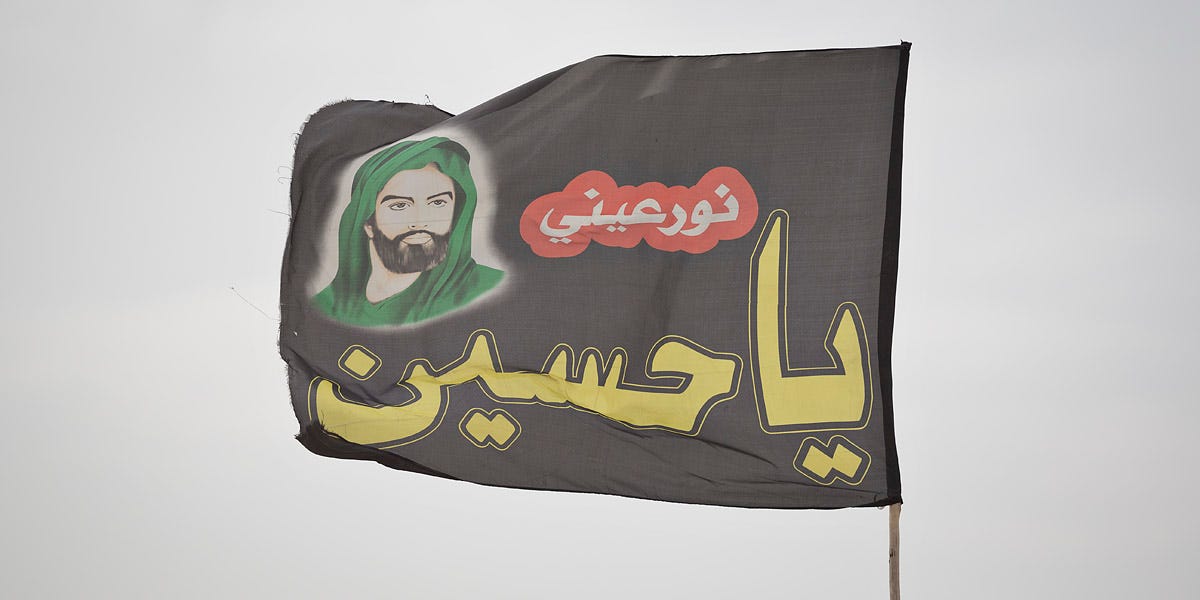
Shia religious flags fly from the roofs of the base’s buildings. “When ISIS took Bashir, 23 people were killed, including women and children,” Abdul says — while surrounded by Turkmen Shia fighters.

“I am from Bashir originally,” Abdul, who is Turkman Shia himself, says. “It’s my neighborhood, so I joined the fight. I am a military man.”

“We are here to protect our land, especially Turkman Shia, [but] we don’t have racism,” Abdul says. “We are all here. There aren’t many of us so we have to work together. Ten Sunni guys joined, we never say no.”

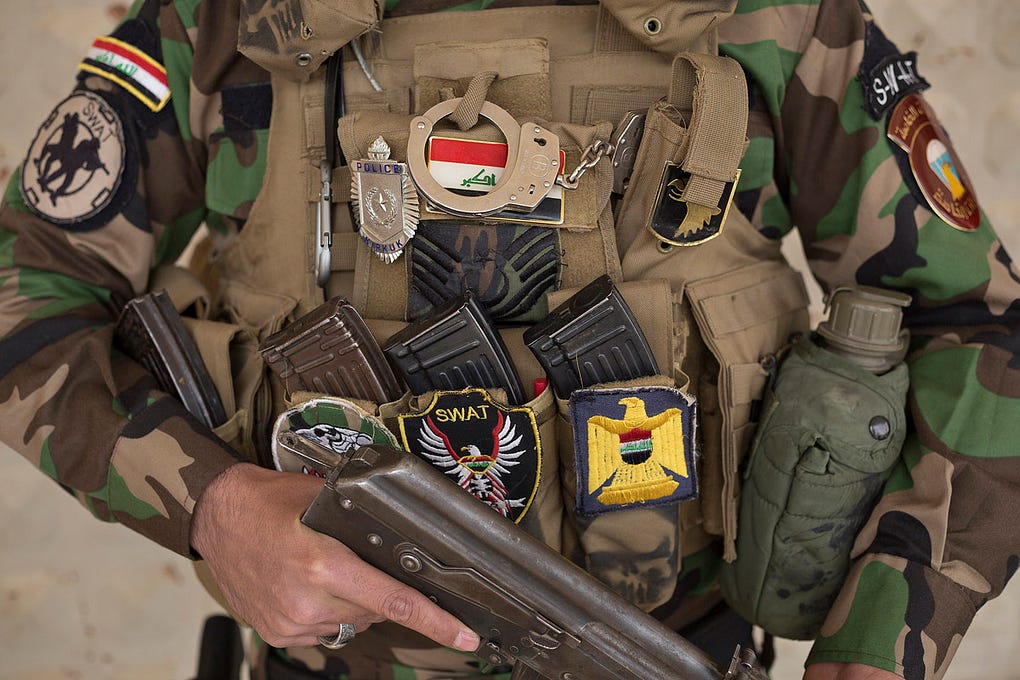
The badge-adorned load carrying vest of a Turkmen Martyr Sadr Force fighter. Matt Cetti-Roberts photo


Abdul says that improvised explosive devices — or IEDs — are a major obstacle to retaking the town.

“When we say we will take Bashir, the fighters move and don’t think there are bombs,” Abdul says. “They are all thinking of the fatwa, it is inside their brain pushing them to this kind of work.”

After his unit evaporated during the Islamic State advance last year, he moved to the Kurdish capital of Erbil and registered to join Unit 16 — the Turkmen Hashd Shaabi formation that covers the area from Tuz Khumartu to Kirkuk.

From there, he helped liberate the besieged Turkmen town of Amerli in September 2014.
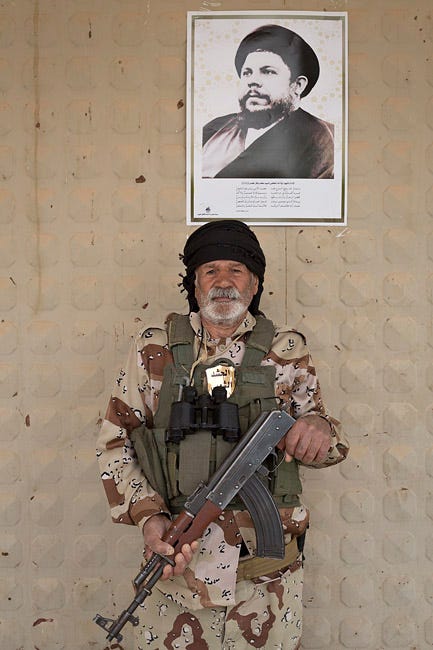
A Shia Turkmen fighter of the Martyr Sadr Force stands beneath a portrait of Muhammad Baqir Al Sadr, a Shia cleric executed in 1980 by the Ba’athists, at the unit’s base near Kirkuk. Matt Cetti-Roberts photo

On June 29, 2014, Abdul took part in the first attack on Bashir, where 26 Turkmen died. He tells us that the fighters were not organized properly — unlike now under the Hashd Shaabi.

But this isn’t the first time Bashir’s residents were forced from their homes.

In 1986, Saddam Hussein’s Arabization policy displaced the town’s Turkmen. The plan was to bring in loyal Sunni tribes to areas where minority groups who opposed the regime flourished.

“I remember I was in the sixth grade, I didn’t pass that year of school,” Abdul recalls. “They [the Iraqi army] said the sewage pipes didn’t work so we couldn’t stay in Bashir — then they gave it to to the Sunni Arabs.”

When American forces invaded in 2003, the Turkmen returned from exile to reclaim their homes. Fighting between returning Turkmen and Sunni Arabs eventually saw Saddam’s emigres forcibly ejected.

Many Sunnis remained in the outlying villages and some joined Islamic State. “Whoever was working with ISIS of course can’t come back home [and] has to go to prison, we have names and intelligence of these people,” Abdul adds.

“We are from this land and trying to protect this land. We are trying to defend Bashir, because it is our land, our property,” he says, explaining why only the Shia Turkmen are trying to liberate the town.

He also doesn’t see Unit 16 having a role in any future liberation of Mosul — a majority Sunni city. He believes former residents of the city should be involved in the operation instead.

A militia flag. Matt Cetti-Roberts

Reprisals

Colorful flags of Iraq’s powerful Shia forces flutter along the front line. On the walls of the Martyr Sadr Force’s base are pictures of Muhammad Baqir Al Sadr, a Shia cleric executed in 1980 by Saddam’s Ba’athist regime.


But the Shia militias’ sectarian nature has provoked fears of retribution attacks against Sunnis. Iraq’s mainly Shia Popular Mobilization Forces were brought together by a fatwa — a religious call to arms — by Grand Ayatollah Ali Al Sistani.

In 2014, Iraq’s then-Prime Minister Nouri Al Maliki authorized the miitias’ deployment and gave them official backing. The militias have since been at the forefront of victories over Islamic State, beating them back in Diyala province and parts of Salahaddin.
But human rights groups have accused Shia fighters of carrying out sectarian attacks against Sunnis — looting homes, setting property on fire and carrying out executions.

There’s even been recurring friction between the Hashd Shaabi and the Peshmerga, such as Tuz Kharmato. Recent reports emerged that the Peshmerga told 80 members of the Saraya Tali’a Al Khurasani militia to leave Jalawla. In January 2015, the Shia told the Peshmerga to leave.

Abdul denies any problems with his unit. “The media says that Hashd Shaabi murders and loots,” he says. “We took Jedadyah [a village close to Bashir] back and didn’t take anything, but ISIS took everything from there.”

Although his group didn’t loot the town, he says, another unit he won’t name tried, and he sent them away. “I won’t let you take anything from that village, go to get permission from the governor,” he claims he told them.

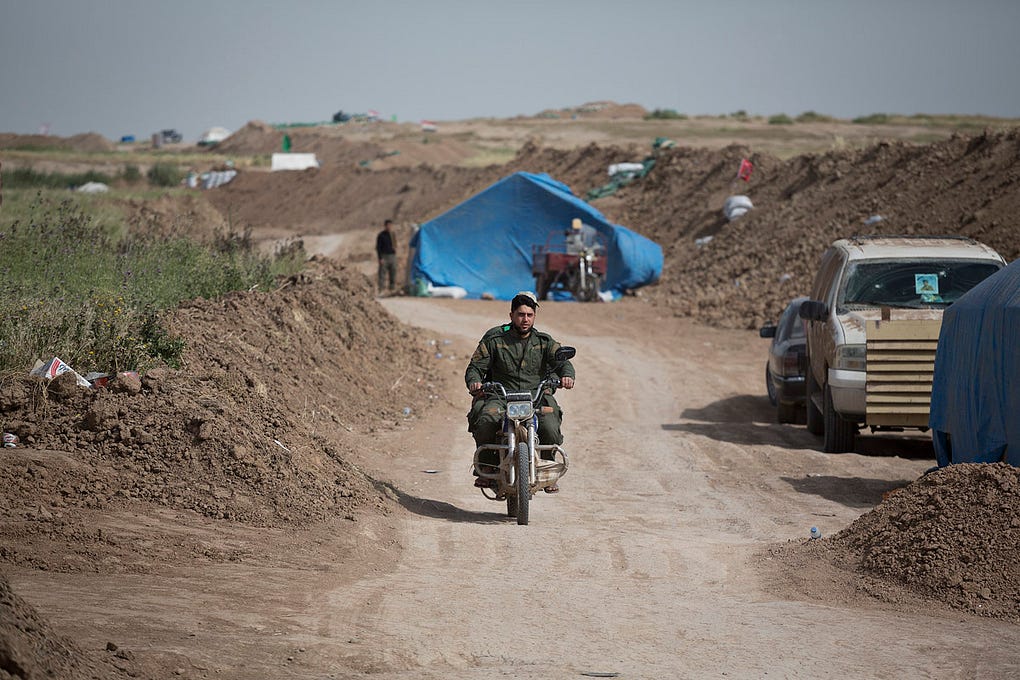
Two Turkmen fighters of the Badr Organisation ride a motorbike along the front line near Bashir. Matt Cetti-Roberts photo


Shaker Hassan Ali, a Turkman spokesperson for the Hashd Shaabi’s Badr Organization based in their Kirkuk offices has a … different take. He says that Islamic State dressed up as Popular Mobilization Troops and carried out looting as a form of disinformation.

“A man with Hashd Shaabi hasn’t seen his family, he is not going back to take things, he is going to fight and be a martyr — he’s not there to steal,” Ali says.

The Iraqi Shia Badr Organization is one of Iraq’s most powerful paramilitary groups. Originally set up in 1982 and — at that time — led by Iranian officers, they were accused of sectarian killings during the 2006–07 Iraqi civil war.

They now operate under the umbrella of the Hashd Shaabi. Shaker says they have around 5,000 fighters in the Kirkuk area and — he claims — even have Christians and Sunni among them.

“If there had been no fatwa in Iraq it would have been a bad situation,” Shakar says as he sits in a large hall in the Badr’s offices. Today, the organization is having a ceremony to remember one of their colonels who died fighting in Tikrit.

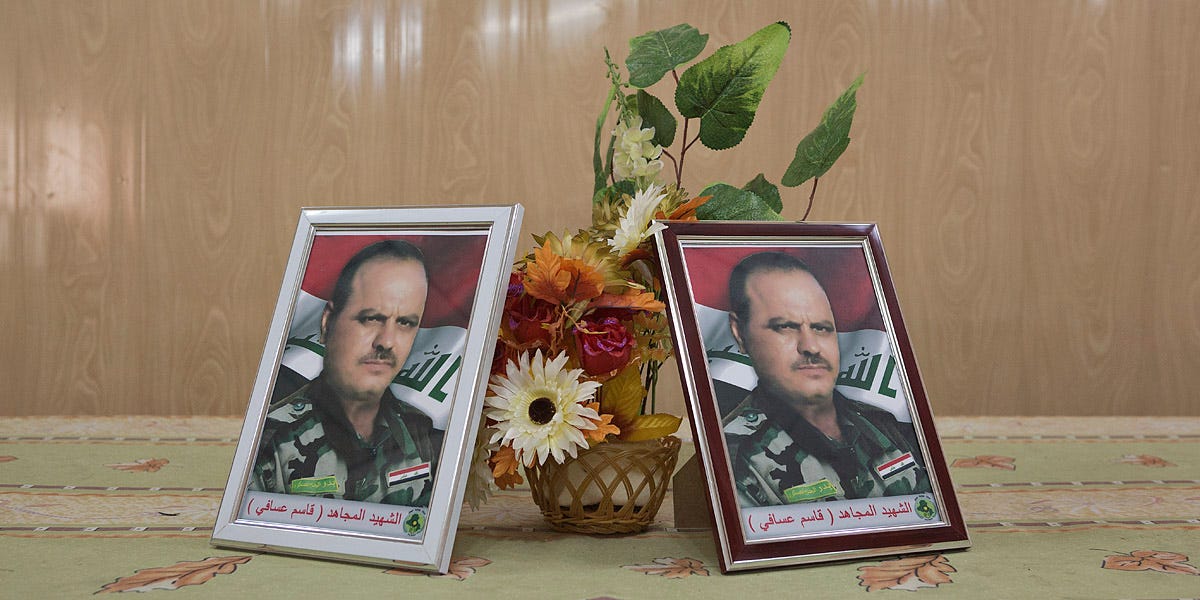
In the dim hall lit by fluorescent tubes, two portraits of a man wearing a uniform photoshopped onto an Iraqi flag sit on a table. His name was Qassim Avaf, a fighter who died in the Turkmen’s first attack on Bashir in June 2014.

The militia found his body in no-man’s land.


Two portraits of Qassim Avaf, a fighter who was killed in the first attack on Bashir in June 2014, are seen on a table in the Kirkuk offices of the Badr Organisation. Matt Cetti-Roberts photo

Another attack

Back at the front line, a group of fighters stand together. Another fighter named Abbas, an officer in charge of around 100 Turkmen, stands with a shotgun over his shoulder.

“Three were injured by mortars,” he says, referring to an Islamic State barrage earlier that day. “Since the first attack on Bashir, 64 fighters have been killed and 103 injured.”

Abbas points to his faith as one reason why he joined the Badr Organisation. But he says he wants to take back the town because it belongs to the Turkmen. “We will fight side-by-side to retake the town ourselves, but we need any help we can get, it’s just us on this front line.”

There haven’t been coalition air strikes on this part of the front line, and in Abbas’ opinion, the U.S.-led coalition only supports the Kurdish Peshmerga. The Badr Organization is one of several groups that the coalition does not support with air strikes because of their sectarian agenda, according to a senior coalition forces officer.

So why hasn’t the Hashd Shaabi taken back the town? Abbas replies frankly that there are too many IEDs.

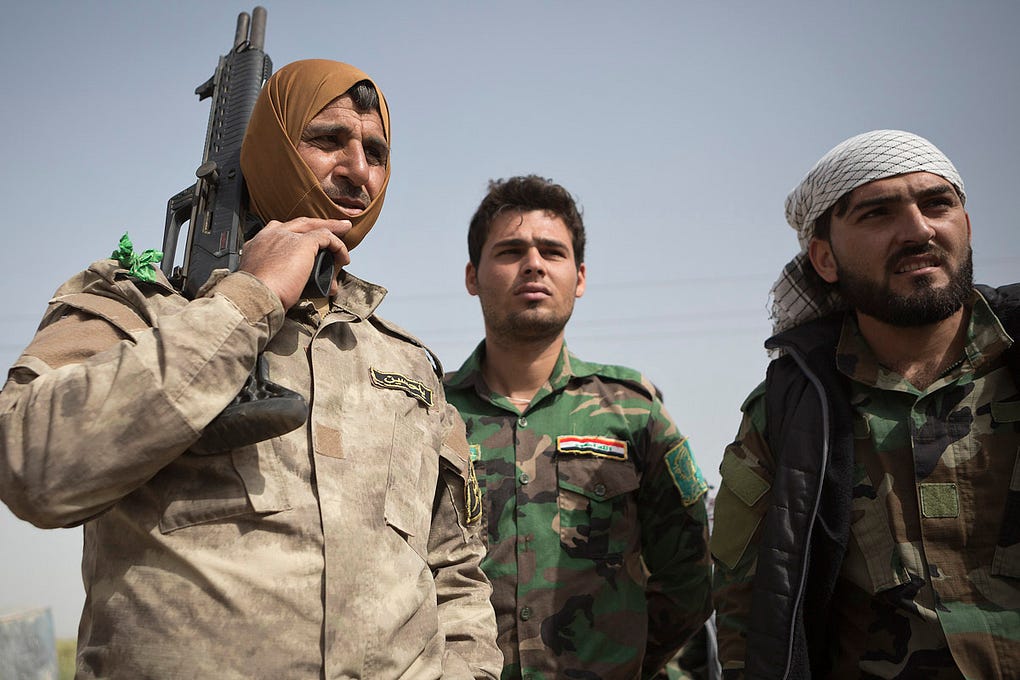
Shia Turkmen fighters, Abbas at left and Abu Mikhail at right, on the front line close to Bashir. Matt Cetti-Roberts photo


Another fighter, 24-year-old Abu Mikhail, left Bashir nine months ago when the town fell to Islamic State. A former carpenter, he joined the Badr Organization the same month.

“The call of fatwa made us join,” he says. “I fight first for faith, then for my country, and also for my brother who died fighting here to get Bashir back.” A few days after our interview, Abu Mikhail was killed when Islamic State detonated a large car bomb during the Turkmen’s attack on Bashir.

Nearly mile behind the Hashd Shaabi is another berm manned by Kurdish troops armed with ancient Soviet tanks and MTLB armored personnel carriers armed with 14.5-millimeter ZPU anti-aircraft guns.

Capt. Hider Sulaiman is a Peshmerga platoon commander. He stands near a T-62 tank.

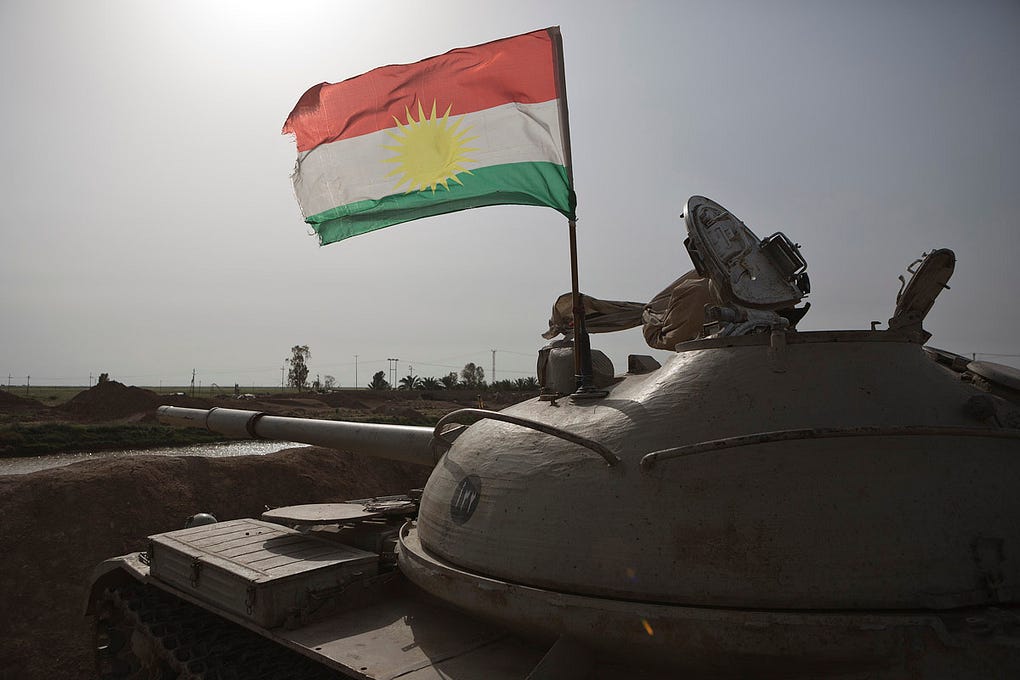
The flag of Kurdistan flies from the top of a Kurdish Peshmerga T-62 tank based at a support weapons line around a kilometer behind the Bashir front line. Matt Cetti-Roberts photo


“We work together on this front line,” Hider says.

He adds that both his unit — affiliated with the Kurdistan Democratic Party — and the Badr Organization communicate and work well together.

The presence of the KDP troops working with the Hashd Shaabi may be related to problems between the Popular Mobilization Forces and Peshmerga forces loyal to the Patriotic Union of Kurdistan — the political party that most of the units in this area belong to.

The Peshmerga are not here to take the village, but to support the Shia Turkmen fighters with heavier weaponry such as artillery. The village is Turkmen, so the job of taking it falls to the Hashd Shaabi.

Hider suggests that there may be as few as 50–60 Islamic State left in the town, and half of them could be snipers.

The militants in the town also use mortars to harass the Hashd Shaabi. “This morning they fired mortars. There is no pattern to their firing,” Hider explains. “Sometimes they shell at 2:00 a.m., sometimes 3:00 a.m., sometimes in the evening.”

Flags bearing names of those killed during the June 2014 attack on Bashir are seen on a wall in the nearby town of Taza. Matt Cetti-Roberts photo


The next attack would take place two days later. The fourth such assault on the town saw 400 Turkmen from all over Brigade 16 — bolstered by other Popular Mobilization forces from the rest of Iraq — attempt to reclaim the Turkmen town.

They failed.

IEDs caused the attack to stall and many — if not all — of the Islamic State insurgents were wearing suicide vests. The militants also drove a large car bomb at the attackers, causing multiple casualties.

The front line is now closer to Bashir, 30 meters in some places, but the town still remains in Islamic State hands.


https://medium.com/war-is-boring/pissed-off-turkmen-want-their-town-back-89d59db228c8

Note: The article by Dr. Hassan Aydinli, Iraqi Turkmen Front EU Representative, about BASHEER has been posted on the European Parliament's website:http://www.europarl.europa.eu/.../tragedyoftheturkmenpeop...