mardi 11 novembre 2014

Presentation first Common Declaration of the Yezidi, Chaldean-Syriac-Assyrian and Turkmen Peoples of Iraq at the European Parliament in Brussels on 19 November 2014


Please click on the poster to enlarge


FROM CRISIS TO SAFE FUTURE FOR IRAQ'S MINORITIES

19 November, 

Brussels

European Parliament, PHS 4B001


Presentation first Common Declaration of the Yezidi, Chaldean-Syriac-Assyrian and Turkmen

Peoples of Iraq


A unique moment of co-operation
towards restoring human rights in Iraq

European Syriac Union - Iraqi Turkmen Front - Federation of Yezidi Associations

in co-operation with the Christian Political Foundation for Europe

Confirmed Speakers:

- MEP Branislav Skripek

- Dr. Hassan Aydinli, Iraqi Turkmen Representation to EU

- Lahdo Hobil, President European Syriac Union

- Fikret Igrek, Head of Foreign Affairs Federation of Yezidi Associations

- Johannes de Jong, Christian Political Foundation for Europe.


vendredi 7 novembre 2014

Iraqi Perspective: Cycles of Violence - Interview with Hussein Al-Alak

Iraqi Perspective: Cycles of Violence - Interview with Hussein Al-Alak

Iraq has been in a near constant state of conflict for almost 35 years beginning with the Iraq/Iran War of the 1980s. This was followed by the original ‘Gulf’ War and then the US government’s war on terror. 

These conflicts have led to immense civilian casualties and seen the development of a humanitarian crisis within the country, which has been particularly devastating for the most vulnerable members of society; women and children.All of these conflicts have now been superseded by the formation of the Islamic State militant group, formerly called ISIS. 

This group began as a relatively small collective of Islamic extremists but has now grown in to a self-sustaining, serious threat to the region taking over numerous towns and villages, taking part in countless atrocities and causing serious issues for domestic and international security forces. 

This current crisis looks set to escalate with the international community preparing for a series of air strikes in the region with several nations having already taken part in strategic bombings. This in itself has serious ramifications for the civilian population and it remains to be seen how drastically this new form of military intervention will affect the already devastated women and children of Iraq. 

Hussein Al-Alak, a British Iraqi writer and editor of Iraq Solidarity News (Al Thawra) – the UK's leading English language news and information provider on Iraq, has recently written numerous blogs and academic pieces on the conflict in Iraq and is held as an authority on issues pertaining to the impact on women and children within the nation, in addition to the topics of genocide and the country’s history.

Read the interview Iraqi Perspective: Cycles of Violence in full, on the website of the Safe World for Women.

http://iraq-solidarity.blogspot.be/2014/11/100-150-iraqi-refugees-arrive-in-jordan.html

By Peter Hilton, Global Correspondent for Safeworld
"For over a decade, Iraqi NGO’s were repeatedly warning both the US/UK governments...  that the forced displacement of Iraqis was being exploited by criminal elements, which had resulted in the kidnap of children for use by terrorist organisations, while displaced poverty stricken women were being forced into the sex-trade."
Hussein Al-Alak
Iraq has been in a near constant state of conflict for almost 35 years beginning with the Iraq/Iran War of the 1980s. This was followed by the original ‘Gulf’ War and then the US government’s war on terror.
These conflicts have led to immense civilian casualties and seen the development of a humanitarian crisis within the country, which has been particularly devastating for the most vulnerable members of society; women and children.

mercredi 5 novembre 2014

A joint delegation representing the Turkmen, Chaldean-Syriac-Assyrian and Yazidi peoples of Iraq was received by the Chair of the EU Parliament's Committee on Foreign Affairs


MEP Elmar Brok, Chairman of the Committee on Foreign Affairs of the European Parliament  received a joint delegation representing the Turkmen, Chaldean-Syriac-Assyrian and Yazidi peoples of Iraq at his office at the EU Parliament on 4th November 2014.

The delegation was composed of:

- Dr. Hassan Aydinli, Iraqi Turkmen Front EU representative and Ms. Merry Fitzgerald, President  of Europe-Iraqi Turkmens Friendships Association, representing the Turkmens.

 -Mr. Lahdo Hobil, President of the European  Syriac Union and Ms. Rima Tüzün, ESU Head of Foreign Affairs, representing the Chaldean-Syriac-Assyrians.

- Mr. Fikret Igrek, Head of Yezidis Foreign Affairs in Europe, representing the Yezidis of Iraq.

The delegation had requested an urgent appointment with Mr. Elmar Brok in order to inform him personally -as an MEP and influential member of the largest political group in the European Parliament (EPP) as well as in his capacity of Chairman of the Committee on Foreign Affairs of the European Parliament  - of the dire situation and the bleak future facing the Turkmen, the Chaldean, Syriac, Assyrian and Yazidi peoples living in the north of Iraq, caused by the terrorist group ISIS, following their attacks on Mosul city on 10th June 2014, immediately followed by planned targeted attacks on towns and villages inhabited by and belonging to these non ruling indigenous peoples of Iraq, where ISIS caused absolute chaos and devastation, terrorising the people, violating their dignity and their human rights, committing crimes against humanity: mass killings, rapes, kidnappings, lootings, ethnically cleansing and forcing these defenceless peoples to flee from their towns and villages.

A joint declaration prepared earlier by the members of the delegation was presented to Mr. Elmar Brok at this meeting, asking for his support and that of the European Union to this declaration which is essentially calling for the restoration of human rights to the non-ruling indigenous peoples of Iraq. 

Each member of the delegation introduced him/herself to Mr. Elmar Brok and made a brief  presentation of the political organizations they represent and of their people's history and actual situation in Iraq, saying that each of their peoples has suffered under the fact that their existence has not been adequately recognized in Iraq and in the international community for many decades. That they have all experienced discrimination, persecution and ethnic and cultural cleansing due to this lack of adequate recognition of their ethnic, cultural and religious identity and the right to be as they are in their country, Iraq.

The Turkmens, Chaldean-Syriac-Assyrians and Yazidis who have now been driven from their homelands in Iraq by ISIS have united themselves to work towards a common future in which each of their peoples are recognised as part of their country (Iraq) and will be able to preserve the existence of their ethnic, cultural and religious identities. They declare that it is their aim to maintain and contribute to the rich diversity of their land and to support in this effort those peoples who are their neighbours and who share the same wish for a common peaceful future.

Dr. Aydinli informed MEP Mr. Brok that since 10th June 2014, ISIS has attacked several Turkmen towns and villages, in the provinces of Mosul, Kirkuk, Salaheddin and Diyala. ISIS terrorists have attacked the Turkmen localities of Tal Afer, Beshir/Taza, Biravcili, Kara Naz, Chardaghli, Bastamli, Amerli, Kifri, Kara Tepe, Jalawla, Salman beg, and many villages belonging to the Turkmen Bayat tribes of Turzhurmatu district, killing over 500 innocent Turkmens and causing the displacement of more than 350.000 Turkmens.
The displaced Turkmens are living in very dire conditions and they are now scattered all over Iraq.

As an example of Turkmens' sufferings, Dr. Aydinli mentioned the tragedy of his native village, Bashir, in Kirkuk Province, which was attacked by ISIS, saying that all the members of his family together with the 1.200 families living in the village had been obliged to flee to save their lives after defending their village against ISIS during three days.  Unfortunately, they were overwhelmed by the heavily armed and better trained ISIS terrorists and 59 villagers were killed. ISIS is now occupying the village and they have destroyed most of the houses.

At the end of the meeting Dr. Aydinli handed a copy of  Mr. Erşat Hürmüzlu's book 'The Turkmen Reality in Iraq' and a copy of Dr. Suphi Saatçi's book : 'The Urban Fabric and Traditional Houses of KIRKUK'  to MEP Elmar Brok who thanked him for this.


Conflict in Iraq forces families to flee their homes and seek shelter where they can

Conflict in Iraq Forces Families to Flee Their Homes and Seek Shelter
Where They Can
Posted: 11/04/2014


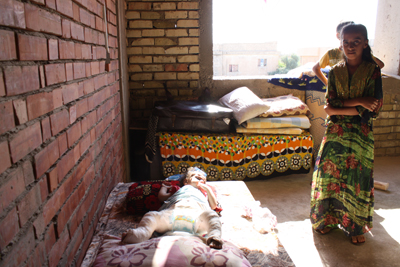
In one neighborhood of Kirkuk, Northern Iraq, more than a hundred Iraqi families forced to leave their homes because of ongoing fighting, live cheek-by-jowl in two unfinished, unheated buildings. There's no privacy, no running water, no proper sanitation facilities and only open windows and unfinished staircases -- a certain hazard for the dozens of young children who run around.


Displaced families are forced to shelter in unfinished,unheated buildings across northern Iraq

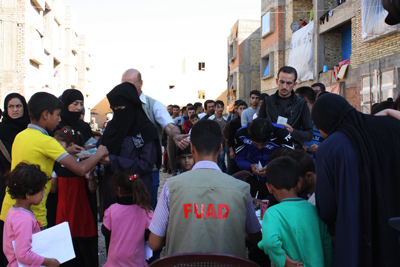
Many families have just moved here and today are receiving emergency hygiene kits funded by the European Commission's Humanitarian Aid and Civil Protection department, ECHO, and distributed by aid agency Mercy Corps and its local partner, FUAD (the United Foundation for Relief and Sustainable Development). The most vulnerable families will also soon receive cash to cover their basic needs, giving them the choice to decide their priority purchasing needs themselves.


Distribution of emergency hygiene kits to displaced families

The families are just some of the estimated 171,000-plus people who have taken refuge in Kirkuk governorate after witnessing and suffering the fighting, shelling and destruction and death of relatives and friends in their home towns. Most left with just the clothes on their back. And while some have managed to rent homes others have sought shelter in public buildings like schools, which have been forced to delay re-opening for the new school year, mosques and half-finished buildings.


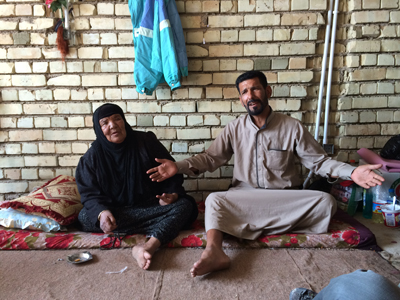
Adnan Abdul Aziz Salah

"If you compare our lives before and now, it's like the ground and the sky" said 43-year-old Adnan Abdul Aziz Salah, a father of eight, who worked as a taxi driver in Tikrit. He lives in one room in the unfinished building with his family and mother, where they cook and sleep. They've placed plastic sheeting around one window in an effort to keep out some of the cold.

"You can see we need health care, food, shelter... everything" said Abdul. "We have not received any help from our government, only from non-governmental organisations".

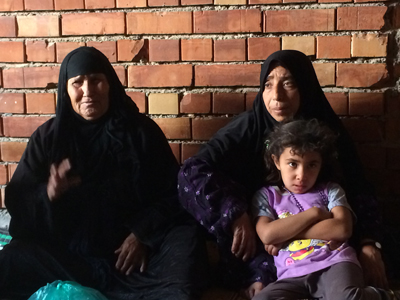
In another room, 56-year-old Fatayim Mohammed Hatab, says her four sons and many daughters were killed in clashes around their home in Sharqat district, Salah al-din, near Tikrit.


Fatayim Mohammed Hatab (left)

"We have no men now, no income, no support" she said, pointing to her remaining daughters and many young children. Her oldest grandson, Hammad, aged 12, manages to earn a little money for the family selling water and tissues on the street. But Fatayim is worried about how the family will cope, especially as winter approaches and temperatures can fall to below freezing.

Since June, Kirkuk, an ethnically diverse governorate where Arabs, Kurds and Turkmen live side-by-side, has seen a massive influx of families displaced by fighting in other areas of the country, including Anbar and Salah al-din governorates. The security in Kirkuk itself has also worsened, making it harder for agencies to reach many displaced and local families in need of assistance.

Across the country, it's estimated that 1.9 million people have been forced to flee their homes because of fighting, a number that is ever-increasing.


Desperate families are taking shelter where they can find it.

"The situation is likely to get worse," predicts Abdul Muneim Ahmed Hassan, executive director of FUAD. "The families cannot return to their original homes because there is still conflict. Winter is approaching, but they are living in very unsuitable places with very little protection against the weather."

The priority is to try to reach as many families as possible with help before winter fully sets in. There are plans to set up new camps in Kirkuk and other areas of Iraq to house displaced families. But it's going to be a race against time and the flow of displaced families shows no signs of slowing down.

For more on the story:

In pictures here.
For more stories about how the EU is helping in Iraq.

dimanche 2 novembre 2014

ITF EU representative Dr. Hassan Aydinli attended the Delegation for Relations with Iraq meeting at the EU Parliament in Brussels

 Brussels, 16th October 2014.

Debate on: The critical situation of all ethnic and religious components of the Iraqi society, facing the "Islamic State" threat, with particular focus on minorities.


The new Chair of the Iraq Delegation MEP David CAMPBELL BANNERMAN
 and the new Vice-Chair MEP Brian HAYES

Dr. Hassan Aydinli represented the Turkmens;
Ms. Rima Tüzün, represented the Chaldean-Syriac-Assyrians
Mr. Naher Arslan, represented the Assyrian Institute of Belgium.
A representative of the Iraqi Embassy in Brussels
 and the representative of the KRG in Brussels 
assisted to the debate.


Mr. William Spencer, Executive Director - International Institute for Law and Human Rights,
Mr. Mark Lattimer, Executive Director - Minority Rights Group International
assisted to the debate.


The new EU Parliament election took place 22-25 May 2014, the formation of political groups took place in June. The 751 newly elected Members of the EU Parliament took up their seats at the opening of the first session on 1st July 2014. The 751 MEPs who took up their seats in July will set the course of European Policies for the next five years. 

The 16th October 2014 was the first meeting with the new members of the Delegation for Relations with Iraq, as The Chair, Vice-Presidents and Members of the Delegation were appointed on 13th October 2014.

Before the beginning of the meeting, Dr. Hassan Aydinli introduced himself to the new Chairman and to the new Vice-President of the Delegation. He briefly introduced the Turkmens' cause and requested an appointment with them to have the opportunity to give them more information and documents about the Turkmens.  
***


The Chair David CAMPBELL BANNERMAN MEP after welcoming all the participants  said that the EU supports the Iraqi government in their fight against ISIL. 

Mr. Mark LATTIMER of MRGI said that 12.000 civilians had been killed this year, most of them belonging to the minorities, he added that the crimes remain uninvestigated.

Mr. William SPENCER of IILHR said that people's lives have been irrevocably changed in Iraq, there are 1.4 million displaced since June 2014 and that there is an urgent need to create safe havens for minorities, he also said that :

-There is need to increase support for NGOs.
- It is important to provide identity documents and ration cards for the IDPs.
-There is need for state assistance.
-There is need to create a Missing Persons Record.
-There is need to have a Property Commission.


Dr. Hassan Aydinli, ITF EU representative, described the sufferings of the Turkmens especially since 10th June 2014 when Turkmen cities and villages were attacked by ISIL. He gave the examples of Telafer, Beshir, Biravceli, Amirli. He said that there are 350.000 internally displaced Turkmens who are living under very dire conditions and who need humanitarian assistance, he added that more than 500 innocent Turkmens were killed by ISIL. 

Dr. Aydinli commented that as this meeting focusses on the "ethnic and religious minorities" of Iraq (implying the Iraqis who are not included in the  'Shia-Sunna-Kurds' description of the Iraqi people) it is necessary to point out that the Shia, Sunna and Kurds are minorities too, seeing that none of these 3 groups is a majority on its own and that consequently, Iraq is a country composed of minorities, it is a multi-ethnic and multi-religious country, it is composed of the following ethnic groups:  Arabs, Kurds, Turkmens, Chaldeo-Syriac-Assyrians, Yezidis, Shabaks and it is composed of the following main religious groups:  Muslims and Christians. Dr. Aydinli added that therefore, it is inaccurate to continue describing the Iraqi people as 'Shia-Sunna-Kurds' omitting to mention the other ethnic and religious components of the Iraqi people. The Chair and the other participants agreed with Dr. Aydinli's comment.

jeudi 30 octobre 2014

ITF EU Representative Dr Hassan Aydinli attended the Conference at the EU Parliament on Ethnic Minorities in Azerbaijan


*


*
Prof. Dr. Etibar A. Najafov, Head Adviser, Service of the State Counsellor of the Republic of Azerbaijan for Multiculturalism, Interethnic and Religious Affaires - Dr. Hassan Aydinli, ITF EU Representative - Mr. Ayhan Demirci, Azerbaijan-Belgium Friendship Association.


Mr. Hüseyin Dönmez, Kanal Avrupa Media GmbH - Dr. Hassan Aydinli, ITF EU representative - Mr. Ayhan Demirci, Azerbaijan-Belgium Friendship Association.

.
The conference was hosted by  MEP György Schöpflin
The conference was organized by Mr. Willy Fautré, Director of Human Rights Without Frontiers who presented the fact-finding mission report about 15 ethnic groups in Azerbaijan.


Dr. Mark Barwick of HRWF made a welcoming speech and introduced the representatives of the Russian and Greek ethnic groups: Russia representative Ms Yelena Voronina and Greek representative Ms Saida Mehdiyeva.
.

Mr. Willy Fautré, Director of Human Rights Without Frontiers (HRWF) based in Brussels presented the report he has recently published: AZERBAIJAN - Ethnic Diversity - Peaceful Co-existence and State Management.
.


The study addresses the issue of the co-existence of ethnic minorities in Azerbaijan and the management of diversity by the state. It highlights the specificities of a number of minorities and their historical roots, as well as the concerns of the state, which is still in the process of creating a new identity from the ashes of the former Soviet Union and which, due to recent experience, is also concerned about its territorial integrity.
.

The challenges were and are still huge: the identification of ethnic minorities in the light of the self-identification of their members, the accommodation of collective rights, social integration while respecting diversity and security.
.
In the absence of a clear definition of basic terms such as "national minority" or "ethnic minority", the number of ethnic and foreign groups that are present in any given country is virtually impossible to define.  Concerning Azerbaijan, the figures vary from 60 to 80, depending on the sources and the actors met by Human Rights Without Frontiers on the occasion of several trips to Azerbaijan.
.

To be a member of a minority is never easy and to accommodate the claims of minorities is often a difficult exercise for any state.
.

On the one hand, minorities would like their identity, their culture, their folklore, their language or their religion to be preserved and developed. However, some of these markers risk getting diluted by mixed marriages and school education in the official language.  They can disappear from one generation to the next. Members of minorities want to be fully integrated in society, but they do not want to be entirely assimilated.
.
On the other hand, states often perceive demands for more collective rights, for more autonomy, for constitutional and political changes with suspicion and as a possible threat to their territorial integrity in the future.
.

Both of these trends are perceptible in Azerbaijan.
.

Mr. Willy Fautré said that there may be lessons to learn from Azerbaijan's experience of ethnic and ethno-religious diversity that could be helpful for other states that are dealing with comparable diversity within their borders.
.

In his report on Azerbaijan, Mr. Willy Fautré included the following National and Ethnic Minorities:

Lezgis
Russians,
Talysh,
Avars,
Turks,
Tatars,
Tsakhurs,
Udis,
Jews,
Kurds,
Armenians,
Poles,
Bulgarians,
Greeks. 

Dr Hassan Aydinli was invited by H.E. The Ambassador of the Republic of Turkey at a reception on the Occasion of the 91st Anniversary of the Proclamation of the Republic of Turkey


ITF EU representative Dr Hassan Aydinli and Mrs Hassan Aydinli were invited by H.E. The Ambassador of the Republic of Turkey Mr Hakan Olcay and Mrs Mehveş Olcay at a reception on the Occasion of the 91st Anniversary of the Proclamation of the Republic of Turkey.

The reception was held at the prestigious Cercle Royal Gaulois in Brussels.


With Ms. Döndu Sarıışık, representative of TRT Radio Télévision Turque


Dr Hassan Aydinli with H.E. the Ambassador of Ukraine to the EU


Dr Hassan Aydinli spoke at length of the situation of the Turkmens in Iraq with Mr Thomas Mergenthaler, Permanent Representation of the Federal Republic of Germany to the EU and with Mr. Jean-Paul Mues, Advisor at the Belgian Ministry of Justice.
He also talked with Minister Emir Kir and several other Turkish VIPs.