dimanche 8 février 2015
The ethnic cleansing of Turkmens continues in Iraq
While the ethnic cleansing of Turkmens continues in Iraq and while the Turkmens' human rights continue to be violated, the U.S. and the E.U. are arming the terrorist group PKK and Barzani's peshmerga.
Turkmens in Iraq have been and are still victims of : massacres, ethnic cleansing, oppression, disappearances, expropriations, land grabbings, kidnappings, torture, arbitrary arrests, killings. Turkmens were victims of forced arabization under the Baath regime and are victims of forced kurdification since the U.S-U.K invasion of the country in 2003.
Despite the regime change in 2003 Turkmens continue to be treated as second class citizens in Iraq. The Arab government in Baghdad and the Kurdish Regional Government are only interested in occupying and reaping the benefits from the oil-rich and fertile Turkmen region in the north of Iraq (called TURKMENELI).
Turkmens, although they are Iraq's third main ethnic community and the north of Iraq's second main ethnic community, have never received their share of Kirkuk's oil, they have never been included in the distribution of the wealth from their land.
It is the Arabs (both Sunna and Shia) and the Kurds who are sharing the wealth of the Turkmen region.
Since 2014 the Kurds have taken control of the entire Turkmen region by force, they are FALSELY claiming that KERKÜK is Kurdish with the intention to annex it to their autonomous region.
When Turkmen cities and villages were attacked and invaded by ISIL terrorists in 2014, nobody came to their rescue. When the Turkmen city of AMIRLI was besieged during 73 days, neither the Iraqi army nor the Kurdish peshmerga who were stationed nearby tried to protect the unarmed population of this city.
AMIRLI did not get the attention of the 'international community' like Kobane. No one shed a tear for this unfortunate Turkmen city.
In the meantime, the U.S. and the E.U. are arming the terrorist group PKK and Barzani's peshmerga.
I hope that Turkmens have been keeping records and have started to document all the grave human rights violations their community has suffered since 1921 (since the beginning of the Iraqi state).
Merry Fitzgerald
jeudi 5 février 2015
THE HEAD OF PARLIAMENT SELIM EL CUBURI IS IN ANKARA AS THE OFFICIAL GUEST OF GNAT SPOKESMAN CEMIL ÇIÇEK
19th January 2015
The diplomatic route between Baghdad and Ankara is rather hectic. While the Minister of Energy and Natural Resources of Turkey Taner Yıldız was in Baghdad carry out various contacts the Head of Parliament and an accompanying mission were in Turkey.
Selim El Cuburi who came to Turkey with an accompany mission on the invitation of GNAT Spokesman Cemil Çicek have started on their round of various contacts. Head of Parliament Selim El Cuburi is accompanied by members of parliament from different commissions on his visit to Ankara. Today Head of Parliament Selim El Cuburi is visiting GNAT Spokesman Cemil Çiçek and the Iraqi mission will also be received by the President of Turkey Recep Tayip Erdoğan on their 3 day visit to Ankara. Kirkuk Turkmen MP Hasan Turan who is included in the mission provided information about the meetings.
19th January 2015
The diplomatic route between Baghdad and Ankara is rather hectic. While the Minister of Energy and Natural Resources of Turkey Taner Yıldız was in Baghdad carry out various contacts the Head of Parliament and an accompanying mission were in Turkey.
Selim El Cuburi who came to Turkey with an accompany mission on the invitation of GNAT Spokesman Cemil Çicek have started on their round of various contacts. Head of Parliament Selim El Cuburi is accompanied by members of parliament from different commissions on his visit to Ankara. Today Head of Parliament Selim El Cuburi is visiting GNAT Spokesman Cemil Çiçek and the Iraqi mission will also be received by the President of Turkey Recep Tayip Erdoğan on their 3 day visit to Ankara. Kirkuk Turkmen MP Hasan Turan who is included in the mission provided information about the meetings.
Dr Hassan Aydinli attended the ODIHR/Venice Commission Guidelines on the Legal Personality of Religious or Belief Communities Launch Event at the EU Parliament
Dr Hassan Aydinli, ITF EU representative, attended the ODIHR/Venice Commission Guidelines on the Legal Personality of Religious or Belief Communities Launch Event at the EU Parliament
BRUSSELS 4th February, 2015
The event was chaired by MEP Dennis de Jong, Co-President of the Intergroup on Freedom of Religion or Belief and Religious Tolerance.
1.The freedom of religion or belief is a fundamental right, as recognized in international instruments and OSCE commitments. International standards specify that everyone has the right to freedom of thought, conscience and religion. This right includes the freedom to manifest one's religion or belief, either alone or in community with others, in public or in private, through worship, teaching, practice and observance.
2. The terms "religion" and "belief" are to be broadly construed. A starting point for defining the application of freedom of religion or belief must be the self-definition of religion or belief, though of course the authorities have a certain competence to apply some objective, formal criteria to determine if indeed these terms are applicable to the specific case. There is a great diversity of religions and beliefs; The freedom of religion or belief is therefore not limited in its application to traditional religions and beliefs or to religions and beliefs with institutional characteristics or practices analogous to those traditional views. The freedom of religion or beliefs protects theistic, non-theistic and atheistic beliefs, as well as the right not to profess any religion or belief.
3. The freedom of religion or belief is closely linked to other human rights and fundamental freedoms, such as, in particular, the freedom of expression, the freedom of assembly and association" and the right to non-discrimination.
4. The freedom to have or to adopt a religion or belief of one's choice, which includes the right to change one's religion or belief, may not be subject to any limitations.
5. The freedom to manifest a religion or belief may only be limited if each of the following criteria is fulfilled:
A. The limitation is prescribed by law;
B. The limitation has the purpose of protecting public safety, (public) order, health or morals, or the fundamental rights and freedoms of others.
C. The limitation is necessary for the achievement of one of these purposes and proportionhate to the intended aim; and
D. The limitation is not imposed for discriminatory purposes or applied in a discriminatory manner.
6. Limitations must not be applied in a manner that would vitiate the freedom or religion or belief. In interpreting the scope of permissible limitation clauses, states should proceed from the need to protect the rights guaranteed under international instruments.
.......
There are three other points which I will not mention in this brief report.
Abbreviations:
ODIHR: Office for Democratic Institutions and Human Rights
OSCE: Organization for Security and Co-operation in Europe
ECHR: European Convention on Human Rights
About the Venice Commission:
The European Commission for Democracy through Law - better known as the Venice Commission as it meets in Venice - is the Council of Europe's advisory body on constitutional matters.
The role of the Venice Commission is to provide legal advice to its member states and, in particular, to help states wishing to bring their legal and institutional structures into line with European standards and international experience in the fields of democracy, human rights and the rule of law.
It also helps to ensure the dissemination and consolidation of a common constitutional heritage, playing a unique role in conflict management, and provides emergency constitutional aid to states in transition.
The Commission has 59 member states, the 47 Council of Europe member states, plus 12 other countries (Algeria, Brazil, Chile, Israel, Kazakhstan, the Republic of Korea, Kyrgyzstan, Morocco, Mexico, Peru, Tunisia and the USA).
Source: OSCE/ODIHR.
Excerpt from:
'Guidelines on the Legal Personality of Religious or Belief Communities' published by the OSCE Office for Democratic Institutions and Human Rights. (Poland)
www.osce.org/odihr
lundi 26 janvier 2015
Iraq invasion 2003: The bloody warnings six wise men gave to Tony Blair as he prepared to launch poorly planned campaign
Exclusive: In November 2002, a group of academics were summoned to advise the then PM. Here, four of them recall that day
COLE MORETON
http://www.independent.co.uk/news/uk/politics/iraq-invasion-2003-the-bloody-warnings-six-wise-men-gave-to-tony-blair-as-he-prepared-to-launch-poorly-planned-campaign-10000839.html
Sunday 25 January 2015
Tony Blair had a cough. He looked sick, pale and exhausted. “Don’t tell me it is going to be bad,” he said to the six men he had summoned to see him in Downing Street as war loomed. “Tell me how bad it will be.”
Those “six wise men” were all academics, expert in Iraq, the Middle East and international affairs. They had been called to the Cabinet Room to outline the worst that could happen if Britain and the United States launched an invasion.
This was a meeting that could have changed the course of history and, with better planning for the aftermath, saved countless lives – if only the Prime Minister and his advisers had listened and acted on the bloody warnings on that day in November 2002.
As we continue to wait for Lord Chilcot’s long-delayed report into Britain’s part in the war, four of those six men have agreed to talk to The Independent on Sunday about how and why things turned out even worse than they predicted. If anybody knows, they do.
The six wise men1 of 6
Next
“They were expecting a short, sharp, easy campaign and that the Iraqis would be grateful,” says Dr Toby Dodge, then of Queen Mary University of London, and the first to speak that morning.
He warned of a possible disaster: that Iraqis would fight for their country against the invaders rather than just celebrate the fall of their leader. A long and nasty civil war could follow. “My aim that day was to tell them as much as I could, so that there would be no excuses and nobody saying, ‘I didn’t know.’”
Blair has been defending himself in advance against the kicking he is expected to get from Lord Chilcot and the panel helping his investigation. There has been outrage at the news that the report will not be published until after the election, but Dr Dodge believes this is partly because members of the panel want to get their draft of history absolutely right – and that they will not pull punches.
“They fought like cats and dogs to get the transcripts of the conversations between Blair and George W Bush,” says the political scientist, who gave evidence to the inquiry’s first gathering back in 2009.
“This is not going to be written in high mandarin. It will be clear and direct. It is going to be damning.”
Professor George Joffe of Cambridge University, who also spoke that morning, and to the panel in 2009, agrees. “I think it is bound to be damning. The errors of judgement were so blatant, there is no way they can whitewash this.”
The six men were assembled around the Cabinet table in 2002 by Sir Lawrence Freedman, professor of war studies at King’s College London and an adviser to Blair. “I simply felt it was important that such decisions should be taken with eyes open about the possible longer-term implications,” he told The Independent on Sunday in 2004. He is now on the Chilcot panel.
Dr Dodge believes the report will criticise Blair’s so-called sofa government, which was “highly informal and backed up with no institutional depth whatsoever. There was no extensive research in terms of risk assessment.”
He expects the panel to attack the chiefs of staff, civil servants and other advisers at the time. “They will damn the diplomats and the top military brass for not doing their job, which was to say, ‘No, minister.’ If Blair was the poodle of Bush then people like Jeremy Heywood [his principal private secretary] served a very poor policy very poorly.”
Others have criticised the Chilcot panel for not pushing witnesses hard enough, but Dr Dodge disagrees. “My reading of the questions was that they were giving them enough rope to hang themselves.”
Families escape from Basra in March 2003 (EPA)
So what did happen? And could lives had been saved if the Prime Minister’s response to that meeting on the morning of Tuesday 19 November 2002 had been different?
“We were heavily briefed,” says Dr Dodge, who is now at the London School of Economics. “They said, ‘Don’t tell him not to do it. He has already made up his mind.’”
So there was no chance of stopping the invasion, or the UK joining it, but what was at stake that morning was the aftermath. What would happen on the day after victory was declared?
“They had no plan for what would happen after the invasion,” says George Joffe. “The approach was, ‘The Americans are heading this up. They will have a detailed plan. We need to follow them.’”
Unfortunately, he says, that was not true. “The State Department had spent a year preparing a detailed briefing about how the after-invasion scenario should be handled. All that was junked. They were making up policy on the hoof.”
The six wise men brought their expertise to Downing Street the day after UN inspectors had arrived in Iraq to look for weapons of mass destruction. Jack Straw, the Foreign Secretary, was also at No 10, explaining details to the Prime Minister and pointing out places on a number of maps. In other news, the tanker Prestige was spilling 76,000 tons of crude oil into the Atlantic off the Spanish coast.
The meeting began with five-minute presentations by Dr Dodge, Professor Joffe and Professor Charles Tripp of the School for Oriental and Asian Studies, an expert in the Middle East. Professor Joffe emphasised the rigid power structures in Iraq that defined Saddam Hussein as much as he defined them, but became frustrated when the Prime Minister responded by personalising the problem again, saying: “But the man is evil, isn’t he?”
Another expert present was Steven Simon, then deputy director of the International Institute for Strategic Studies. He was also a US diplomat who had been seconded from the State Department; it is unclear whether Blair was aware of this.
Mr Simon now believes that even with greater forward planning the invasion would have had the same catastrophic results, as it was absurd for the White House to think it could bring democracy to Iraq with a war. “If everything had been done differently, there might have been some small shot at avoiding disaster. But only a small shot.”
Professor Joffe disagrees, and believes there could have been a more positive and peaceful outcome if Blair had taken on board what was said that day and used his influence with George W Bush to push for a detailed post-invasion plan that kept stability in the country. “The people who were put in charge in Iraq had very little knowledge or experience of the Middle East,” he says. “There was nobody in leadership with any practical experience of how to handle a transition to democracy like that. They were quite childish in somehow believing that democracy would bloom. This showed ignorance, not only of the region but also of the way politics works.”
The Pentagon and the White House took the decision to remove those at the top of the Iraqi army and the ruling Ba’ath Party, he says, but Paul Bremer took it much further in his role as Governor of Iraq and demolished both entirely. This opened Pandora’s box, says Professor Joffe, by removing the lid that had been in place under Saddam. “Islamic State is a direct consequence of the decision to invade.”
The civil war and violent chaos that followed the war created the right conditions for Islamic State to grow, says Professor Joffe. The movement picked up strength on the ground by forming alliances with the former Ba’ath party leaders who served under Saddam and who still had extensive networks, he says. “Given their sense of alienation from the Shia-led government, their organisation and the reputation of the Ba’ath Party for bringing order in the past, whatever their methods, you can see why Sunni tribes have said, ‘These are the guys we have got to support.’”
The sixth wise man was Professor Michael Clarke, then at King’s College London and now the director general of the Royal United Services Institute. He was neither a hawk nor a dove that day, but “agnostic” about what might happen after an invasion. “Blair knew this was going to be serious,” he says. “He was not blasé about it at all.”

So what did happen? And could lives had been saved if the Prime Minister’s response to that meeting on the morning of Tuesday 19 November 2002 had been different?
“We were heavily briefed,” says Dr Dodge, who is now at the London School of Economics. “They said, ‘Don’t tell him not to do it. He has already made up his mind.’”
So there was no chance of stopping the invasion, or the UK joining it, but what was at stake that morning was the aftermath. What would happen on the day after victory was declared?
“They had no plan for what would happen after the invasion,” says George Joffe. “The approach was, ‘The Americans are heading this up. They will have a detailed plan. We need to follow them.’”
Unfortunately, he says, that was not true. “The State Department had spent a year preparing a detailed briefing about how the after-invasion scenario should be handled. All that was junked. They were making up policy on the hoof.”
The six wise men brought their expertise to Downing Street the day after UN inspectors had arrived in Iraq to look for weapons of mass destruction. Jack Straw, the Foreign Secretary, was also at No 10, explaining details to the Prime Minister and pointing out places on a number of maps. In other news, the tanker Prestige was spilling 76,000 tons of crude oil into the Atlantic off the Spanish coast.
The meeting began with five-minute presentations by Dr Dodge, Professor Joffe and Professor Charles Tripp of the School for Oriental and Asian Studies, an expert in the Middle East. Professor Joffe emphasised the rigid power structures in Iraq that defined Saddam Hussein as much as he defined them, but became frustrated when the Prime Minister responded by personalising the problem again, saying: “But the man is evil, isn’t he?”
Another expert present was Steven Simon, then deputy director of the International Institute for Strategic Studies. He was also a US diplomat who had been seconded from the State Department; it is unclear whether Blair was aware of this.
Mr Simon now believes that even with greater forward planning the invasion would have had the same catastrophic results, as it was absurd for the White House to think it could bring democracy to Iraq with a war. “If everything had been done differently, there might have been some small shot at avoiding disaster. But only a small shot.”
Professor Joffe disagrees, and believes there could have been a more positive and peaceful outcome if Blair had taken on board what was said that day and used his influence with George W Bush to push for a detailed post-invasion plan that kept stability in the country. “The people who were put in charge in Iraq had very little knowledge or experience of the Middle East,” he says. “There was nobody in leadership with any practical experience of how to handle a transition to democracy like that. They were quite childish in somehow believing that democracy would bloom. This showed ignorance, not only of the region but also of the way politics works.”
The Pentagon and the White House took the decision to remove those at the top of the Iraqi army and the ruling Ba’ath Party, he says, but Paul Bremer took it much further in his role as Governor of Iraq and demolished both entirely. This opened Pandora’s box, says Professor Joffe, by removing the lid that had been in place under Saddam. “Islamic State is a direct consequence of the decision to invade.”
The civil war and violent chaos that followed the war created the right conditions for Islamic State to grow, says Professor Joffe. The movement picked up strength on the ground by forming alliances with the former Ba’ath party leaders who served under Saddam and who still had extensive networks, he says. “Given their sense of alienation from the Shia-led government, their organisation and the reputation of the Ba’ath Party for bringing order in the past, whatever their methods, you can see why Sunni tribes have said, ‘These are the guys we have got to support.’”
The sixth wise man was Professor Michael Clarke, then at King’s College London and now the director general of the Royal United Services Institute. He was neither a hawk nor a dove that day, but “agnostic” about what might happen after an invasion. “Blair knew this was going to be serious,” he says. “He was not blasé about it at all.”
Sir John Chilcot, centre, and his panel (Getty)
The Prime Minister arrived that day looking ill, he says. “He looked like a man who should not have been working full time, a man who was just getting over a virus that had left him worn out.”
Did he look like a man who should not have been making big decisions? “There is no let-up in leadership. The poor guy had to carry on.”
Professor Clarke does believe that the way Tony Blair was already attempting to justify the invasion to the public was a mistake. “We knew there was no nuclear stuff in Iraq,” he says. “We genuinely believed there were battlefield chemical weapons in the country.” Could they be described as weapons of mass destruction? “Yes, because of the indiscriminate effect they could have on the civilian population.”
The irony was that Saddam himself thought he had chemical WMDs, says Professor Clarke, because his own generals had not dared admit to him that they had not built as many as he thought. “Everyone believed the weapons existed but they didn’t because they had deteriorated and Iraq had not built as many as we thought.” Those that were in existence had deteriorated. Each general thought the others had the weapons, but they too were bluffing: “Nobody would tell Saddam the truth.”
What about the public claim that Iraq could launch a chemical strike against British troops in Cyprus within 45 minutes? “That was always absurd,” says Professor Clarke. “Tony Blair fell into the trap of bringing intelligence material into the public debate, which is a very foolish thing to do. Even the best intelligence is always messy.”
He believes Blair did not actually decide to go to war on the basis of intelligence, but made it look as if he had with his two “dodgy” dossiers. “He presented the case to the public as if they had incontrovertible evidence that Saddam had weapons of mass destruction. That was rubbish. They were ridiculous documents, both those documents.”
He does not believe Chilcot’s findings will come as a shock. “We all know the basic picture. The Americans committed a strategic blunder. Tony Blair never gave any real thought to not supporting them.”
Like Steven Simon, Professor Clarke believes that it barely occurred to the Prime Minister not to support the invasion, as his first concern had to be about the long-standing relationship between Britain andthe US. “He has been knocked about, but I think history will judge him more kindly than his contemporaries.”
Back in that meeting in 2002, it was Michael Clarke who showed sympathy for the ailing Tony Blair. He was the last to leave the room, and as he did so he placed a hand on the leader’s shoulder, saying, “Good luck, Prime Minister.” What was the reaction? “He gave me a knowing smile and said, ‘Yeah. Thank you.’”
He could probably do with such sympathy now.
The Prime Minister arrived that day looking ill, he says. “He looked like a man who should not have been working full time, a man who was just getting over a virus that had left him worn out.”
Did he look like a man who should not have been making big decisions? “There is no let-up in leadership. The poor guy had to carry on.”
Professor Clarke does believe that the way Tony Blair was already attempting to justify the invasion to the public was a mistake. “We knew there was no nuclear stuff in Iraq,” he says. “We genuinely believed there were battlefield chemical weapons in the country.” Could they be described as weapons of mass destruction? “Yes, because of the indiscriminate effect they could have on the civilian population.”
The irony was that Saddam himself thought he had chemical WMDs, says Professor Clarke, because his own generals had not dared admit to him that they had not built as many as he thought. “Everyone believed the weapons existed but they didn’t because they had deteriorated and Iraq had not built as many as we thought.” Those that were in existence had deteriorated. Each general thought the others had the weapons, but they too were bluffing: “Nobody would tell Saddam the truth.”
What about the public claim that Iraq could launch a chemical strike against British troops in Cyprus within 45 minutes? “That was always absurd,” says Professor Clarke. “Tony Blair fell into the trap of bringing intelligence material into the public debate, which is a very foolish thing to do. Even the best intelligence is always messy.”
He believes Blair did not actually decide to go to war on the basis of intelligence, but made it look as if he had with his two “dodgy” dossiers. “He presented the case to the public as if they had incontrovertible evidence that Saddam had weapons of mass destruction. That was rubbish. They were ridiculous documents, both those documents.”
He does not believe Chilcot’s findings will come as a shock. “We all know the basic picture. The Americans committed a strategic blunder. Tony Blair never gave any real thought to not supporting them.”
Like Steven Simon, Professor Clarke believes that it barely occurred to the Prime Minister not to support the invasion, as his first concern had to be about the long-standing relationship between Britain andthe US. “He has been knocked about, but I think history will judge him more kindly than his contemporaries.”
Back in that meeting in 2002, it was Michael Clarke who showed sympathy for the ailing Tony Blair. He was the last to leave the room, and as he did so he placed a hand on the leader’s shoulder, saying, “Good luck, Prime Minister.” What was the reaction? “He gave me a knowing smile and said, ‘Yeah. Thank you.’”
He could probably do with such sympathy now.
Iraq invasion 2003: The bloody warnings six wise men gave to Tony Blair as he prepared to launch poorly planned campaign
Exclusive: In November 2002, a group of academics were summoned to advise the then PM. Here, four of them recall that day
COLE MORETON
http://www.independent.co.uk/news/uk/politics/iraq-invasion-2003-the-bloody-warnings-six-wise-men-gave-to-tony-blair-as-he-prepared-to-launch-poorly-planned-campaign-10000839.html
Sunday 25 January 2015
Tony Blair had a cough. He looked sick, pale and exhausted. “Don’t tell me it is going to be bad,” he said to the six men he had summoned to see him in Downing Street as war loomed. “Tell me how bad it will be.”
Those “six wise men” were all academics, expert in Iraq, the Middle East and international affairs. They had been called to the Cabinet Room to outline the worst that could happen if Britain and the United States launched an invasion.
This was a meeting that could have changed the course of history and, with better planning for the aftermath, saved countless lives – if only the Prime Minister and his advisers had listened and acted on the bloody warnings on that day in November 2002.
As we continue to wait for Lord Chilcot’s long-delayed report into Britain’s part in the war, four of those six men have agreed to talk to The Independent on Sunday about how and why things turned out even worse than they predicted. If anybody knows, they do.
The six wise men1 of 6
Next
“They were expecting a short, sharp, easy campaign and that the Iraqis would be grateful,” says Dr Toby Dodge, then of Queen Mary University of London, and the first to speak that morning.
He warned of a possible disaster: that Iraqis would fight for their country against the invaders rather than just celebrate the fall of their leader. A long and nasty civil war could follow. “My aim that day was to tell them as much as I could, so that there would be no excuses and nobody saying, ‘I didn’t know.’”
Blair has been defending himself in advance against the kicking he is expected to get from Lord Chilcot and the panel helping his investigation. There has been outrage at the news that the report will not be published until after the election, but Dr Dodge believes this is partly because members of the panel want to get their draft of history absolutely right – and that they will not pull punches.
“They fought like cats and dogs to get the transcripts of the conversations between Blair and George W Bush,” says the political scientist, who gave evidence to the inquiry’s first gathering back in 2009.
“This is not going to be written in high mandarin. It will be clear and direct. It is going to be damning.”
Professor George Joffe of Cambridge University, who also spoke that morning, and to the panel in 2009, agrees. “I think it is bound to be damning. The errors of judgement were so blatant, there is no way they can whitewash this.”
The six men were assembled around the Cabinet table in 2002 by Sir Lawrence Freedman, professor of war studies at King’s College London and an adviser to Blair. “I simply felt it was important that such decisions should be taken with eyes open about the possible longer-term implications,” he told The Independent on Sunday in 2004. He is now on the Chilcot panel.
Dr Dodge believes the report will criticise Blair’s so-called sofa government, which was “highly informal and backed up with no institutional depth whatsoever. There was no extensive research in terms of risk assessment.”
He expects the panel to attack the chiefs of staff, civil servants and other advisers at the time. “They will damn the diplomats and the top military brass for not doing their job, which was to say, ‘No, minister.’ If Blair was the poodle of Bush then people like Jeremy Heywood [his principal private secretary] served a very poor policy very poorly.”
Others have criticised the Chilcot panel for not pushing witnesses hard enough, but Dr Dodge disagrees. “My reading of the questions was that they were giving them enough rope to hang themselves.”
Families escape from Basra in March 2003 (EPA)
So what did happen? And could lives had been saved if the Prime Minister’s response to that meeting on the morning of Tuesday 19 November 2002 had been different?
“We were heavily briefed,” says Dr Dodge, who is now at the London School of Economics. “They said, ‘Don’t tell him not to do it. He has already made up his mind.’”
So there was no chance of stopping the invasion, or the UK joining it, but what was at stake that morning was the aftermath. What would happen on the day after victory was declared?
“They had no plan for what would happen after the invasion,” says George Joffe. “The approach was, ‘The Americans are heading this up. They will have a detailed plan. We need to follow them.’”
Unfortunately, he says, that was not true. “The State Department had spent a year preparing a detailed briefing about how the after-invasion scenario should be handled. All that was junked. They were making up policy on the hoof.”
The six wise men brought their expertise to Downing Street the day after UN inspectors had arrived in Iraq to look for weapons of mass destruction. Jack Straw, the Foreign Secretary, was also at No 10, explaining details to the Prime Minister and pointing out places on a number of maps. In other news, the tanker Prestige was spilling 76,000 tons of crude oil into the Atlantic off the Spanish coast.
The meeting began with five-minute presentations by Dr Dodge, Professor Joffe and Professor Charles Tripp of the School for Oriental and Asian Studies, an expert in the Middle East. Professor Joffe emphasised the rigid power structures in Iraq that defined Saddam Hussein as much as he defined them, but became frustrated when the Prime Minister responded by personalising the problem again, saying: “But the man is evil, isn’t he?”
Another expert present was Steven Simon, then deputy director of the International Institute for Strategic Studies. He was also a US diplomat who had been seconded from the State Department; it is unclear whether Blair was aware of this.
Mr Simon now believes that even with greater forward planning the invasion would have had the same catastrophic results, as it was absurd for the White House to think it could bring democracy to Iraq with a war. “If everything had been done differently, there might have been some small shot at avoiding disaster. But only a small shot.”
Professor Joffe disagrees, and believes there could have been a more positive and peaceful outcome if Blair had taken on board what was said that day and used his influence with George W Bush to push for a detailed post-invasion plan that kept stability in the country. “The people who were put in charge in Iraq had very little knowledge or experience of the Middle East,” he says. “There was nobody in leadership with any practical experience of how to handle a transition to democracy like that. They were quite childish in somehow believing that democracy would bloom. This showed ignorance, not only of the region but also of the way politics works.”
The Pentagon and the White House took the decision to remove those at the top of the Iraqi army and the ruling Ba’ath Party, he says, but Paul Bremer took it much further in his role as Governor of Iraq and demolished both entirely. This opened Pandora’s box, says Professor Joffe, by removing the lid that had been in place under Saddam. “Islamic State is a direct consequence of the decision to invade.”
The civil war and violent chaos that followed the war created the right conditions for Islamic State to grow, says Professor Joffe. The movement picked up strength on the ground by forming alliances with the former Ba’ath party leaders who served under Saddam and who still had extensive networks, he says. “Given their sense of alienation from the Shia-led government, their organisation and the reputation of the Ba’ath Party for bringing order in the past, whatever their methods, you can see why Sunni tribes have said, ‘These are the guys we have got to support.’”
The sixth wise man was Professor Michael Clarke, then at King’s College London and now the director general of the Royal United Services Institute. He was neither a hawk nor a dove that day, but “agnostic” about what might happen after an invasion. “Blair knew this was going to be serious,” he says. “He was not blasé about it at all.”

So what did happen? And could lives had been saved if the Prime Minister’s response to that meeting on the morning of Tuesday 19 November 2002 had been different?
“We were heavily briefed,” says Dr Dodge, who is now at the London School of Economics. “They said, ‘Don’t tell him not to do it. He has already made up his mind.’”
So there was no chance of stopping the invasion, or the UK joining it, but what was at stake that morning was the aftermath. What would happen on the day after victory was declared?
“They had no plan for what would happen after the invasion,” says George Joffe. “The approach was, ‘The Americans are heading this up. They will have a detailed plan. We need to follow them.’”
Unfortunately, he says, that was not true. “The State Department had spent a year preparing a detailed briefing about how the after-invasion scenario should be handled. All that was junked. They were making up policy on the hoof.”
The six wise men brought their expertise to Downing Street the day after UN inspectors had arrived in Iraq to look for weapons of mass destruction. Jack Straw, the Foreign Secretary, was also at No 10, explaining details to the Prime Minister and pointing out places on a number of maps. In other news, the tanker Prestige was spilling 76,000 tons of crude oil into the Atlantic off the Spanish coast.
The meeting began with five-minute presentations by Dr Dodge, Professor Joffe and Professor Charles Tripp of the School for Oriental and Asian Studies, an expert in the Middle East. Professor Joffe emphasised the rigid power structures in Iraq that defined Saddam Hussein as much as he defined them, but became frustrated when the Prime Minister responded by personalising the problem again, saying: “But the man is evil, isn’t he?”
Another expert present was Steven Simon, then deputy director of the International Institute for Strategic Studies. He was also a US diplomat who had been seconded from the State Department; it is unclear whether Blair was aware of this.
Mr Simon now believes that even with greater forward planning the invasion would have had the same catastrophic results, as it was absurd for the White House to think it could bring democracy to Iraq with a war. “If everything had been done differently, there might have been some small shot at avoiding disaster. But only a small shot.”
Professor Joffe disagrees, and believes there could have been a more positive and peaceful outcome if Blair had taken on board what was said that day and used his influence with George W Bush to push for a detailed post-invasion plan that kept stability in the country. “The people who were put in charge in Iraq had very little knowledge or experience of the Middle East,” he says. “There was nobody in leadership with any practical experience of how to handle a transition to democracy like that. They were quite childish in somehow believing that democracy would bloom. This showed ignorance, not only of the region but also of the way politics works.”
The Pentagon and the White House took the decision to remove those at the top of the Iraqi army and the ruling Ba’ath Party, he says, but Paul Bremer took it much further in his role as Governor of Iraq and demolished both entirely. This opened Pandora’s box, says Professor Joffe, by removing the lid that had been in place under Saddam. “Islamic State is a direct consequence of the decision to invade.”
The civil war and violent chaos that followed the war created the right conditions for Islamic State to grow, says Professor Joffe. The movement picked up strength on the ground by forming alliances with the former Ba’ath party leaders who served under Saddam and who still had extensive networks, he says. “Given their sense of alienation from the Shia-led government, their organisation and the reputation of the Ba’ath Party for bringing order in the past, whatever their methods, you can see why Sunni tribes have said, ‘These are the guys we have got to support.’”
The sixth wise man was Professor Michael Clarke, then at King’s College London and now the director general of the Royal United Services Institute. He was neither a hawk nor a dove that day, but “agnostic” about what might happen after an invasion. “Blair knew this was going to be serious,” he says. “He was not blasé about it at all.”
Sir John Chilcot, centre, and his panel (Getty)
The Prime Minister arrived that day looking ill, he says. “He looked like a man who should not have been working full time, a man who was just getting over a virus that had left him worn out.”
Did he look like a man who should not have been making big decisions? “There is no let-up in leadership. The poor guy had to carry on.”
Professor Clarke does believe that the way Tony Blair was already attempting to justify the invasion to the public was a mistake. “We knew there was no nuclear stuff in Iraq,” he says. “We genuinely believed there were battlefield chemical weapons in the country.” Could they be described as weapons of mass destruction? “Yes, because of the indiscriminate effect they could have on the civilian population.”
The irony was that Saddam himself thought he had chemical WMDs, says Professor Clarke, because his own generals had not dared admit to him that they had not built as many as he thought. “Everyone believed the weapons existed but they didn’t because they had deteriorated and Iraq had not built as many as we thought.” Those that were in existence had deteriorated. Each general thought the others had the weapons, but they too were bluffing: “Nobody would tell Saddam the truth.”
What about the public claim that Iraq could launch a chemical strike against British troops in Cyprus within 45 minutes? “That was always absurd,” says Professor Clarke. “Tony Blair fell into the trap of bringing intelligence material into the public debate, which is a very foolish thing to do. Even the best intelligence is always messy.”
He believes Blair did not actually decide to go to war on the basis of intelligence, but made it look as if he had with his two “dodgy” dossiers. “He presented the case to the public as if they had incontrovertible evidence that Saddam had weapons of mass destruction. That was rubbish. They were ridiculous documents, both those documents.”
He does not believe Chilcot’s findings will come as a shock. “We all know the basic picture. The Americans committed a strategic blunder. Tony Blair never gave any real thought to not supporting them.”
Like Steven Simon, Professor Clarke believes that it barely occurred to the Prime Minister not to support the invasion, as his first concern had to be about the long-standing relationship between Britain andthe US. “He has been knocked about, but I think history will judge him more kindly than his contemporaries.”
Back in that meeting in 2002, it was Michael Clarke who showed sympathy for the ailing Tony Blair. He was the last to leave the room, and as he did so he placed a hand on the leader’s shoulder, saying, “Good luck, Prime Minister.” What was the reaction? “He gave me a knowing smile and said, ‘Yeah. Thank you.’”
He could probably do with such sympathy now.
The Prime Minister arrived that day looking ill, he says. “He looked like a man who should not have been working full time, a man who was just getting over a virus that had left him worn out.”
Did he look like a man who should not have been making big decisions? “There is no let-up in leadership. The poor guy had to carry on.”
Professor Clarke does believe that the way Tony Blair was already attempting to justify the invasion to the public was a mistake. “We knew there was no nuclear stuff in Iraq,” he says. “We genuinely believed there were battlefield chemical weapons in the country.” Could they be described as weapons of mass destruction? “Yes, because of the indiscriminate effect they could have on the civilian population.”
The irony was that Saddam himself thought he had chemical WMDs, says Professor Clarke, because his own generals had not dared admit to him that they had not built as many as he thought. “Everyone believed the weapons existed but they didn’t because they had deteriorated and Iraq had not built as many as we thought.” Those that were in existence had deteriorated. Each general thought the others had the weapons, but they too were bluffing: “Nobody would tell Saddam the truth.”
What about the public claim that Iraq could launch a chemical strike against British troops in Cyprus within 45 minutes? “That was always absurd,” says Professor Clarke. “Tony Blair fell into the trap of bringing intelligence material into the public debate, which is a very foolish thing to do. Even the best intelligence is always messy.”
He believes Blair did not actually decide to go to war on the basis of intelligence, but made it look as if he had with his two “dodgy” dossiers. “He presented the case to the public as if they had incontrovertible evidence that Saddam had weapons of mass destruction. That was rubbish. They were ridiculous documents, both those documents.”
He does not believe Chilcot’s findings will come as a shock. “We all know the basic picture. The Americans committed a strategic blunder. Tony Blair never gave any real thought to not supporting them.”
Like Steven Simon, Professor Clarke believes that it barely occurred to the Prime Minister not to support the invasion, as his first concern had to be about the long-standing relationship between Britain andthe US. “He has been knocked about, but I think history will judge him more kindly than his contemporaries.”
Back in that meeting in 2002, it was Michael Clarke who showed sympathy for the ailing Tony Blair. He was the last to leave the room, and as he did so he placed a hand on the leader’s shoulder, saying, “Good luck, Prime Minister.” What was the reaction? “He gave me a knowing smile and said, ‘Yeah. Thank you.’”
He could probably do with such sympathy now.
dimanche 25 janvier 2015
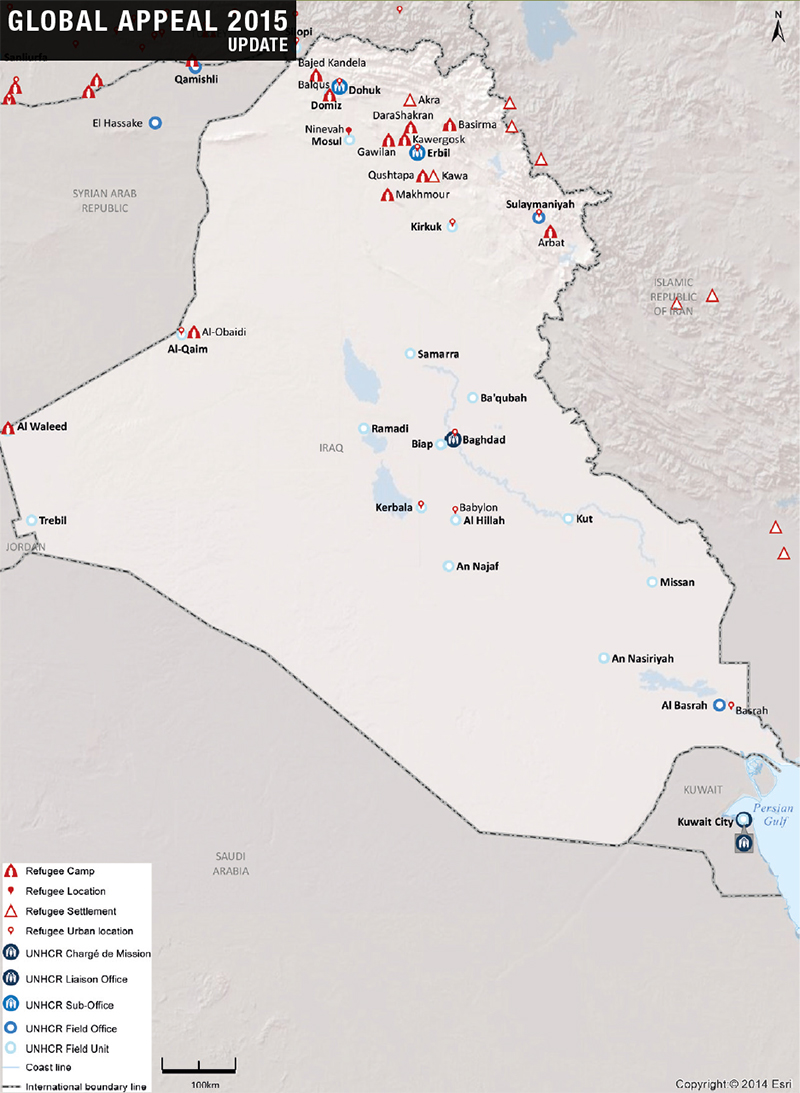
UNHCR's access to IDP and refugee locations in Iraq
| Overview |
Working environment
PLEASE CLICK ON THE PICTURE TO ENLARGE
The escalation of armed conflict across the central governorates of Iraq, and the constantly changing security situation, have resulted in new and secondary movements of internally displaced people (IDPs) across central Iraq and the Kurdistan Region of Iraq (KR-I).
UNHCR's access to some IDP and refugee locations (particularly in central Iraq), as well as the ability of IDPs and refugees to transit through certain areas of Iraq, will likely remain restricted.
Newly displaced people in Iraq find their limited financial resources quickly depleted by the increasing costs of accommodation and basic foods.
The number of Iraqis seeking refuge in other countries is rising considerably; however, it is anticipated that the Syrian refugee population currently in Iraq will probably remain at a similar level or increase slightly, depending on developments in the north-eastern part of the Syrian Arab Republic (Syria).
The central Government and KR-I authorities have contributed to the IDP and Syrian refugee response with: registration, core relief item (CRI) distribution, cash assistance, essential services in collective centres, and land allocation and site preparation for camps.
PLEASE SEE/:
http://www.unhcr.org/pages/49e486426.html
Refugees In Iraqi Camps Face Harrowing Winter
HuffPost Spain | By Antonio Ponce
Posted: 01/24/2015
Despite the latest successes of the Iraqi Army and the forces of the Kurdish regional government, known as the peshmerga, hundreds of thousands of refugees in Iraq are facing a harrowing winter in makeshift camps across the country.
Numbers of the United Nations’ Office of the High Commissioner for Refugees (UNHCR), published in January indicated that there were 2,047,700 refugees in Iraq alone. More than 300,000 of them are Syrians who have fled the brutal civil war in their home country. A majority, however, are Iraqis that have been internally displaced. Most refugees are now living in the Kurdistan Region, in the northeastern part of the country.
A group of young Yazidi refugees.
In 2014, when fighters of the Islamic State group crossed the Syrian border and conquered Iraq's second largest city, Mosul, ethnic and religious persecutions flared up across the country. The extremists mainly targeted Kurds, Shiites and other minorities, but thousands of Sunnis also decided to flee their homes in occupied cities rather than face the zero-tolerance doctrines of the Islamic State.
Now, more than two million refugees are confronting winter with few or no resources. International humanitarian assistance can't cope with the refugees’ most basic needs.
At the Barika Refugee Camp near Sulaymaniyah, nearly 1,200 families pile up around muddied streets. The mere act of walking is difficult. Sanitary conditions are awful. Many of the refugees feel the government has abandoned them. They say the camps are poorly managed and that the relief efforts have not been enough.
“People send us money. We know that there is help, but we are not receiving it,” says Munir, a refugee who decided to build his own modest concrete house after two years of displacement. “The government subsidized a room where we could barely fit a kitchen. We had to pay for the rest with our own savings.”
Thousands of families have done the same thing, and now Barika has become an improvised city of 8,000 refugees. Some small shops business have recently sprouted between the mud-flooded streets and the gray buildings.
In Arbat, ten minutes by car from Barika, Hussein Ali's family has two tents for ten people. “We only have one heater,” he says. The Ali family are Yazidis from Sinjar, who fled from the Iraqi city months ago fearing the advance of the Islamic State. Hussein says he lives with bitter memories and claims that the peshmerga escaped from Mount Sinjar and left his religious minority to fend for themselves. Last August, the Islamic State group executed at least 500 Yazidis. They also sold hundreds of captured women as slaves in Mosul.
The conditions in Arbat are the same or worse than those in Barika. A small covered building serves both as the school and as the center for food distribution. Dozens of families line up in front of it every day to claim their daily rations.
The inside of Munir’s house. He is a Kurdish refugee from Syria who now lives at Barika.
The refugees are pessimistic about their future. Some say they have lost all trust in their government and refuse to return to their homes. The atrocities of the Islamic State are still too fresh in their minds.
One of the refugees shows his body, full of scars and burns. He refuses to give his name or to appear in front of the camera. He says he's a former Iraqi Army soldier. When the jihadists reached his village, he says, they set his house on fire while he was inside with the rest of his family.
The refugee camp at Arbat.
The situation is becoming desperate. Few refugees in the camps can find jobs. Even in large cities like Sulaymaniyah or Erbil, it’s hard to find employment.
Muhammed Kamil, a young man who is studying to become a doctor, says that there is growing racism among the Kurds.
“Many see them as terrorists or as bad people, even though they are refugees. The fact is that many Sunnis supported Saddam Hussein in the past and now support the Islamic State. This has worsened an already bad situation,” Kamil says.
Kamil and his sister are Kurds and they both work with an association called IFMSA-Kurdistan, a group that collects food and medicines for the refugees. “We are all people and human beings. I have Arab friends in Baghdad and they’ve always treated me like an equal.”
A line of refugees waiting for basic foods.
Abdul al-Baqi, another refugee, says his family is trying to find something positive in their current situation by comparing it to their lives in Damascus.
“In Syria, my shop was destroyed during the protests, the government was after us,” he says. “The only thing that we have here is peace, but at least that is something.”
Inside of a tent at Camp Arbat.
This post originally appeared on HuffPost Spain and was translated into English.
http://www.huffingtonpost.com/2015/01/24/iraqi-isis-refugees_n_6526540.html?utm_hp_ref=tw
samedi 24 janvier 2015
The Chilcot inquiry: September 11 and the road to the Iraq War
http://www.independent.co.uk/news/world/middle-east/the-chilcot-inquiry-september-11-and-the-road-to-the-iraq-war-9999788.htmlThe Iraq Report – Part 1: The beginning
ANDY MCSMITH
Friday 23 January 2015
After six years and nearly £9m, the report of Sir John Chilcot’s inquiry into Britain’s involvement in the Iraq war remains unpublished – and, we were told this week, will not be published this side of the general election.
Will the British public ever be told the truth about a conflict that millions of them opposed, whose lethal fallout can still be felt across the world today?
In the absence of an official account, this series of articles – based on evidence given to the inquiry and other accounts that are already in the public domain – is an attempt to set down in writing, as objectively as possible, the known facts and unresolved questions of one of the most bitterly controversial episodes in recent British history
***
Tony Blair was in a hotel room reading through the speech he was due to deliver to the TUC annual conference when Alastair Campbell came bursting in and insisted that he switch on the television. At 1.46pm British time, a Boeing 767 passenger airliner had hit the north tower of the World Trade Centre in New York. The south tower was hit 17 minutes later.
READ MORE:THE IRAQ REPORT – PART 2: INVASION AND OCCUPATION OF IRAQ
THE IRAQ REPORT – PART 3: THE AFTERMATH
THE IRAQ REPORT – PART 4: TIMELINE OF EVENTS
THE IRAQ REPORT – PART 5: THE KEY PROTAGONISTS
THE IRAQ REPORT – PART 6: A SUMMARY OF THE IRAQ WAR BY NUMBERS
The Prime Minister grasped at once that what he was seeing, from the Grand Hotel, Brighton, on 11 September 2001, was seminal, a pivotal moment in world affairs. There would obviously be a reaction from the US government that would be felt across the world: and whatever the US did, Blair decided, the UK must back them up.
“TB said that we had to help the US, that they could not go it on their own, that they felt beleaguered and this would be tantamount to a military attack in their minds,” Campbell recorded in his diary.
Tony Blair was not, of course, the only head of government to promise to be at America’s side as it embarked on what became known as the “war on terror”. One of the first world leaders on the phone to Washington was the German Chancellor Gerhard Schroder. The day after the attack, he reported to the Bundestag that he had promised Bush “Germany’s full – I repeat, full – solidarity.” The first foreign head of government to visit the smouldering remains of New York’s Twin Towers was France’s President Jacques Chirac one week after the attack. Standing on US soil, he announced: “France, I can tell you, will not stand aside in a fight against a scourge that defies all democracies.”
Though neither Chirac nor Schroder said so at the time, their promise of support was not unconditional: it depended on what the US decided to do. Within 14 months, Schroder and Chirac were meeting to co-ordinate their opposition to the planned invasion of Iraq.
But when Tony Blair broadcast from Downing Street on the evening of 11 September, promising that “we here in Britain stand shoulder to shoulder with our American friends”, there was no unspoken codicil. He fully intended to go wherever the Americans went.
The Iraq War: A timeline1 of 17
Inscription à :
Articles (Atom)