Affichage des articles dont le libellé est Turkmen IDPs. Afficher tous les articles

vendredi 19 septembre 2014

REPORT ON THE SITUATION OF DISPLACED TURKMEN FAMILIES IN IRAQ AFTER THE EVENTS OF MOSUL


THE REPUBLIC OF IRAQ
BELADI CENTER FOR STRATEGIC STUDIES AND RESEARCH
DEPARTMENT OF HUMAN RIGHTS


REPORT ON THE SITUATION OF DISPLACED TURKMEN FAMILIES
AFTER THE EVENTS OF MOSUL
JUNE 2014

LIVING CONDITIONS OF TURKMEN FAMILIES
01/08/2014


IN ARABIC        https://docs.google.com/file/d/0Bw0JXzUnszw8XzdlN2xPSmJzU0k/edit


mardi 22 juillet 2014

Iraqi Turkmens ‘left for dead’ in desert

İpek Yezdani - ARBIL

ipek.yezdani@hurriyet.com.tr

Thousands of Turkmen refugees who fled ISIL violence in Telafer are being abandoned to their fate under 50 degrees of hot weather in the desert

Hürriyet Photo, Selçuk Şamiloğlu
A humanitarian tragedy is unfolding in Iraq as Turkmens who fled the advance of the feared Islamic State of Iraq and the Levant (ISIL) are now succumbing to the region’s scorching summer sun as refugees. And with death approaching, many refugees are apoplectic at Turkey and Kurdistan’s indifference to their plight.

“There is always someone to look after Kurds and Arabs in Iraq, but there is no one to look after Turkmens. Turks were calling Telafer ‘Little Istanbul;’ why doesn’t Turkey take care of us now?” said Eyat Suttu, 35, noting that said his wife had been seriously ill for five days but that he had not been able to bring her to a hospital because the Iraqi Kurdish peshmarga had not let them enter Arbil.   

“We are going to die here under the sun in the dust. Just kill all of us at once and this torture will be finished for all of us,” he said. 

On June 15, ISIL, who had recently renamed itself as the Islamic State (IS), seized the control of the northern Iraqi city of Telafer, a largely Turkmen city.  

Thousands of Shiite Turkmens first fled to the northwestern city of Sinjar in order to flee to either Kirkuk, Baghdad, Karbala of Najaf. However, they have been kept waiting for days in 50-degree weather in the desert by peshmarga forces at the Hazer security checkpoint just outside Arbil. 

Hazer is the main security checkpoint between Arbil and ISIL-controlled Mosul. Outside the checkpoint, there are thousands of people from new-born babies to the elderly, who have been trying to survive in tents which they have made from blankets in the desert heat.

Small children and elderly people die every day because of the intense heat, according to refugees waiting at the checkpoint.

‘We buried three children’


Mahsoun Habil Muhsin, 35, escaped from Telafer with his wife and five children. “We have been suffering here for a week. The peshmarga doesn’t allow us to enter Arbil. Our children are dying because of the heat and diseases. We buried two old women and three children yesterday. There are new-born babies in the camp and they could die at any minute,” Muhsin said.    

The only area Shiite Turkmens think they can take shelter in in northern Iraq is the peshmarga-controlled city of Kirkuk. 

“When ISIL attacked Telafer, we have fled to Sinjar on June 16. But there was no food or water there. So we had to leave Sinjar and come here. However, the peshmarga keeps us waiting here. Why don’t they let us go? We are Turkish, why doesn’t Turkey take care of us?” Muhsin added. 

Hidir Suleiman, 42, who used to be an elementary school teacher in Telafer, fled to Hazer with his nine children. “We left everything we had behind. We didn’t even take our ID cards. Elderly people died on the road. Our wives and children are dying here. We just want to get out of here, we don’t want anything else. Just save us and allow us to enter a town in Turkey,” he said. 

Thousands of Turkmens stay in the storage as hot as oven


In addition to Turkmens who have been kept waiting at the Hazer checkpoint, there are also thousands more who have been living inside an empty storage in Arbil. They are being sent to Baghdad, Najaf or Karbala in small number of groups by plane once a week.

Inside the storage, it is much hotter than outside. They have divided the storage into three- to five-square-meter rooms with blankets for each family. There are at least 10 people staying in every room. 

Fazil Muhammad, a hammersmith from Telafer, fled Arbil with nine people from his family. “We had had clashes with ISIL for three days, and then the Iraqi army brigade who came from Baghdad fought against them for a week. Then ISIL started to bomb the town. Gen. Abu Walid withdrew his soldiers. We had to run away too. We have been staying here for 30 days, we are waiting to be sent to southern Iraq,” he said. 

‘ISIL killed all those left behind’


Hadi Hasan, who came to the storage a week ago, said ISIL had killed all the Shiites who were not able to flee and who were left behind in Telafer. 

“They killed even 40-day-old babies and the elderly. They have blasted all the Shiite mosques. They even killed the animals, cows and sheep. We didn’t have time to bury some of the bodies.” 

Zeynep Ali Ekber, 25, said ISIL militants took away 20 people including her father and her brother from the Bekkekut village of Telafer. “They have arrested many from the other Shiite villages. We haven’t heard from them since then,” she said.
July/22/2014

http://www.hurriyetdailynews.com/iraqi-turkmens-left-for-dead-in-desert.aspx?pageID=238&nID=69432&NewsCatID=352

dimanche 13 juillet 2014

THE ETHNIC CLEANSING OF TURKMENS, IRAQ'S THIRD MAIN ETHNIC COMMUNITY

THE ETHNIC CLEANSING OF IRAQ’S THIRD MAIN ETHNIC COMMUNITY: 

THE TURKMENS

There are over 350.000 internally displaced Turkmens in Iraq since June 2014, they fled from their cities and villages which were attacked by ISIS (the Islamic State of Iraq and Sham) in June, many were killed and wounded. 

After attacking  and occupying Mosul city on 9th June 2014, ISIS attacked Tel Afer, the largest Turkmen city in the province of Mosul.
When ISIS moved to the Turkmen inhabited region of  Kirkuk, Salaheddin and Diyala provinces, they attacked the Turkmen towns and villages situated in these provinces:Bashir, Biravceli, Bastamli, Chardaghli, Kara Tepe, Salman Pak, Jalawla and several villages belonging to the Turkmen Bayat tribes.

Please click on the link below to read the S.O.S. AND URGENT APPEAL FROM THE IRAQI TURKMENS TO THE UNITED NATIONS FOR THE ESTABLISHMENT OF A SAFE HAVEN FOR THE TURKMENS IN THE NORTH OF IRAQ


MAP OF IRAQ ( THE REGION INHABITED BY TURKMENS ‘Turkmeneli’ IS INDICATED IN BLUE)
map_of_turkmeneli
 THE TURKMENS’ VOICES HAVE ALWAYS BEEN STIFLED IN IRAQ
The history of the Turkmens in Iraq is one of continuous sufferings since the establishment of the Iraqi State in 1921.
Turkmens should be amongst the wealthiest people on earth,  their region Turkmeneli,
is rich in oil, gas, and their agricultural lands are very fertile.
Unfortunately their region continues to be coveted by Arabs and Kurds.
Turkmens do not have armed militias, they are an easy target.

 The dramatic situation of the internally displaced Turkmens

The Internally Displaced Turkmens in Iraq will never be able to return to their cities and villages which are now de facto occupied and controlled by ISIS and/or by their Sunni Arab allies, or by the  Kurdish Peshmerga.
.
The Turkmens who are transferred to the south of Iraq will be arabised while those who remain in the north of Iraq will be kurdified.
.
The Kurds, taking advantage of the weakness of the Iraqi government,  advanced their forces beyond the Kurdish autonomous region. Kurdish Peshmerga forces are now de facto occupying the Turkmen region in the north of Iraq (called TURKMENELI)  they control almost all Turkmen cities and towns in the four provinces in the north of Iraq (Mosul, Kirkuk, Salaheddin and Diyala).  
.
The majority of Sunni Arabs in the north of Iraq support ISIS, they did not try to resist when ISIS attacked Mosul.
.
Turkmen IDPs have lost everything, their houses were looted after they were forced to flee to save their lives. They are now homeless and landless.
.
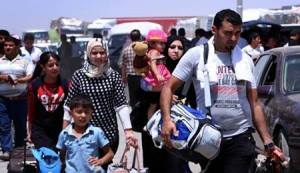
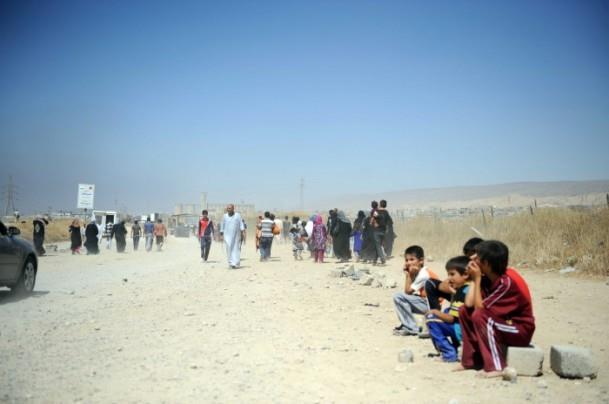
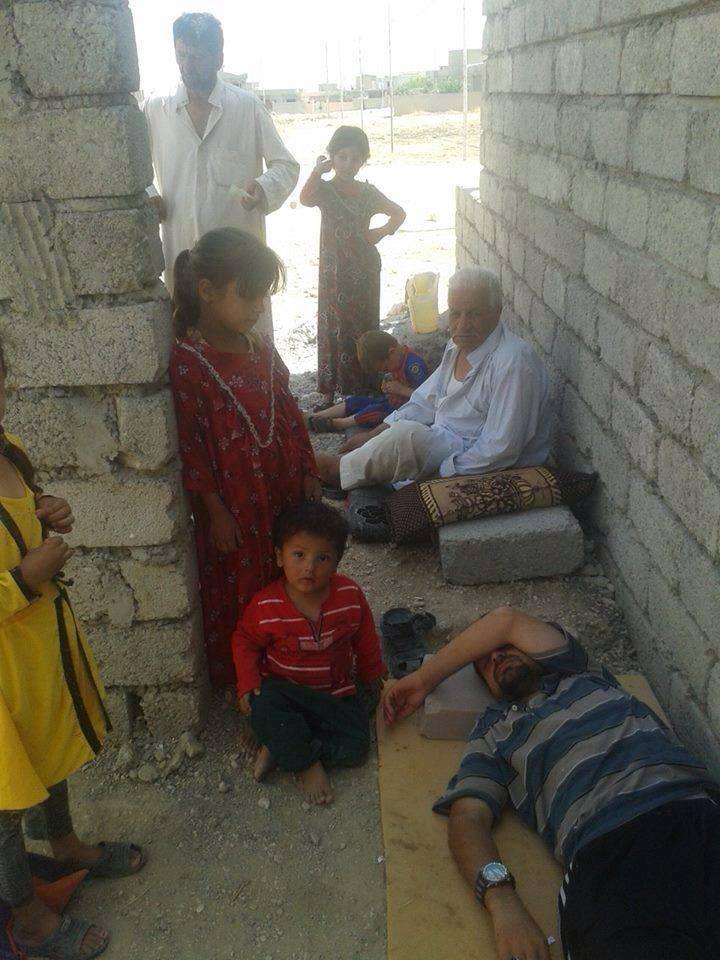
 Photos of  Turkmens in Iraq  fleeing their cities and villages after being attacked by ISIS (in June 2014).
Turkmen refugees 8

Turkmen refugees 4
telafer refugees2
TURKMEN IDPs
 Trying to protect themselves from the scorching heat
Turkmens fleeing from Telafer
Photo above: Turkmens fleeing from Tel Afer (a Turkmen city in the north west of Iraq) under heavy shelling by ISIS
Turkmen refugees truck

Turkmens were taken to transit camps by trucks

Hereunder, photos taken at one of the Transit camps (situated in the Kurdish Autonomous Region - Baharka camp, 10 km from Erbil city)

Turkmen IDs in warehouse Erbil
11th July, 2014 -BAHARKA Transit Camp : After waiting for several days in the scorching heat, with hardly any water and food, 5.000 Internally Displaced Turkmens arriving from Tel Afer (a Turkmen city in the north west of Iraq) were finally allowed to enter Erbil.
.
They are now in Baharka Transit Camp (10 km north of Erbil ) which is an old warehouse. But their ordeal is far from over, the living conditions there are appalling. The place is very dirty, very hot (48°C) and there is no sanitation infrastructure and no medical help.
.
Almost all of the IDPs had to stop several times before arriving to Baharka , with on average each IDP family stopping 5 times.
.
Over half of the IDPs relying on their own savings to meet their basic needs reported that it would last only one week. The remaining  reported that they had no means to support their families.
UNHCR help has not yet reached these IDPs.
.
Iraqi Turkmen Front (ITF) Executive Board Members Messrs Ali Mehdi and Aydin Maruf, and ITF Erbil  representative Mr. Dilsat Terzi, delivered some humanitarian assistance to the IDPs.
.
The Turkish Relief Organization UKBA (Uluslararasi Kardeşlik Banş ve Ahlak Vakfi) International Brotherhood, Peace and Moral Foundation, also provided assistance to the IDPs.
.
There is an urgent need for baby milk and diapers. There are not enough mattresses. Many people are sleeping on the floor outside the warehouse. Children are suffering from diarrhoea and dehydration.
The Internally Displaced   Turkmens of this Transit camp near Erbil are waiting to be flown to  NAJAF in the South of Iraq.
.
More IDPs are on their way to this Transit camp…
We had reports today that 13 IDPs, including children,  have died between Mosul and Erbil because of lack of food and water.

Turkmen refugee father and baby
 A father trying to cool his baby (babies are the first to suffer from dehydration in this temperature of  48°C).
Turkmen ids 6
 The whereabouts of many Turkmen IDPs is still  unknown.
 Note: According to a report from  OCHA (United Nations OFFICE FOR THE COORDINATION OF HUMANITARIAN AFFAIRS), Iraq is now contending with one of the largest internally displaced populations in the world; over 1.2 million have been displaced since January 2014. Since the fall of Mosul on 9th June 2014, armed opposition groups (AOGs), including Baathists, tribal militias and members of the former regime/military, along with the Islamic State of Iraq and Sham (ISIS), have taken control of large swathes of Iraq’s provinces.

Turkmen refugee children water
Water being delivered by the Turkmen community of Erbil  to the Turkmen children (of Tel Afer) at Camp Baharka  near Erbil – Apart from two Turkish Aid Agencies and the Iraqi Turkmen Front, no one is providing humanitarian help to the poor IDPs.

Turkmen refugee, mother with sick child

Turkmen refugees in Iraq 6
Exhausted Turkmen IDPs trying to find a place in the shade (Temperature in June, July and August reaches 50°C in Iraq)
Turkmen refugee 10
An employee of a Turkish Humanitairian Aid Agency trying to comfort an exhausted refugee..
...

Hereunder : URGENT APPEAL FROM THE IRAQI TURKMENS’ EU REPRESENTATIVE ADDRESSED TO THE UNITED NATIONS 
irak-turkmen-cephesi1
IRAQI TURKMEN FRONT
European Representation
Brussels-Belgium

For the urgent attention of The Secretary-General of the United Nations, Mr. Ban Ki-moon
S.O.S. AND URGENT APPEAL FROM THE IRAQI TURKMENS TO THE UNITED NATIONS FOR THE ESTABLISHMENT OF A SAFE HAVEN FOR TURKMENS IN THE NORTH OF IRAQ.

Your Excellency,

As the representative of the Iraqi Turkmen front in the European Union and on behalf of the Iraqi Turkmens, who constitute  Iraq’s  third largest ethnic group and one of the three  main communities forming  the backbone of the Iraqi people with the Arabs and Kurds, I am writing to you in order to bring to your attention the grave situation the Turkmens are facing in the north of Iraq after the attacks and the invasion of Mosul city by the terrorist organization ‘ISIS’(the Islamic State of Iraq and Sham) on the 9th of June 2014.

Since then, the terrorist organization ISIS has multiplied its attacks and extended its invasion to the north of Iraq rapidly because of the unexpected and astonishing sudden withdrawal of the Iraqi army divisions from their positions in the four provinces in the north of Iraq (Mosul, Kirkuk, Salaheddin and Diyala), leaving a vacuum and facilitating the partial occupation of these provinces by ISIS and by the Kurdish Peshmerga.

Indeed, the Kurdish Peshmerga, either in prior agreement with the terrorist organization  ISIS or opportunistically taking advantage of the present weakness of the Iraqi government forces in the north of Iraq, have quickly advanced their forces beyond the Kurdish autonomous region to occupy and control the so-called ‘contested territories’ in the provinces of  Kirkuk, Mosul, Salaheddin and Diyala. The Kurdish Peshmerga forces are now de facto occupying almost all the Turkmen region in the north of Iraq (Türkmeneli) and controlling almost all Turkmen cities and towns in these four provinces.

After occupying Mosul city, ISIS attacked Telafer, the largest Turkmen city in the province of Mosul, killing over one hundred Turkmens and wounding several hundreds of them, 200.000 Turkmen inhabitants of Telafer, mainly women, children and elderly people fled the city under heavy shelling. These defenceless people are facing huge difficulties to find shelter, water and food, they are in the desert under scorching heat. Some of them have been denied entry to the Kurdish region where they were seeking refuge.

ISIS after establishing its control on Mosul moved forward to the south and took control of Tikrit, the capital of the Salaheddin province and of the town of Hawija, the largest Sunni Arab town in Kirkuk province where they took control without any resistance neither from the central government forces nor from the local authorities because of the sudden withdrawal of the Iraqi army divisions from their positions in these provinces as mentioned earlier.

After controlling Tikrit and Hawija , ISIS  moved to the Turkmen region of Kirkuk, Salaheddin and Diyala provinces and attacked the Turkmen towns and villages situated  in these provinces such as Bashir, Biravceli, Bastamli,  Chardaghli, Kara Naz, Kara Tepe, Salman Pak, Jalawla and several villages belonging to the Turkmen Bayat tribes.

In each of these Turkmen localities ISIS has committed crimes against humanity, torturing, raping, kidnapping young girls, looting Turkmens’ properties and mass killing indiscriminately women, men and children.

The Turkmens in Iraq have been betrayed by the Iraqi government who assured them that the Iraqi army would protect the Turkmens in the entire Turkmen region in the north of Iraq.

The 12th division of the Iraqi army which was supposed to defend and protect Kirkuk province, unexpectedly abandoned its position, leaving all its weapons and equipment behind.

The Kurdish Peshmerga took over the area and confiscated the weapons which were abandoned by the Iraqi army. The Peshmerga were supposed to protect and defend Kirkuk province from ISIS attacks.

Unfortunately, when ISIS encircled and attacked the village of Beshir (situated some 30 km south west of Kirkuk)  the Peshmerga forces abandoned their position around Beshir, leaving the poorly armed Turkmen inhabitants on their own to defend their village. They resisted as long as they could until they ran out of ammunition.  ISIS conquered the village and the inhabitants fled, but unfortunately not all of them succeeded.  Dozens of people were killed, more than 30 were wounded and a large number of them are still missing, they are either dead or still trapped inside the village.

ISIS has committed the same crimes in the Turkmen locality of Biravceli, in Salaheddin province, where they killed 23 defenceless Turkmens, most of them women and children.

The above are just a few examples of what is happening to the unarmed and unprotected Turkmens in  their towns, cities and villages in the north of Iraq.

Since 2003, Turkmens have been continuously targeted and attacked. They have been killed, wounded, kidnapped for ransom, their properties have been looted or burned and their political leaders have been assassinated.

In view of the above, it is clear that the survival of the Turkmen community in Iraq is at stake. They are facing ethnic cleansing and a potential genocide in the present day troubled situation of the country.

Therefore, Iraqi Turkmens urge the General Secretary of the United Nations to do his utmost to come to the help of the Turkmens to protect them by providing a safe haven for them in the north of Iraq, similar to the safe haven the UN provided for the Kurds of Iraq from 1991 to 2003.

Furthermore, Turkmens urge the United Nations to bring the criminals from ISIS as well as those responsible in the Iraqi central government and local authorities in these provinces who betrayed the Turkmens by leaving them without defence and protection to the International Criminal Court to be judged.

Yours respectfully,
Dr. Hassan Aydinli
Iraqi Turkmen Front EU representative
Brussels, 21st June 2014.

The Turkmens: Caught between the devil and the deep sea

Caught between the devil and the deep sea


A woman cleans a tent at a camp for displaced Iraqi Turkmen who fled their town of Tal Afar, in Shikhan, in Kurdistan’s Dohuk province. The strategic north Iraq town of Tal Afar and its airport were in the hands of militants  after days of heavy fighting. The state of Iraq, in its modern form, was created in 1920, and has always been a patchwork of ethnicities and religious confessions. — AFP

Tens of thousands of people fleeing militants have sought refuge in the small northern Iraqi town of Sinjar, cramming into schools and mosques. But now, there is simply no room left.

“No place remains for us to settle displaced people,” local official Myaser Haji Saleh says despondently.

Huge numbers of people fled a Sunni militant onslaught on the predominantly-Shiite Turkmen town of Tal Afar last month, part of a jihadist-led offensive that saw swathes of territory across five provinces fall out of government hands.

Some 58,000 of them — mostly children — made their way to Sinjar, further west toward the Syrian border, flooding into a town with a population of around 300,000.

“We opened schools, mosques and shrines for them,” says Saleh, the local official responsible for Sinjar and the surrounding area.

“In the early days, the people provided aid before international organizations arrived,” he says.

“We desperately need to open a camp for them, because our problem lies in housing this large number of displaced people.”

But a camp would create its own problems, as the area lies several hours from the nearest government-held city, and just a short distance from territory controlled by militants led by the Islamic State (IS) group.

Sinjar is controlled by peshmerga forces from Iraq’s autonomous northern Kurdistan region, and protecting both the town and the camp from insurgents would stretch the peshmerga.

“We are afraid of them being attacked,” says Saleh.

“We cannot exclude the possibility of Daash militants attacking them with mortars if they were in a camp,” he adds, referring to IS by its former Arabic acronym.

Sinjar is populated mostly by Yazidis, who speak a dialect of Kurdish and live mainly in the mountains of northern Iraq, and the town has long played a key role in Iraq’s struggle with militancy.

The town lies along a well-travelled smuggling route, with the US military seizing a trove of documents near Sinjar indicating that hundreds of militants passed through the area from Syria to Iraq in a one-year period between 2006 and 2007.

And in August 2007, suicide bombers killed more than 200 people in a series of brutal truck bombs in Yazidi-populated villages in the Sinjar area.

Now, the town is grappling with displaced families from Tal Afar fleeing a renewed militant offensive that started on June 9 and which Iraq’s security forces have struggled to repel.

Sinjar’s sewage system has been overwhelmed by the sudden uptick in its population, while families seeking shelter in a local girls’ school must make do with just one hour of electricity a day indoors or bear the scorching summer heat outside.

Many have even had to set fire to wooden chairs to cook food.

The United Nations voiced fears of overcrowding, poor hygiene and limited access to safe drinking water causing increased instances of diarrhoeal diseases, following a humanitarian visit to the town this month.
“We do not know what to do, or where to go,” says Zainab Jarallah, clinging to her two grandchildren inside the girls’ school.

“We have big families, but we do not have anything. What happened was a surprise for us,” the 68-year-old adds. “We saw death with our own eyes.”

After seizing Mosul on June 10, IS-led fighters swiftly took control of Sunni-majority areas of five provinces, but Iraqi forces battled for days to keep control of Tal Afar. On June 23, however, the town fell out of government hands.

Many sought to flee to Dohuk, one of the three provinces in Iraq’s autonomous Kurdish region, but non-Kurds require local sponsors before being allowed to enter.

As a result, countless cars sit idle on the side of the road connecting Dohuk to Sinjar, ostensibly belonging to Iraqis who sought to enter Kurdistan but were unsuccessful.

Those who fled to Sinjar have sought safety in a shrine revered by the Shiites. Women sit within the shrine, while men stay outside, watching over their children as they run and play in a nearby graveyard.

Others who have not found physical structures have had to settle for tying a large piece of cloth between two parked cars to provide some shade from the sun, including a mother cradling her child, born just two days earlier.

Nearby are 39-year-old Saad Yunus and his 44-year-old brother Ali, both fathers who fled Tal Afar with their families, who have themselves had to resort to similar measures to shield their families from the heat.

“All the roads were blocked to us,” says Saad. “We are trapped here and within days, our savings will run out.
“We do not know what to do.” –  AFP


http://www.saudigazette.com.sa/index.cfm?method=home.regcon&contentid=20140712211285

jeudi 10 février 2011

ITF EU Representative, Dr. Hassan AYDINLI, attended the meeting on the Humanitarian Consequences of the Nagorno-Karabakh Conflict

Dr. Hassan Aydinli, ITF EU Representative and Mr. Ayhan Demirci, President of Azerbaijan- Belgium Friendship Association


Mr. Laszlo Tokes, Vice-President of the European Parliament, EPP-coordinator of the Human Rights Committee and Mr. Willy Fautré, Director of Human Rights Without Frontiers.

MEETING ON THE HUMANITARIAN CONSEQUENCES OF THE


NAGORNO-KARABAKH CONFLICT


AT THE EU PARLIAMENT IN BRUSSELS


on 9th February 2011.


The meeting was hosted by MEP Lazlo Tokes, Vice-President of the EU Parliament.


After the opening speech by MEP Lazlo Tokes, Mr. Willy Fautré, Director of Human Rights Without Frontiers, Brussels, made a presentation on IDPs in Azerbaijan: "From Nagorno-Karabah/Khojali to Baku".


On 26-31 January 2011, a three-member team of Human Rights Without Frontiers International conducted a fact-finding mission to Azerbaijan with the objective of investigating the current situation of the Internationally Displaced Persons (IDPs) in the country within the context of a protracted displacement crisis and the stalled peace process on the Nagorno-Karabakh conflict. The team visited IDPs dormitories and collective settlement centers located in Baku and at its outskirts. The mission's findings are based on household interviews with around 100 IDPs from Nagorno-Karabakh (Khojali and Shusha) and some of the adjacent occupied districts (Kelbajar, Agdam, Fizuli, and Zangelan). The interviews were conducted with a view to obtaining first-hand accounts of the challenges IDPs currently face and their priorities for addressing these challenges.


Internally displaced persons in Azerbaijan have lived in a virtual limbo over the past 20 years. Highly dependent on state aid and deeply traumatized by their conflict-induced displacement, they face huge obstacles - psychological, economic and social - that hinders their integration into local communities and the reconstruction of the life of their families These obstacles are aggravated by the lack of closure as regards the tragic events they experienced twenty years ago as well as the lack of prospects for the peaceful settlement of the conflict of Nagorno-Karabakh that would make the return to their lands possible.


During its mission to Azerbaijan, HRWF Int. realized how difficult it would be to disentangle the economic and social grievances of the internally displaced persons from the overall context of the armed conflict that has induced their displacement. These grievances cannot be redressed in the absence of clear prospects for the resolution of the conflict.


In his Presentation Mr. Fautré covered the following topics:


Background


Findings and Analysis


IDPs and Armed Conflicts


IDPs and Poverty


HRWF's Recommendations are:


The final resolution of the protracted displacement crisis in Azerbaijan is contingent upon the outcome of the peace process on the conflict of Nagorno-Karabakh that would make possible the return of IDPs to their lands. In line with the European Parliament Report on the need for an EU Strategy for the South Caucasus of the Committee on Foreign Affairs, HRWF International believes that the European Union should play an active role in providing political momentum to the peaceful resolution of the conflict of Nagorno-Karabakh.


Mr. Fautré ended his presentation by making specific recommendations.


The third speaker who made a presentation about IDPs was Mr. Scott Crosby, of Kemmler Rapp Böhlke & Crosby EU Law Office in Brussels.


The presentations were followed by a reception during which ITF EU Representative Dr Hassan Aydinli spoke with Mr. Togrul Malikov, First Secretary of the Embassy of the Republic of Azerbaijan to Belgium and Luxemburg and with Mr. Ayhan Demirci, President of Azerbaijan-Belgium Friendships.
With EU Lawyer Mr. Scott Crosby and HRWF's Director Mr. Willy Fautré, Dr. Hassan Aydinli spoke about the problem of the Turkmen IDPs in Iraq, informing them that since the 1980s many thousands of Turkmens had been forcedly displaced and dispersed all over Iraq under all sorts of pretexts by the former regime.


Dr. Hassan Aydinli informed them "that entire populations of Turkmen villages and towns: BESHIR, TIRKALAN, YAYCHI, BILAWA, TERJIL, TURKESHKAN, HAMZELI, YAHYAWA, TOPZAWA, had been evicted and that Turkmen towns around Mosul city had also been evacuated: Harabe, Gokcheli, Bazvaya, Qarateppe, and most of the inhabitants were forcedly deported to the Suleymaniyya province.

Dr. Hassan Aydinli explained what had happened to the 7.500 inhabitants of the large Turkmen agricultural village of BESHIR (which is situated 20 km to the South West of Kerkuk city):
In the early 1980s the Iraqi Security forces arrested hundreds of intellectuals from BESHIR accusing them of being activists in the outlawed Islamic Da'wa Party, over one hundred of these Turkmen intellectuals were later executed.

In 1986, while the young men of Beshir were fighting on the front in the war against Iran, their families were subjected to terrible human rights abuses: they were given 48 hours to pack their personal effects and leave their homes and were forcibly moved to some communal compounds which had been built in a rush to serve as 'transitional residence' on the road to Tikrit. Their houses were razed to the ground and their agricultural lands were later given to Arabs brought by the Ba'ath regime from the centre and south of Iraq, and to neighbouring Arab tribes, in application of a policy designed to arabise Turkmen towns and villages in KERKUK Province.
While each of these 'immigrant' Arab families were given 10.000 Iraqi Dinars (equivalent to 30.000 USD) as incentive to settle on Turkmen lands, the unfortunate Turkmens did not receive any compensation.

After a year spent in the communal compounds, almost all the Turkmen families from BESHIR were dispersed to several cities throughout Iraq: Basra, Diyala, Erbil, Kut...without being provided with housing and without being compensated by the government for the loss of their livelihoods, houses and agricultural lands. From being landowners and farmers they became refugees in their own country and were left completely destitute.


In 2003 when they U.S. occupied Iraq the displaced people of BESHIR thought things would change and many of them came and planted their tents around their village, hoping they would finally be able to move back on their ancestral lands, but unfortunately the Arabs who had been brought under the former regime refused to leave. As the Turkmens threatened to march on their village in order to remove them by force, the U.S. occupation authorities intervened and prevented them to enter the village. The U.S. led and controlled a "mediation" and later a Property Claims Commission was set up.


In 2005 the people of BESHIR took a lawyer and presented their files to the Property Claims Commission, giving copies of their deeds, in order to receive compensation and get back their lands which had been confiscated, but the Iraqi authorities are in no haste to process the files belonging to Turkmens, although the ordeals of the Turkmens of BESHIR are mentioned in the Preamble of the Iraqi Constitution together with the tragedy of the Arabs of AL-DUJAIL and the massacre of the Kurds of HALABJA.

Since 2005 only 2.000 files out of the 45.000 files belonging to Turkmens have been processed. Dr. Aydinli said that this is clearly a sign of discrimination against Turkmens as in Kerkuk, all the 'pending files' belong to Turkmens, and that all the Kurds who submitted their files have already been compensated."

Mr. Fautré and Mr. Crosby said they were interested to receive further information about the Turkmen IDPs, Dr. Aydinli told them he would keep them informed.