Affichage des articles dont le libellé est Human Rights Watch. Afficher tous les articles

mercredi 11 mars 2015

Iraqi Kurdistan: Arabs Displaced, Cordoned Off, Detained - HUMAN RIGHTS WATCH


Iraqi Kurdistan: Arabs Displaced, Cordoned Off, Detained
Harsh Restrictions in Northern Iraq While Kurds Move Freely

FEBRUARY 26, 2015


Enlarge

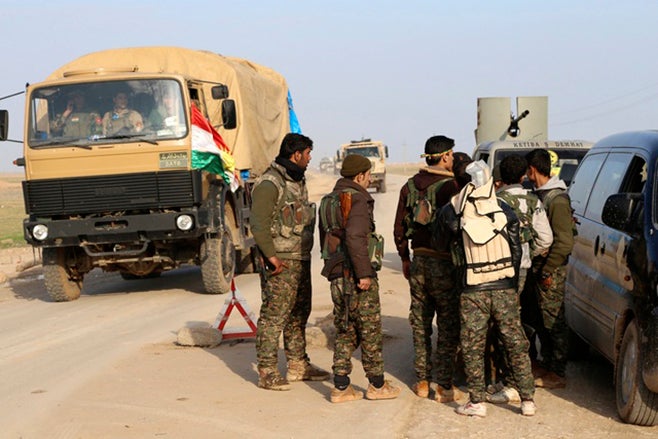
Military vehicles pass as Kurdish People's Protection Units (YPG) and Kurdistan Workers Party (PKK) fighters man a checkpoint north of Mount Sinjar, Iraq on December 20, 2014.
© 2014 Reuters


Enlarge

RELATED MATERIALS:
World Report 2015: Iraq
JANUARY 11, 2015


Iraqi Kurdish forces have confined thousands of Arabs in “security zones” in areas of northern Iraq that they have captured since August 2014 from the extremist group Islamic State, also known as ISIS. Kurdish forces for months barred Arabs displaced by fighting from returning to their homes in portions of Ninewa and Erbil provinces, while permitting Kurds to return to those areas and even to move into homes of Arabs who fled. Some restrictions were eased in January 2015, after Human Rights Watch communicated with the Kurdish regional government about the issue, but others remain.

Local Kurds told Human Rights Watch that Iraqi Kurdish citizens or forces of the Kurdistan Regional Government (KRG) have destroyed dozens of Arab homes in the areas, which the KRG appears to be seeking to incorporate into Kurdish autonomous territory. Arab residents in one cordoned-off zone said that KRG forces detained 70 local Arab men for long periods without charge.

“Cordoning off Arab residents and refusing to let them return home appears to go well beyond a reasonable security response to the ISIS threat,” said Letta Tayler, senior terrorism and counterterrorism researcher at Human Rights Watch. “The US and other countries arming the Iraqi Kurdish forces should make clear that they won’t stand for discrimination under the guise of countering terrorism.”


Human Rights Watch found no evidence of Kurdish forces imposing similar restrictions on movements of Kurds. The regional government is a key ally of the United States-led coalition fighting ISIS. The US has pledged $350 million to create three new brigades of the Kurdish military force, the Peshmerga.Germany, the UK, Italy, France, the Czech Republic, and Albania also are arming or training Peshmerga forces.

Human Rights Watch raised its concerns about ethnic discrimination with KRG authorities in December and in a January 20 letter. In a statement to Human Rights Watch, the regional government denied any ethnic discrimination but pledged to investigate the Human Rights Watch findings. In January, Kurdish military and intelligence forces eased several of the restrictions.

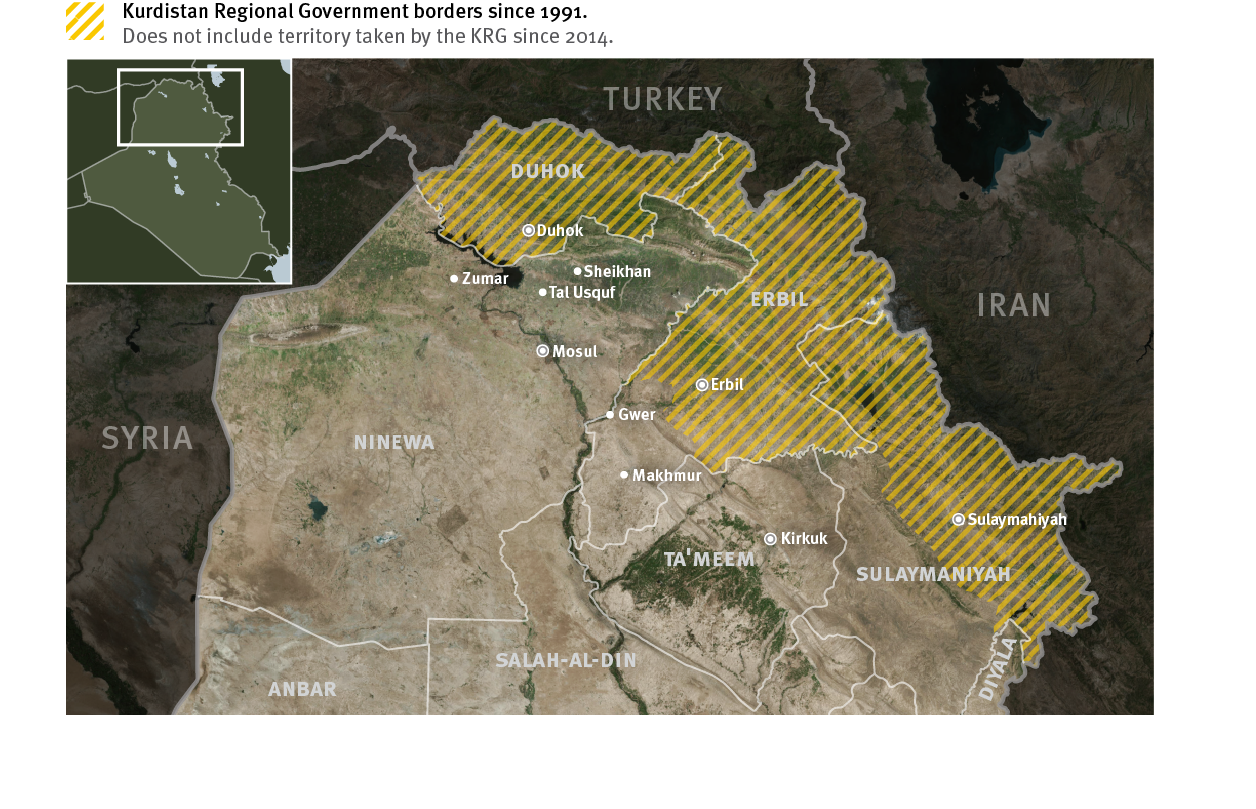
Human Rights Watch documented the apparently discriminatory acts in communities inSheikhan and Tilkaif districts and Zumar subdistrict, all in Ninewa province, and Makhmur district in Erbil province, while visiting these areas in December and January. The areas are part of the so-called disputed territories that both the regional government and Iraq’s central government in Baghdad claim.

With the exception of Sheikhan, which is governed by the KRG, the districts had been under the central Iraqi government’s authority until ISIS captured portions of them in mid-2014. Many of the districts’ residents – an ethnically diverse population of 600,000 – fled before ISIS captured their areas. Others stayed put because the fighting did not reach their towns, while others, primarily Sunni Arabs, were trapped or chose to stay inside ISIS-held territory.

Backed by US airstrikes, Kurdish forces wrested several communities in or near the districts from ISIS between August and October. Other parts of the districts remain under ISIS control and sporadic fighting has continued between ISIS and Peshmerga forces. Most of the towns and villages where Human Rights Watch found apparently unlawful conduct by Kurdish forces were directly behind or near the front line with ISIS.

Human Rights Watch has extensively documented crimes against humanity and other atrocities by ISIS in Syria and Iraq, as well as violations by the Syrian and Iraqi forces and allied militia.

In December Human Rights Watch saw Peshmerga and members of the KRG’s Asayish intelligence service turning away all civilians – including Arabs and Kurds – from some parts of these districts that they had captured, saying they were still too dangerous to resettle or visit because of the proximity of ISIS, ongoing fighting, and unexploded ordnance including booby-traps in homes. However Human Rights Watch found that Peshmerga and Asayish forces were allowing Kurdish residents who had fled the fighting to return to other towns and villages in these same districts that they deemed relatively safe, while denying displaced Arab residents re-entry to these same areas.

Local Asayish officials confirmed the bans at the time, telling Human Rights Watch at checkpoints into the four districts that “No Arabs are allowed.”

In its February 5 response to Human Rights Watch, which included comments from the Ministries of Interior, Peshmerga, and Asayish, the KRG said upholding human rights was a “main priority.” The statement said that regional government authorities have repeatedly instructed security forces, including immediately after receiving the Human Rights Watch letter, that “no one is above the law” and that all violators “will be held accountable.” In December, however, some Kurdish officials in meetings with Human Rights Watch defended restrictions singling out Arab residents, saying that many Arabs had assisted the ISIS advance and might again collaborate with the armed group, which is predominantly Sunni Arab.

mardi 1 février 2011

HRW: Iraq: Secret Jail Uncovered in Baghdad

Iraq: Secret Jail Uncovered in Baghdad
Detainees Describe Torture at Another Facility Also Run by Elite Security Forces
Human Rights Watch


HRW, February 1, 2011


(Baghdad) - Elite security forces controlled by the military office of Prime Minister Nuri al-Maliki of Iraq are operating a secret detention site in Baghdad, Human Rights Watch said today. The elite forces are also torturing detainees with impunity at a different facility in Baghdad, Human Rights Watch said.

Beginning on November 23, 2010, and continuing over the next three to four days, Iraqi authorities transferred more than 280 detainees to a secret site within Camp Justice, a sprawling military base in northwest Baghdad, interviews and classified government documents obtained by Human Rights Watch reveal. The Army's 56th Brigade, also known as the Baghdad Brigade, and the Counter-Terrorism Service, both under the authority of the prime minister's office, control this secret site. The hurried transfers took place just days before an international inspection team was to examine conditions at the detainees' previous location at Camp Honor in the Green Zone. Human Rights Watch has also obtained a list of more than 300 detainees held at Camp Honor just before the transfer to Camp Justice. Almost all were accused of terrorism.

"Revelations of secret jails in the heart of Baghdad completely undermine the Iraqi government's promises to respect the rule of law," said Joe Stork, deputy Middle East director at Human Rights Watch. "The government needs to close these places or move them under control of the justice system, improve conditions for detainees, and make sure that anyone responsible for torture is punished."

The Iraqi government should immediately close the facilities or regularize their position and make them open for inspections and visits, Human Rights Watch said.

Approximately 80 of the 280 detainees are being held by the 56th Brigade at the secret site at Camp Justice and have had no access to lawyers or family members. Prison inspectors are not permitted to conduct visits to the section of the facility controlled by the 56th brigade, prompting fresh concerns that the brigade may be torturing detainees. According to government sources, the Counter-Terrorism Service is holding the 200 remaining transferred detainees, although the 56th Brigade maintains primary responsibility for security at the site in Baghdad's Kadhmiya neighborhood.

In one of the 18 documents obtained by Human Rights Watch, a letter from the prosecutor's office of the Higher Judicial Council asks the Office of the Prime Minister to instruct officials at the Camp Justice site to stop preventing prison inspectors and relatives from visiting detainees. The letter, dated December 6, 2010, says such a refusal "meets neither legal nor humanitarian standards, unless [the refusal is] specifically ordered by a judge at a specialized court."A second letter, dated January 13, 2011, from the justice minister to the Office of the Commander in Chief of the Armed Forces, through which the prime minister controls Iraqi security forces, stated that a 56th Brigade officer prevented prison inspectors from the Human Rights Ministry from visiting the site.

The secret detention site is located within a legitimate Justice Ministry detention facility at Camp Justice, known as Justice 2 (Sijn al-Adaleh 2), which holds just over 1,000 other detainees. Camp Justice is the site of the former "Fifth Department" (al-Sha'ba al-Khamsa) intelligence office notorious during the rule of Saddam Hussein for torture and disappearances. The former dictator was executed there in 2006.

Camp Honor, from which the detainees were transferred, became the subject of media scrutiny on January 23, after the Los Angeles Times uncovered abuse there and described the conditions as "miserable." The article said detainees were held in cramped windowless cells that reeked of human excrement.

Recent interviews by Human Rights Watch of more than a dozen former detainees from Camp Honor had documented how detainees are held incommunicado and in inhumane conditions, often for months at a time. Detainees described in detail the wide ranging abuses they endured during interrogation sessions at the facility, usually to extract false confessions. They said interrogators beat them, hung them upside down for hours at a time, administered electric shocks to various body parts, including the genitals, and asphyxiated them repeatedly with plastic bags put over their heads until they passed out.

In interviews with Human Rights Watch in December, former detainees described the abuse at Camp Honor:

One detainee said on December 26 that: "The cell was so crowded that we had to take turns standing and lying down, and would try to let someone lie down if they were an old man, or especially if they had just been brought back from interrogation. Then we usually could not stand."
Another said on December 18 that: "I was blindfolded and put on the floor, face-down with my hands tied tightly behind my back. The interrogator stepped on my arms, and put more and more weight down on them until I was screaming."
A third detainee, who had been held in Camp Honor the summer of 2010, said in a December 27 interview that: "My hands were tied over my head and my feet were put in water, then they shocked me in my head and my neck and my chest. The interrogators beat me repeatedly and told me that they would go to my house and rape my sister if I did not sign a confession, so I did. I did not even know what I was confessing to."
In response to the Los Angeles Times article, which said Camp Honor is run by the 56th Brigade and the Counter-Terrorism Service, Iraq's deputy justice minister, Busho Ibrahim, told Agence France-Presse on January 24 that his ministry alone controlled the site.

"It is my responsibility, and I deny all these accusations - they are all lies," he said. "Families can visit their sons or husbands, lawyers can visit them regularly. It's like any other prison run by the Justice Ministry."

He reiterated, "It is not true that it follows Maliki's orders - it is run by the Justice Ministry."

However, documents obtained by Human Rights Watch refute government claims that Camp Honor is controlled by the Justice Ministry. In one classified document dated August 2, 2010, the former justice minister, Dara Nour al-Din, requested that his staff obtain approval from the Office of the Commander in Chief of the Armed Forces to transfer detainees from Camp Honor, demonstrating the ministry's subordinate role at the facility.

In the note to his staff, the justice minister asks them to write a letter to the Office of the Commander in Chief of the Armed Forces "requesting permission for custody of the prisoners to be turned over" to the ministry so they can be transferred elsewhere. The document indicates that the issue arose after Deputy Justice Minister Ibrahim acknowledged that his ministry could not transfer detainees due to external interference, particularly from military interrogators.

Another document, from October 2010, signed by Ibrahim himself, says the ministry "has no objection to allowing lawyers and families to visit detainees" at Camp Honor but that, "it is only the tough security measures implemented by the Defense Ministry/56th Brigade section [of the prison] and the Counter-Terrorism administration section, and also the location of the prison in the Green Zone, that has prevented this."

In response to the Los Angeles Times article, Ibrahim also said that the International Committee of the Red Cross (ICRC) had visited the Camp Honor prison. But when contacted by Human Rights Watch, the ICRC spokesperson, Graziella Leite Piccolo, said that ICRC had not been able to visit Camp Honor because the government had not met the organization's criteria for such site visits, including access to the entire facility and its detainees.

"It is important to note that, even if we had been able to visit, a visit alone is not a certificate of validation, but part of a process," she said. Government sources told Human Rights Watch that authorities have prevented the Human Rights Ministry from conducting any prison inspections at Camp Honor for more than a year.

Several government sources said that although the 56th Brigade, and its sibling, the 54th Brigade, technically fall under Defense Ministry administration, the brigades' chain of command bypass the ministry. They do not report to the defense minister or army chief of staff, but instead to Maliki through the Office of the Commander in Chief of the Armed Forces. Through this office, the prime minister also controls the Counter-Terrorism Service, which falls under no ministry and is not governed by any legislation. The Counter-Terrorism Service works closely with US Special Forces.

Military officers and officials from both the Defense and Interior ministries told Human Rights Watch that the 56th Brigade and the Counter-Terrorism Service routinely conduct operations, including mass arrests and detentions, without notifying the security ministries. A high-level Interior Ministry officer told Human Rights Watch on December 18 that these units "create confusion and a dangerous atmosphere where special units who have a separate authority storm in and take people." The official said that regular security forces were afraid of these elite forces.

Another official, from the Defense Ministry, told Human Rights Watch on January 23 that contrary to the usual practice, in which security forces process detainees through the main prison system, the 56th and 54th Brigades often refuse to give up their prisoners.

"Their families and lawyers cannot visit them," he said, "and sometimes cannot even find out if they are dead or alive."

Defense Ministry officials interviewed by Human Rights Watch said there is close cooperation between the 56th and 54th Brigades, commonly referred to by military and police as "Maliki's forces." Prisoners arrested and initially held in the prison run by one brigade are often transferred to the prison run by the other.

An Interior Ministry official told Human Rights Watch on January 13 that "people come to police stations or prisons looking for their family members who have been arrested. If we find out they were taken by Maliki's forces, we don't get any information about them or have jurisdiction to do anything."

Last year, the Human Rights Ministry uncovered a secret prison run by the 54th Brigade, with the assistance of the 56th Brigade, in the old Muthanna airport in Western Baghdad. In April, Human Rights Watch interviewed 42 detainees who had been tortured at this facility over a period of months. The secret prison held about 430 detainees who had no access to their families or lawyers. The prisoners said security forces personnel kicked, whipped, and beat them, asphyxiated them, gave them electric shocks, burned them with cigarettes, and pulled out their fingernails and teeth. They said that interrogators sodomized some detainees with sticks and pistol barrels. Some young men said they had been forced to perform oral sex on interrogators and guards, and that interrogators forced detainees to molest one another sexually.

A US Embassy cable viewed by the Los Angeles Times stated that 56th Brigade interrogators had been sent to Muthanna from Camp Honor. A separate cable said the brigade "reports directly to the prime minister's office."

At the time, Maliki described the prison at Muthanna as a transit site under the control of the Defense Ministry.

However, a high-ranking Defense Ministry official distanced his ministry from the allegations of torture at Muthanna. In a classified letter to the Human Rights Ministry dated May 3, 2010, and seen by Human Rights Watch, Saleh Sarhan, general secretary to the defense minister, wrote: "Our ministry has no relationship with those military investigation committees nor to the Sur Ninewa [Muthanna] Detention Center, because both are attached to the Office of the Commander in Chief of the Armed Forces."

www.uruknet.info?p=74503
dimanche 24 octobre 2010

Iraq: Wikileaks Documents Describe Torture of Detainees

Iraq: Wikileaks Documents Describe Torture of Detainees

US Handed Over Detainees Despite Systematic Abuse by Iraqi Forces(New York, October 23, 2010)

– The Iraqi government should investigate credible reports that its forces engaged in torture and systematic abuse of detainees, Human Rights Watch said today. Hundreds of documents released on October 22, 2010, by Wikileaks reveal beatings, burnings, and lashings of detainees by their Iraqi captors. Iraq should prosecute those responsible for torture and other crimes, Human Rights Watch said.

The US government should also investigate whether its forces breached international law by transferring thousands of Iraqi detainees from US to Iraqi custody despite the clear risk of torture. Field reports and other documents released by Wikileaks reveal that US forces often failed to intervene to prevent torture and continued to transfer detainees to Iraqi custody despite the fact that they knew or should have known that torture was routine.

“These new disclosures show torture at the hands of Iraqi security forces is rampant and goes completely unpunished,” said Joe Stork, deputy Middle East director at Human Rights Watch. “It’s clear that US authorities knew of systematic abuse by Iraqi troops, but they handed thousands of detainees over anyway.”

The 391,831 documents released by Wikileaks, mostly authored by low-ranking US officers in the field between 2004 and 2009, refer to the deaths of at least six detainees in Iraqi custody.

The reports also reveal many previously unreported instances in which US soldiers killed civilians, including at checkpoints on Iraq’s roads and during raids on people’s homes.

The documents indicate that US commanders frequently failed to follow up on credible evidence that Iraqi forces killed, tortured, and mistreated their captives. According to the documents, US authorities investigated some abuse cases, but much of the time they either ignored the abuse or asked Iraqis to investigate and closed the file.

In one incident on January 2, 2007, Iraqi security forces took detainees to an abandoned house and beat them, resulting in a death. The report stated, “As Coalition Forces were not involved in the alleged abuse, no further investigation is necessary.”

Even when US officials reported abuse to Iraqi authorities, the Iraqis often did not act. In one report, an Iraqi police chief told US military inspectors that his officers engaged in abuse “and supported it as a method of conducting investigations.” Another report said that an Iraqi police chief refused to file charges “as long as the abuse produced no marks.”

The documents reveal extensive abuse of detainees by Iraqi security forces over the six-year period.

In a November 2005 document, US military personnel described Iraqi abuse at a Baghdad facility that held 95 blindfolded detainees in a single room: “Many of them bear marks of abuse to include cigarette burns, bruising consistent with beatings and open sores... according to one of the detainees questioned on site, 12 detainees have died of disease in recent weeks.”On June 16, 2007, US soldiers reported that Iraqi forces interrogated and tortured a terrorism suspect by burning him with chemicals or acid and cutting off his fingers.

According to the Wikileaks file, “Victim received extensive medical care at the Mosul General Hospital resulting in amputation of his right leg below the knee[,] several toes on his left foot, as well as amputation of several fingers on both hands. Extensive scars resulted from the chemical/acid burns, which were diagnosed as 3rd degree chemical burns along with skin decay.”

In a case reported on December 14, 2009, the US military received a video showing Iraqi Army officers executing a bound detainee in the northern town of Talafar: “The footage shows [Iraqi] soldiers moving the detainee into the street, pushing him to the ground, punching him, and shooting him.”

In at least two cases, postmortems revealed evidence of death by torture. On December 3, 2008, a sheikh who a police chief claimed had died from “bad kidneys” in fact was found to have “evidence of some type of unknown surgical procedure on [his] abdomen. The incision was closed by 3-4 stitches. There was also evidence of bruises on the face, chest, ankle, and back of the body.”

On August 27, 2009, a US medical officer found “bruises and burns as well as visible injuries to the head, arm, torso, legs and neck” on the body of another detainee. Police claimed the detainee had committed suicide while in custody.

The disclosures by Wikileaks come almost six months after Human Rights Watch interviewed 42 detainees who had been tortured over a period of months by security forces at a secret prison in the old Muthanna airport in West Baghdad.

The facility held about 430 detainees who had no access to their families or lawyers. The prisoners said their torturers kicked, whipped, and beat them, tried to suffocate them, gave them electric shocks, burned them with cigarettes, and pulled out their fingernails and teeth. They said that interrogators sodomized some detainees with sticks and pistol barrels. Some young men said they were forced to perform oral sex on interrogators and guards and that interrogators forced detainees to molest one another. Iraqi authorities have still not prosecuted any officials responsible.

Between early 2009 and July 2010, US forces transferred thousands of Iraqi detainees to Iraqi custody. International law prohibits the transfer of detained individuals to the authorities of another state where they face a serious risk of torture and ill-treatment.

“US authorities have an obligation not to transfer any of the 200 or so detainees still in their custody to Iraqi forces or to anyone else who might mistreat them,” said Stork.

“The US should also make sure those detainees already transferred are not in a dungeon somewhere currently facing torture.”

At a Pentagon news conference on November 29, 2005, Gen. Peter Pace, chair of the Joint Chiefs of Staff, responded to a question about Pentagon guidance in situations where US commanders witness abuse by Iraqi forces, saying, “It is absolutely the responsibility of every US service member, if they see inhumane treatment being conducted, to intervene to stop it.” Then-Secretary of Defense Donald Rumsfeld, who was also on the podium, intervened and said: “But I don’t think you mean they have an obligation to physically stop it; it’s to report it.” Pace responded, “If they are physically present when inhumane treatment is taking place, sir, they have an obligation to try to stop it.”A reporter then asked Rumsfeld if it was his sense that alleged Iraqi abuses were not widespread. Rumsfeld responded that he did not know.“It’s obviously something that the – General Casey and his troops are attentive to and have to be concerned about,” Rumsfeld told the reporter. “It – I’m not going to be judging it from 4,000 miles away – how many miles away?”


For more Human Rights Watch reporting on Iraq, please visit:http://www.hrw.org/en/middle-eastn-africa/iraq

For more information, please contact:In Washington, DC, Joe Stork (English): +1-202-299-4925 (mobile); or storkj@hrw.org
In Dubai, Samer Muscati (English): +971-50-923-7654; or muscats@hrw.org