Iraqi Kurdistan: Arabs Displaced, Cordoned Off, Detained
Harsh Restrictions in Northern Iraq While Kurds Move Freely
FEBRUARY 26, 2015
Enlarge
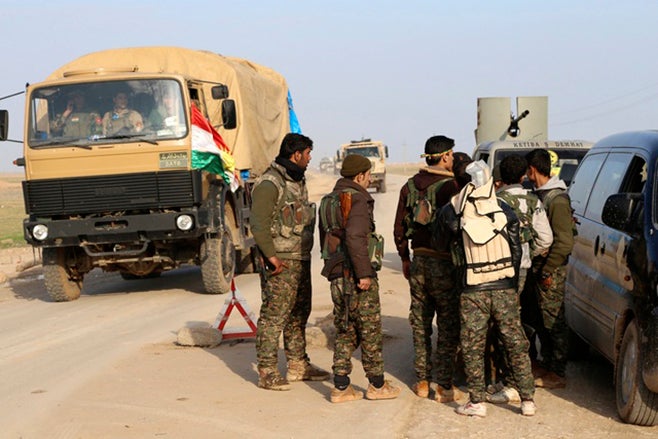
Military vehicles pass as Kurdish People's Protection Units (YPG) and Kurdistan Workers Party (PKK) fighters man a checkpoint north of Mount Sinjar, Iraq on December 20, 2014.
© 2014 Reuters
Enlarge
RELATED MATERIALS:
World Report 2015: Iraq
JANUARY 11, 2015
Iraqi Kurdish forces have confined thousands of Arabs in “security zones” in areas of northern Iraq that they have captured since August 2014 from the extremist group Islamic State, also known as ISIS. Kurdish forces for months barred Arabs displaced by fighting from returning to their homes in portions of Ninewa and Erbil provinces, while permitting Kurds to return to those areas and even to move into homes of Arabs who fled. Some restrictions were eased in January 2015, after Human Rights Watch communicated with the Kurdish regional government about the issue, but others remain.
Local Kurds told Human Rights Watch that Iraqi Kurdish citizens or forces of the Kurdistan Regional Government (KRG) have destroyed dozens of Arab homes in the areas, which the KRG appears to be seeking to incorporate into Kurdish autonomous territory. Arab residents in one cordoned-off zone said that KRG forces detained 70 local Arab men for long periods without charge.
“Cordoning off Arab residents and refusing to let them return home appears to go well beyond a reasonable security response to the ISIS threat,” said Letta Tayler, senior terrorism and counterterrorism researcher at Human Rights Watch. “The US and other countries arming the Iraqi Kurdish forces should make clear that they won’t stand for discrimination under the guise of countering terrorism.”
Human Rights Watch found no evidence of Kurdish forces imposing similar restrictions on movements of Kurds. The regional government is a key ally of the United States-led coalition fighting ISIS. The US has pledged $350 million to create three new brigades of the Kurdish military force, the Peshmerga.Germany, the UK, Italy, France, the Czech Republic, and Albania also are arming or training Peshmerga forces.
Human Rights Watch raised its concerns about ethnic discrimination with KRG authorities in December and in a January 20 letter. In a statement to Human Rights Watch, the regional government denied any ethnic discrimination but pledged to investigate the Human Rights Watch findings. In January, Kurdish military and intelligence forces eased several of the restrictions.
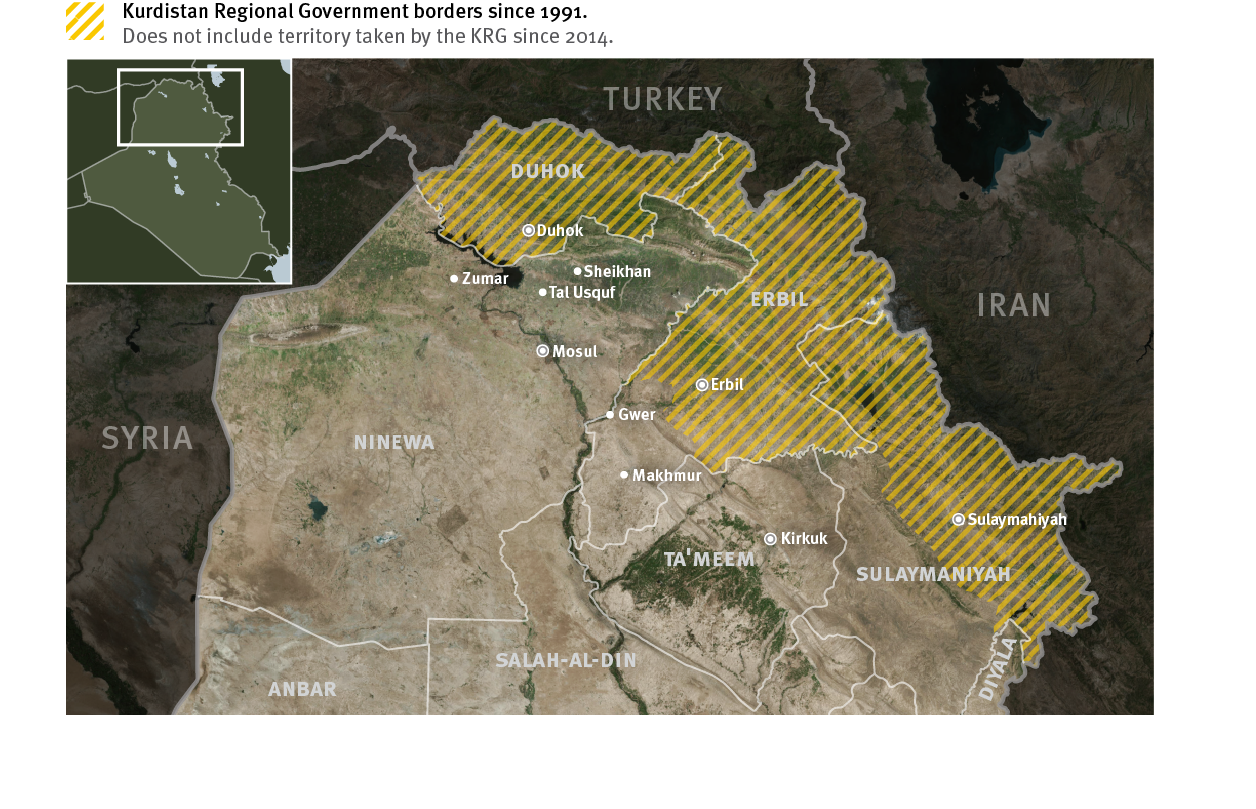
Human Rights Watch documented the apparently discriminatory acts in communities inSheikhan and Tilkaif districts and Zumar subdistrict, all in Ninewa province, and Makhmur district in Erbil province, while visiting these areas in December and January. The areas are part of the so-called disputed territories that both the regional government and Iraq’s central government in Baghdad claim.
With the exception of Sheikhan, which is governed by the KRG, the districts had been under the central Iraqi government’s authority until ISIS captured portions of them in mid-2014. Many of the districts’ residents – an ethnically diverse population of 600,000 – fled before ISIS captured their areas. Others stayed put because the fighting did not reach their towns, while others, primarily Sunni Arabs, were trapped or chose to stay inside ISIS-held territory.
Backed by US airstrikes, Kurdish forces wrested several communities in or near the districts from ISIS between August and October. Other parts of the districts remain under ISIS control and sporadic fighting has continued between ISIS and Peshmerga forces. Most of the towns and villages where Human Rights Watch found apparently unlawful conduct by Kurdish forces were directly behind or near the front line with ISIS.
Human Rights Watch has extensively documented crimes against humanity and other atrocities by ISIS in Syria and Iraq, as well as violations by the Syrian and Iraqi forces and allied militia.
In December Human Rights Watch saw Peshmerga and members of the KRG’s Asayish intelligence service turning away all civilians – including Arabs and Kurds – from some parts of these districts that they had captured, saying they were still too dangerous to resettle or visit because of the proximity of ISIS, ongoing fighting, and unexploded ordnance including booby-traps in homes. However Human Rights Watch found that Peshmerga and Asayish forces were allowing Kurdish residents who had fled the fighting to return to other towns and villages in these same districts that they deemed relatively safe, while denying displaced Arab residents re-entry to these same areas.
Local Asayish officials confirmed the bans at the time, telling Human Rights Watch at checkpoints into the four districts that “No Arabs are allowed.”
In its February 5 response to Human Rights Watch, which included comments from the Ministries of Interior, Peshmerga, and Asayish, the KRG said upholding human rights was a “main priority.” The statement said that regional government authorities have repeatedly instructed security forces, including immediately after receiving the Human Rights Watch letter, that “no one is above the law” and that all violators “will be held accountable.” In December, however, some Kurdish officials in meetings with Human Rights Watch defended restrictions singling out Arab residents, saying that many Arabs had assisted the ISIS advance and might again collaborate with the armed group, which is predominantly Sunni Arab.

