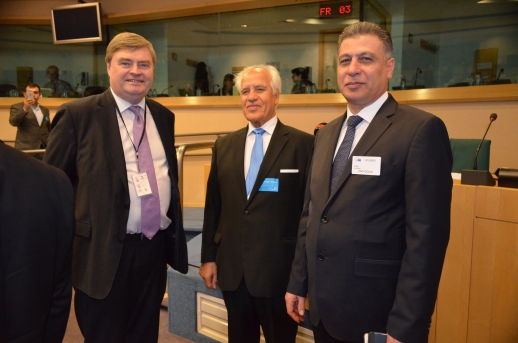
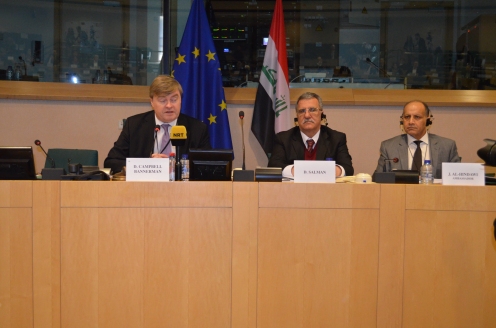
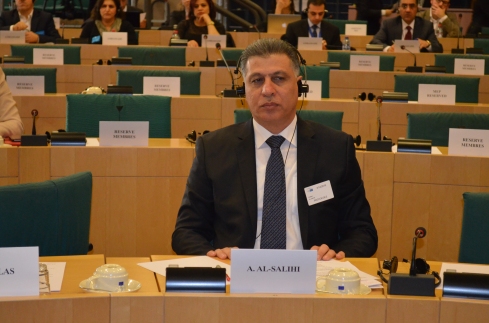
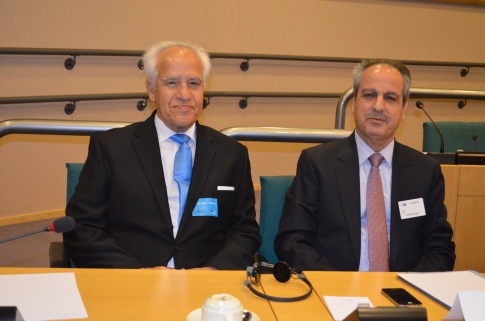
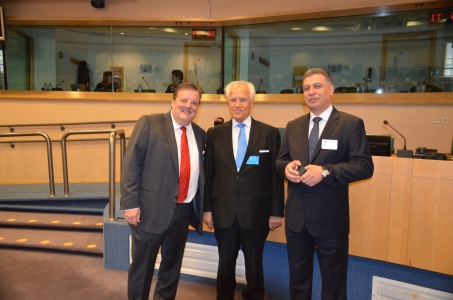
Dr. Hassan Aydinli, Iraqi Turkmen Front EU Representative and Mr. Niyazi Mimar Oğlu, Member of the Iraqi Council of Representatives were invited as guest speakers at the Delegation for Relations with Iraq Meeting at the EU Parliament in Strasbourg.
Hereunder the official Minutes of the Meeting:
DELEGATION FOR RELATIONS WITH IRAQ MEETING AT THE EUROPEAN PARLIAMENT
D-IQ_PV(2015)0610
MINUTES
of
the meeting of 10 June 2015, 15.00-17.00
The meeting opened at 15.00 on Wednesday, 10 June 2015,
with David Campbell Bannerman (Chair)
presiding.
1. Chair’s announcements
Mr Brian Hayes
(EPP - IRELAND), welcomed guest speakers from the Yazidi, Turkmen and
Chaldean/Syriac/Assyrian communities in Iraq. He reminded the audience that the
EU supports those actors who promote national reconciliation processes in Iraq,
including Iraqi institutions promoting the creation of an inclusive Iraqi
National Guard. In this regard, he announced that he recently met with the
Speaker of the Iraqi Council of Representatives, Mr Al-Jabouri, at a joint
AFET-DEVE meeting dedicated to the humanitarian response plan for Iraq. The
outcome of this meeting was positive.
2. Adoption of draft agenda (PE 553.741)
The agenda was adopted.
3. Adoption of minutes of the Delegation
meeting of 29 April 2015 (PE 553.735)
The minutes were adopted.
4. Exchange of views with the
Representatives of the 'Yazidi Democratic Movement' in Sinjar, created for the
fight against Daesh:
Mr. Said Hassan, a
representative of the 'Yazidi Democratic Movement', argued that the different
peoples living under dictatorships in the MENA region were forced to protest
against their respective regimes, a phenomenon commonly known as the Arab
Spring. Unfortunately, this phenomenon, he explained, generated a situation in
Iraq that threatens the survival of Iraqi minorities. Subsequently, he called
upon EU institutions and the UN Security Council to focus on Iraqi minorities
under risk of disappearing, particularly the Yazidi community.
In August 2014, DAESH killed thousands of Yazidi men in
Sinjar. This massacre, among others, is part of DAESH' destruction of Iraqi
heritage, an action that will result, in his opinion, in a major cultural loss.
In this regard, he thanked the Kurdish people for helping the Yazidi community,
which, he claimed, might face extinction. In order to avoid such extinction, a
constituent assembly has been established to govern the Yazidi community in
Mount Sinjar and the surrounding territories. Another governing body has been
established outside of Iraq to support Yazidi efforts inside Iraqi territory,
he explained.
Then, he argued that the Yazidi community has had to resort
to the creation of its own forces, as Iraqi forces do not guarantee their
security. In March 2015, the Yazidi community formed its own forces, which now
operate in Sinjar. According to him, if they had had more weapons and military
backup, they could have hired more people to fight against DAESH. He called
upon the international community and the EU to support the Yazidi forces, as it
is not acceptable to permit the extinction of ancient minorities such as the
Yazidi community.
Mr. Nouri Mirza, a
member of the 'Yazidi Democratic Movement', thanked the EU for inviting Yazidi
representatives to speak about their current situation in Iraq. He argued that
the international community is paying little attention to the Yazidi community,
which is suffering DAESH' atrocities, among them the Sinjar massacre. As a
board member of the Yazidi Democratic Movement, he stated that the conditions
faced by the Yazidi community are severe. He explained how this community has
been displaced through Iraq, Syria and Turkey. According to statistics, more
than 5.000 Yazidi people have been kidnaped by DAESH; most of them women and
children. Also, 11 massive graves have been found containing bodies of Yazidi
people, and the holy places of this community have been destroyed by DAESH.
He then provided an example: in August and September 2014,
DAESH militants in northern Iraq perpetrated a massacre in the village of
Kocho, and abducted women and children. Before said event, there were 344
Yazidi families living in Kocho, that is 1738 Yazidi people. From this amount
of people, over 450 were killed by DAESH militants.
He called upon the international community to help Yazidi
refugees. He thanked the Iraqi Kurdistan for hosting the Yazidi community,
which has been settled in camps. The conditions in these camps are not proper;
he argued. Refugees lack access to medical health care, being diseases common.
Also, over 10.000 people are hiding in the Sinjar Mountain receiving no help
from the international community. They have no water, tents, weapons, nor
clothing.
5. Exchange of views with the representatives
of minority communities in Iraq:
Mr David Campbell
Bannerman (ECR-UK, Delegation Chair), resumed his role as Chair of the
Delegation.
Dr. Hassan Tawfiq
Aydinli, Iraqi Turkmen Front EU Representative, thanked the EU for inviting
Iraqi representatives to speak for an EU audience. He focused his contribution
on two of the main problems faced by Turkmen in Iraq. Turkmen have been twice
internally displaced people: first under Saddam Hussein, and now under DAESH.
This has led to the loss of property. Reclaiming this property is difficult.
There is a Commission in charge of handling confiscations, properties and
related topics. Nevertheless, due to administrative difficulties and the
advance of DAESH, it has proven almost impossible for Turkmen to regain their
property. The other problem is the following: 300.000 Shia people belonging to
the Turkmen community have been forced to leave the community, as DAESH attacks
the Shia community. Defending the Shia Turkmen community is causing the death
of Turkmen, who receive no help from the Iraqi government nor the Peshmerga.
Mr. Niyazi Mimar Oglu, a member Iraqi Council of
Representatives who has been targeted 28 times, also thanked the EU for
inviting Turkmen representatives to discuss the concerns of this community.
This community, he explained, is composed of over 2 million people. It faces
DAESH, and the differences between the government in Baghdad and that in the
Kurdish region. Many people have been killed, and many others have been forced
to flee. Others have been kidnapped.
The Turkmen believe in diplomacy, in formal negotiations, he
argued. However, given the circumstances, the Turkmen have been forced to
fight. The international community has ignored the difficulties faced by this
community, he emphasised. Also, the rights of this community have been
violated, and their territory -under the umbrella of the central government-,
reduced.
He sought to obtain international support for the Turkmen
community, and explained the need for stronger military action against DAESH.
Also, he stated that, from the entire EU funding to Iraq, the Turkmen did not
receive an euro.
Mr. David Campbell
Bannerman (ECR-UK, Delegation Chair) thanked the Turkmen guests for
travelling to EU and for their contributions.
Above: with Mr. Brian HAYES, Fine Gael MEP for Dublin, Ireland.
Member of the European People's Party.
He then gave the floor to
Assyrian representatives.
Mr. Sharbil Hanna
Matty, General of the Assyrian "Nineveh Plain Forces", thanked
the EU for the invitation to participate in the meeting. He referred to the
Assyrian people as a Christian nation looking for co-existence in Iraq,
partnership and equal rights. He thanked the Kurdistan region for hosting all
types of refugees, and urged the EU to support the Kurdish government and to
implement all the measures promised by the EU. They have received no military
support. The Peshmerga is currently training Christian Assyrian forces, yet
this is not enough. They need weapons; vehicles and clothing.
Furthermore, he stated that the Assyrian community seeks to
become an independent administration within the Kurdistan region. Also, he
expressed his support to other minorities and the willingness of the Assyrian
community to work with other communities towards a common project, that is, a
unified and democratic Iraq. In order to achieve this project, he explained,
the support of the European Union is needed. The EU needs to be involved in the
negotiations so that minorities are conceived of as equal partners, and so that
displaced people feel like returning to their homes.

MPE Mr. Gérard Deprez (Group
of the Alliance of Liberals and Democrats for Europe, Belgium) welcome the
willingness of the different minorities to work together towards an end of the
conflict. He then requested a clarification on whether these minorities are
seeking any sort of political or territorial autonomy. Also, he noted that,
despite the fact that all minorities feel part of Iraq, all the representatives
thanked the Peshmerga or the Kurdistan region rather than the Iraqi forces or
the central government. He asked what the Iraqi government could do for these
minorities; and whether the Iraqi government can guarantee their security.
MPE Mr. Afzal Khan (Group
of the Progressive Alliance of Socialists and Democrats in the European
Parliament, United Kingdom) asked the representatives of these minorities about
the emergence of DAESH. Other MPE
enquired about the deplorable situation in Kurdistan, and, in line to Mr.
Khan's question, asked about the emergence and success of DAESH, which is seen
as a protector of the Sunni people.
The representatives argued that their demand for autonomy was
not new, but a demand that was formulated in 2004 following the fall of the
Saddam regime. This autonomy is supported by the Iraqi constitution, they
explained, and does not imply the division of Iraq, but the creation of
autonomies within Iraq. The representatives of these minorities argued that
minorities look forward to have their own administrations and to achieve
equality, and that they support each other in their aspirations. They also
asserted that, when it comes to autonomy, all the difficulties faced by the
different communities in Iraq are rooted in the creation of Iraq following
World War I. They argued that if one part of Iraq is allowed to have its own
autonomy, so do other parts.
Furthermore, they argued that the Iraqi government does not
have the capacity to rule the country, and that minorities do not receive help
from the central government. These minorities are settled between DAESH and the
Kurdish region. Consequently, following the fall of the Saddam regime, the
Kurdish region became the ally of these minorities, who ask for equal access to
help.
In regard to the emergence of DAESH, they argued that it is
an organisation that rose in a space where it could expand itself. Also, there
is a theory that DAESH has been created in order to design a new Middle East
map. Anyway, they argued, the different parties in Iraq were not able to
coordinate themselves, particularly with the Iraqi government, making it
difficult to act cohesively against DAESH. Moreover, they underlined that
people joining DAESH do so because they have not been able to find a place
within their respective countries, from Saddam's former military heads in Iraq
to European militants joining the ranks of DAESH.
Finally, the called upon the EU to support internally
displaced people as well as the reconstruction of Iraq. They called for
resolutions to be implemented. They argued that people is losing hope in the
international community.
A representative from the Iraqi Embassy argued that Iraq is a
democratic country, since all minorities do have representatives in the central
government. He argued that these representatives should express their concerns
to their elected members of parliament. Iraq has financial issues, and this has
to be taken into consideration.
6. Any other business
None.
7. Date and place of next meeting
The meeting closed at 17.00.
The following MEPS attended the meeting:
David Campbell Bannerman, Brian Hayes, Javier Couso
Permuy, Joëlle
Bergeron, Gérard Deprez, Ana Gomes, Michel Reimon, Afzal
Khan, Branislav Škripek, György Hölvényi, Bas Belder