
mardi 15 janvier 2013

dimanche 13 janvier 2013
Ministry of Peshmerga negotiator delegation arrived on Sunday to Baghdad and held a meeting with Iraqi government military delegation.
BAGHDAD,shafaaq.com | ninanews.com – 13.1.2013 –
A member of the parliamentary Committee on Security and Defense, Hassan Jihad declared that the meeting between the delegations of the Kurdistan military Ministry of Peshmerga and the federal government has started on the military presence in the disputed areas. He said in a statement to the National Iraqi News Agency that “Peshmerga’s delegation arrived Sunday, January 13, to Baghdad, and it is currently holding a meeting with military representatives of the Federal Government.”
Jihad added: “The previous meetings of the two military delegations in Baghdad and Erbil had brought the views of both sides closer, so it is hoped that today’s meeting is the last one to reach a final agreement on the management of the security file in the disputed areas.” The two delegations had met earlier this month, in Erbil to discuss the mechanism of the deployment and the presence of the security force in the disputed areas, as the first meeting was held in Baghdad last week and resulted in a principle agreement to resolve the crisis rose in those areas. The Ministry of Peshmerga in the Kurdistan Regional Government KRG announced earlier that its delegation to Baghdad is carrying a worksheet of nine points, but did not explain the nature of these points.
The Problem with Human Rights/Humanitarian Law Taking Precedence over the Nuremberg Principle: Torture is Wrong but So Is the Supreme War Crime
http://antiwar.com/blog/2013/01/10/the-problem-with-human-rightshumanitarian-law-taking-precedence-over-the-nuremberg-principle-torture-is-wrong-but-so-is-the-supreme-war-crime/
Posted By Coleen Rowley
A number of human rights issues converge on Friday January 11, 2013. In Washington DC [1] and many other cities around the country, including the Twin Cities [2], people will don orange “Gitmo” jumpsuits and black hoods to protest the 11th year anniversary-travesty of Guantanamo as well as the (bizarrely coincidental) national release of the despicable, CIA-inspired “zero conscience” film [3]that falsely conveys the message that torture “works” and is somehow heroic.
The third, far less known issue involves the resignation (effective on January 11) of Suzanne Nossel, Director of Amnesty International-USA. Her resignation after only one year as American Director would be unimportant except for how it exposes more fundamental problems involving the way human rights principles during peace time and humanitarian rules governing warfare can function to undercut the more well established jus ad bellum prohibitions, under international law, of launching wars of choice. Nossel’s statement itself gave little clue of the more fundamental problematic issues underlying her resignation (except for the fact that she only mentioned her appreciation for working to uphold “human rights” in the Soviet Union, Afghanistan, Myanmar and Syria but left out the human rights violations that the US-NATO-Israel is responsible for).
There’s no need to rehash the points we tried to make in “Amnesty’s Shilling for US Wars [4]” (co-authored with Col Ret’d Ann Wright) and “Are Human Rights Becoming a Tool of US ‘Smart Power? [5]” which described the way Nossel personified [6] some of these revolving door conflicts of interest plaguing human rights and humanitarian non-governmental organizations (NGOs) based in the West. It’s simply not possible for anyone to constantly go back and forth from serving US national interests vis a vis other nation-state sovereigns in the world to the theoretically loftier role of promoting human rights around the world as head of a non-governmental organization whose credibility depends upon not being aligned with any country’s national interests.
To be sure, these conflicts of interest did not begin with Suzanne Nossel but have a long history [7]which also reside in the NGO’s donor base according to former Amnesty-USA Board member Francis Boyle [8]. There seems to be an even more fundamental problem, however, engulfing not only Amnesty but a great many other “human rights” NGOs and academics based in the United States and its western allies. Amnesty’s verbatim response back in June to our “Amnesty Shilling for Wars” article was telling:
Among many distortions in this post, it is ludicrous, offensive and irresponsible to suggest that Amnesty International USA’s work on Afghan women’s rights is being scripted by the Central Intelligence Agency “Red Cell” report of 2010. Amnesty International has been monitoring and reporting on Afghanistan for decades, and we have been issuing statements and reports pertaining to the human rights of women in Afghanistan since at least the 1990s.
AI’s advocacy is based on our own independent research into human rights abuses in a given country. As a matter of longstanding policy, we remain independent of governments, we do not espouse political ideologies or systems of governance, and we do not take positions on armed intervention. We did not call for NATO’s involvement in Afghanistan, we are not calling for NATO to remain in the country, and we are not praising NATO’s actions in Afghanistan or elsewhere. The Shadow Summitwas exclusively about the right of women in Afghanistan to participate in political decisions that will impact their lives. In order to press for them to be at the table, it was necessary to direct our message to the entities who set the table. This is no way breaches our independence or impartiality.
Apparently this “longstanding policy” also led Amnesty and Human Rights Watch to take no position regarding the US launching of the Iraq War in spite of large world-wide protests as well as widespread knowledge, including amongst key UN officials and monitoring agencies, that US politicians were deceptively ginning up a “war of choice” on Iraq. Moreover, such a “policy” simply ignores the entire huge body of international law known as jus ad bellum or “just war theory” upon which the Kellogg Briand Pact, UN Charter and Nuremberg Principles are based, premised upon nation-state sovereignty and equality. Firmly established international law holds that a nation commits the “supreme crime” by launching an unjustified “war of aggression” since such a war tends to give rise to and encompass the other (lesser) war crimes and humanitarian abuses. Countries are consequently prohibited from launching such “wars of choice” as tools of foreign policy. So any “non-governmental organization” that dismisses jus ad bellum and states it’s only concerned with the two bodies of international “human rights” and “humanitarian law of warfare” (jus in bello military law, i.e. which aims to restrict hurting and killing of civilians and prisoners of war as well as prohibiting the use of torture and cruel and inhumane treatment during warfare) is choosing to see the trees instead of the forest.
In fact the common theme of US government and military lawyers since 9-11 has fully borne out the rationale for the Nuremberg Principle, that wars of aggression are the supreme crime. US militarists have essentially argued the need to “go to the dark side”, because the jus in bello “humanitarian law of warfare” is “increasingly obsolete” and/or has failed to keep pace with how “terrorists” operate outside the Geneva Conventions. One might imagine some of the British Redcoats similarly pleading with the King to bend their rigid rules and regimentation in order to more effectively combat the American revolutionary soldiers who were picking them off from behind trees and fighting more of a guerrilla war. Simply put, ignoring the commission of the “supreme crime” will inherently and always lead to a certain amount of hypocrisy and complicity.
International law professor Richard Falk recently gave a rather long interview on the “The Future of International Law and Human Rights” in which he was asked about this. He generously described this issue as “tricky”, explaining that:
Human rights and international criminal law both illustrate the contradictory potential of international law. On one level, the imposition of human rights norms is a restraint on interventionary diplomacy, especially if coupled with respect for the legal norm of self-determination. But on another level, the protection of human rights creates a pretext for intervention as given approval by the UN Security Council in the form of the R2P (responsibility to protect) norm, as used in the 2011 Libyan intervention.
Posted By Coleen Rowley
On January 10, 2013
A number of human rights issues converge on Friday January 11, 2013. In Washington DC [1] and many other cities around the country, including the Twin Cities [2], people will don orange “Gitmo” jumpsuits and black hoods to protest the 11th year anniversary-travesty of Guantanamo as well as the (bizarrely coincidental) national release of the despicable, CIA-inspired “zero conscience” film [3]that falsely conveys the message that torture “works” and is somehow heroic.
The third, far less known issue involves the resignation (effective on January 11) of Suzanne Nossel, Director of Amnesty International-USA. Her resignation after only one year as American Director would be unimportant except for how it exposes more fundamental problems involving the way human rights principles during peace time and humanitarian rules governing warfare can function to undercut the more well established jus ad bellum prohibitions, under international law, of launching wars of choice. Nossel’s statement itself gave little clue of the more fundamental problematic issues underlying her resignation (except for the fact that she only mentioned her appreciation for working to uphold “human rights” in the Soviet Union, Afghanistan, Myanmar and Syria but left out the human rights violations that the US-NATO-Israel is responsible for).
There’s no need to rehash the points we tried to make in “Amnesty’s Shilling for US Wars [4]” (co-authored with Col Ret’d Ann Wright) and “Are Human Rights Becoming a Tool of US ‘Smart Power? [5]” which described the way Nossel personified [6] some of these revolving door conflicts of interest plaguing human rights and humanitarian non-governmental organizations (NGOs) based in the West. It’s simply not possible for anyone to constantly go back and forth from serving US national interests vis a vis other nation-state sovereigns in the world to the theoretically loftier role of promoting human rights around the world as head of a non-governmental organization whose credibility depends upon not being aligned with any country’s national interests.
To be sure, these conflicts of interest did not begin with Suzanne Nossel but have a long history [7]which also reside in the NGO’s donor base according to former Amnesty-USA Board member Francis Boyle [8]. There seems to be an even more fundamental problem, however, engulfing not only Amnesty but a great many other “human rights” NGOs and academics based in the United States and its western allies. Amnesty’s verbatim response back in June to our “Amnesty Shilling for Wars” article was telling:
Among many distortions in this post, it is ludicrous, offensive and irresponsible to suggest that Amnesty International USA’s work on Afghan women’s rights is being scripted by the Central Intelligence Agency “Red Cell” report of 2010. Amnesty International has been monitoring and reporting on Afghanistan for decades, and we have been issuing statements and reports pertaining to the human rights of women in Afghanistan since at least the 1990s.
AI’s advocacy is based on our own independent research into human rights abuses in a given country. As a matter of longstanding policy, we remain independent of governments, we do not espouse political ideologies or systems of governance, and we do not take positions on armed intervention. We did not call for NATO’s involvement in Afghanistan, we are not calling for NATO to remain in the country, and we are not praising NATO’s actions in Afghanistan or elsewhere. The Shadow Summitwas exclusively about the right of women in Afghanistan to participate in political decisions that will impact their lives. In order to press for them to be at the table, it was necessary to direct our message to the entities who set the table. This is no way breaches our independence or impartiality.
Apparently this “longstanding policy” also led Amnesty and Human Rights Watch to take no position regarding the US launching of the Iraq War in spite of large world-wide protests as well as widespread knowledge, including amongst key UN officials and monitoring agencies, that US politicians were deceptively ginning up a “war of choice” on Iraq. Moreover, such a “policy” simply ignores the entire huge body of international law known as jus ad bellum or “just war theory” upon which the Kellogg Briand Pact, UN Charter and Nuremberg Principles are based, premised upon nation-state sovereignty and equality. Firmly established international law holds that a nation commits the “supreme crime” by launching an unjustified “war of aggression” since such a war tends to give rise to and encompass the other (lesser) war crimes and humanitarian abuses. Countries are consequently prohibited from launching such “wars of choice” as tools of foreign policy. So any “non-governmental organization” that dismisses jus ad bellum and states it’s only concerned with the two bodies of international “human rights” and “humanitarian law of warfare” (jus in bello military law, i.e. which aims to restrict hurting and killing of civilians and prisoners of war as well as prohibiting the use of torture and cruel and inhumane treatment during warfare) is choosing to see the trees instead of the forest.
In fact the common theme of US government and military lawyers since 9-11 has fully borne out the rationale for the Nuremberg Principle, that wars of aggression are the supreme crime. US militarists have essentially argued the need to “go to the dark side”, because the jus in bello “humanitarian law of warfare” is “increasingly obsolete” and/or has failed to keep pace with how “terrorists” operate outside the Geneva Conventions. One might imagine some of the British Redcoats similarly pleading with the King to bend their rigid rules and regimentation in order to more effectively combat the American revolutionary soldiers who were picking them off from behind trees and fighting more of a guerrilla war. Simply put, ignoring the commission of the “supreme crime” will inherently and always lead to a certain amount of hypocrisy and complicity.
International law professor Richard Falk recently gave a rather long interview on the “The Future of International Law and Human Rights” in which he was asked about this. He generously described this issue as “tricky”, explaining that:
Human rights and international criminal law both illustrate the contradictory potential of international law. On one level, the imposition of human rights norms is a restraint on interventionary diplomacy, especially if coupled with respect for the legal norm of self-determination. But on another level, the protection of human rights creates a pretext for intervention as given approval by the UN Security Council in the form of the R2P (responsibility to protect) norm, as used in the 2011 Libyan intervention.
samedi 12 janvier 2013
The PKK bookkeeper and cover-up
|
Abdullah
Bozkurt
|
|
|
|
|
|
The execution-style assassination of
Sakine Cansız, a top financier for the terrorist Kurdistan Workers' Party
(PKK) in Europe, in a building on busy Rue Lafayette behind the Gare du Nord,
one of the main train stations in
|
|
|
|
|
|
There are lots of
speculations surrounding the deaths of Cansız and two other Kurdish women who
were found on Thursday in the Centre d'Information du Kurdistan (Information
Center of Kurdistan) in
It can be read as a
warning message to the PKK leadership in northern Iraq that if they were to
relocate to a third country in Europe as part of a peace deal in the ongoing
negotiations between the Turkish government and jailed PKK leader Abdullah
Öcalan, “You won't be safe even if you settle in downtown Paris after you
decide to give up your fight against Turkey and lay down your arms.”
Though all these
explanations have a valid point, my guess is that it has to do with money and
the huge financial operations worth hundreds of millions of dollars that
Cansız was managing on behalf of the Marxist-Leninist militant organization
that turned out to be a major racketeering network instead of a
freedom-fighting Kurdish political activist group. This criminal enterprise
is benefiting from illegal drug trafficking, human trafficking, extortions,
illegal tax levying, contract killings and disruptive sabotage operations. In
other words, they are guns for hire.
Cansız, who was one of
the co-founders of the PKK, raised money for the PKK across Europe, funneled
it to other PKK leaders located in the Kandil Mountains in northern Iraq, and
helped to fund arms and munitions for a conflict that has claimed the lives
of some 40,000 people over three decades, most of them Kurds. It is amazing
that she conducted all these financial transactions under the close scrutiny
of European security agencies, mainly French, British and German intelligence
monitoring units, which simply turned a blind eye to her travels and business
dealings for years.
Even when American
officials, acting under the
For example, when
Cansız was arrested in
Ever since PKK leader
Öcalan entered into negotiations with the Turkish government with pretty much
no preconditions following a year-and-a-half of mop up operations by Turkish
security forces that significantly diminished the ability of the terrorist
organization to successfully mount attacks against Turkish interests, it
seems that there has been a panic spreading among the backers of the PKK. The
supporters of the terrorist organization wanted to clean up their acts by
muzzling the people whom they have dealt with for years.
Cansız, as the leading
bookkeeper for the PKK in
It is interesting to
note that French President François Hollande said he and several politicians
knew one of the women professionally. He did not say which one. But the fact
that Hollande himself admitted that he had been involved with a group known
to have a clear affiliation with the PKK gave rise to further speculations
that the French establishment is deeply engaged with the organization listed
as a terrorist group by the US, the EU and Turkey. If we are to lend credence
to these allegations, how do we make sense of the ongoing judicial cases
initiated against the PKK in
As Turkish Interior
Minister İdris Naim Şahin announced recently, there has not been a single
extradition of a PKK terrorist from
Let's assume Cansız
could have been a key suspect or even a witness in these cases which the
French have started. Now that she, along with her secrets, is gone, we will
never know how the French investigations will eventually turn out. Whoever
ordered her killing was probably targeting the derailment of the ongoing
judicial cases against the PKK in
We know that Cansız
was part of a list of senior PKK leaders that the Turkish government wanted
and has in fact distributed to different countries, including
We will probably never
know exactly the motivations that played into the assassination of this
woman, rendering all explanations mere speculation. But suffice it to say,
whoever gave the order for the killing of Cansız, an accountant and arms
dealer, wanted to cover up her tracks in order to prevent embarrassing
revelations in the future.
The counterstrategy
for this dirty game is to stick strongly with the negotiations with those who
represent peace while continuing to fight the hard-core militants who have no
interest in laying down their arms. This should be complemented with strong
signals from
|
|
Procès - 21 janvier 2013 : Gilles Munier sur le banc des accusés

Procès - 21 janvier 2013 : Gilles Munier sur le banc des accusés
Revue de presse : 7 Jours (Rennes – 12/1/13)
Le Rennais Gilles Munier, connu depuis la fin des années 70 pour sa connaissance de l’Irak, puis pour son combat contre l’embargo, a été mis en examen par le juge Philippe Courroye en octobre 2005 dans l’affaire dite « Pétrole contre nourriture », pour « trafic d’influence passif » et « corruption d’agents publics étrangers », autrement dit pour « avoir violé une résolution de l’ONU ». L’enquête de la brigade financière n’a pas décelé d’enrichissement personnel. Il sera jugé à partir du 21 janvier devant le tribunal correctionnel de Paris, avec une quinzaine de personnalités dont deux ambassadeurs de France, Charles Pasqua et Christophe de Margerie, patron de la société Total. Retour rapide sur une affaire qui ne manque pas de zones d’ombre.
Dans les mois qui précédèrent la Première guerre du Golfe (janvier 1990), l’Irak fut placé sous embargo international, ce qui provoqua, au final, une crise humanitaire grave. En 1996, les Nations unies furent alors obligées de mettre en place un programme spécial supposé plus adapté, appelé « Pétrole contre nourriture » : les Irakiens gardaient la maîtrise de leurs achats de produits autorisés à l’importation, mais leur règlement était effectué par des fonctionnaires de l’ONU sur un compte bloqué, alimenté par les ventes de pétrole irakien dont le prix était fixé par l’ONU.
Asphyxié financièrement, l’Etat irakien s’est d’abord tourné vers les grandes compagnies pétrolières - notamment Chevron que dirigeait Condoleeza Rice, future Secrétaire d’Etat de George Bush fils - leur demandant d’agir en coulisse pour faire lever les sanctions. Les tankers emportèrent le brut, mais les compagnies n’intervinrent pas. Suite à l’échec de cette opération, l’Irak s’adressa aux pétroliers de moindre importance. Avec l’accord de Tarek Aziz – vice-Premier ministre irakien – Gilles Munier obtint qu’un trader pétrolier français disposant des autorisations du Quai d’Orsay, du ministère de la Défense et de l’Onu, finance – sur sa marge bénéficiaire - les Amitiés franco-irakiennes dont il est secrétaire général depuis 1985. Il pu ainsi organiser des conférences internationales, des expositions, des voyages d’information en Irak, et publier - dans Le Monde et l’Herald Tribune - des placards publicitaires contre l’embargo. « Toutes mes activités étaient connues du Bureau de mon association et des services français à Paris : Quai d’Orsay, Bercy, Défense, DST, DGSE... parce que rien n’était secret ».
Trois jours de garde à vue
Il a fallu que le juge Courroye soit de retour des Etats-Unis, à l’approche de l’élection présidentielle où son ami Nicolas Sarkozy se présentait, pour que plusieurs membres du supposé lobby gaulliste pro-irakien soient interrogés, mis en examen, puis libérés contre le versement d’une caution. Pour Gilles Munier, gardé à vue trois jours, son montant était de 80 000 euros - rabaissée à 50 000 par Jacques Vergès, son avocat – avec en prime une interdiction de sortir de France métropolitaine. « Courroye m’a pourri la vie pendant 8 ans, m’a empêché de mener à bien des projets de reconversion. J’ai même reçu des menaces de mort… », dit-il.
Au-delà de son cas, Gilles Munier espère que le procès qui va s’ouvrir permettra d’évoquer le « génocide » dont le peuple irakien a été victime « car sans ces centaines de milliers de morts – dont 1,5 million d’enfants selon l’ONU - il n’y aurait pas eu d’affaire « Pétrole contre nourriture ». Il voudrait aussi savoir pourquoi la « justice internationale » n’est appliquée qu’en France, pourquoi les trafiquants alimentant le marché noir en pétrole irakien n’ont jamais été inquiétés, et pourquoi les enquêteurs des Nations unies qui suivaient une piste impliquant l’armée américaine, ayant trouvé porte close au Pentagone, n’ont pas crié au scandale et ameuté les médias. Tout cela, « peut-être parce qu’il fallait punir la France de son vote anti-guerre à l’Onu en février 2003, trouver des victimes expiatoires, faire élire un président pro-américain. Ainsi va le monde… », conclu-t-il un brin fataliste.
Le procès devrait durer trois semaines.
mardi 8 janvier 2013
Emergency Session of Iraqi Parliament Indicates Size of Opposition to Maliki
Posted by Reidar Visser on Monday, 7 January 2013
Yesterday’s attempted emergency session of the Iraqi parliament was an important expression of how recent weeks of protests in Iraq translate into parliamentary arithmetic.

dimanche 6 janvier 2013
“Wiping Countries Off the Map”: Who’s Failing the “Failed States”
Washington is in the "business of destroying" a very long list of countries.
By Prof Michel Chossudovsky
Global Research, December 29, 2012
http://www.globalresearch.ca/destroying-countries-transforming-syria-into-a-failed-state/5317160
“Across the world, a dangerous rumor has spread that could have catastrophic implications. According to legend, Iran’s President has threatened to destroy Israel, or, to quote the misquote, “Israel must be wiped off the map”. Contrary to popular belief, this statement was never made, …” (Arash Norouzi, Wiped off The Map: The Rumor of the Century January 2007)
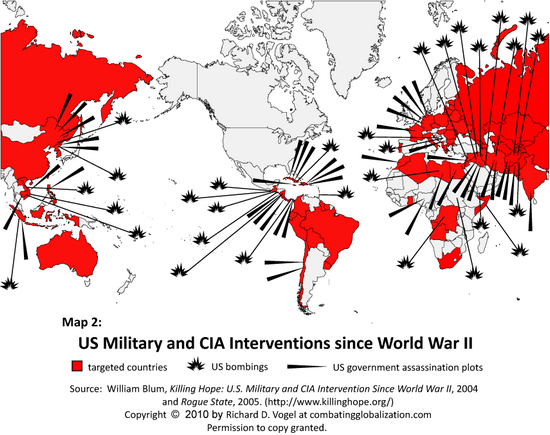
“The United States has attacked, directly or indirectly, some 44 countries throughout the world since August 1945, a number of them many times. The avowed objective of these military interventions has been to effect “regime change”. The cloaks of “human rights” and of “democracy” were invariably evoked to justify what were unilateral and illegal acts. (Professor Eric Waddell, The United States’ Global Military Crusade (1945- ), Global Research, February 2007
“This is a [Pentagon] memo that describes how we’re going to take out seven countries in five years, starting with Iraq, and then Syria, Lebanon, Libya, Somalia, Sudan and, finishing off, Iran.” I said, “Is it classified?” He said, “Yes, sir.” I said, “Well, don’t show it to me.” (General Wesley Clark, Democracy Now, March 2, 2007)
SEE: http://www.globalresearch.ca/we-re-going-to-take-out-7-countries-in-5-years-iraq-syria-lebanon-libya-somalia-sudan-iran/5166
* * *
Washington is in the “business of destroying” a very long list of countries.
Who is “Wiping Countries off the Map”? Iran or the United States?
During a period which is euphemistically called the “post-war era” –extending from 1945 to the present–, the US has directly or indirectly attacked more than 40 countries.
While the tenets of US foreign policy are predicated on the “spread of democracy”, US interventionism –through military means and covert operations– has resulted in the outright destabilization and partition of sovereign nations.
Destroying countries is part of a US Imperial project, a process of global domination. Moreover, according to official sources, the US has a total of 737 military bases in foreign countries. (2005 data)
Continued....
By Prof Michel Chossudovsky
Global Research, December 29, 2012
http://www.globalresearch.ca/destroying-countries-transforming-syria-into-a-failed-state/5317160
“Across the world, a dangerous rumor has spread that could have catastrophic implications. According to legend, Iran’s President has threatened to destroy Israel, or, to quote the misquote, “Israel must be wiped off the map”. Contrary to popular belief, this statement was never made, …” (Arash Norouzi, Wiped off The Map: The Rumor of the Century January 2007)
“The United States has attacked, directly or indirectly, some 44 countries throughout the world since August 1945, a number of them many times. The avowed objective of these military interventions has been to effect “regime change”. The cloaks of “human rights” and of “democracy” were invariably evoked to justify what were unilateral and illegal acts. (Professor Eric Waddell, The United States’ Global Military Crusade (1945- ), Global Research, February 2007
“This is a [Pentagon] memo that describes how we’re going to take out seven countries in five years, starting with Iraq, and then Syria, Lebanon, Libya, Somalia, Sudan and, finishing off, Iran.” I said, “Is it classified?” He said, “Yes, sir.” I said, “Well, don’t show it to me.” (General Wesley Clark, Democracy Now, March 2, 2007)
SEE: http://www.globalresearch.ca/we-re-going-to-take-out-7-countries-in-5-years-iraq-syria-lebanon-libya-somalia-sudan-iran/5166
* * *
Washington is in the “business of destroying” a very long list of countries.
Who is “Wiping Countries off the Map”? Iran or the United States?
During a period which is euphemistically called the “post-war era” –extending from 1945 to the present–, the US has directly or indirectly attacked more than 40 countries.
While the tenets of US foreign policy are predicated on the “spread of democracy”, US interventionism –through military means and covert operations– has resulted in the outright destabilization and partition of sovereign nations.
Destroying countries is part of a US Imperial project, a process of global domination. Moreover, according to official sources, the US has a total of 737 military bases in foreign countries. (2005 data)
Continued....
Jalal Talabani is clinically dead
Berlin – January 5, 2013 AFP – Figaro – 5.1.2013 – Kurdish political sources said that Iraqi president and Kurdish leader Jalal Talabani is “clinically dead” in Berlin hospital where he is treated, the French “Le Figaro” newspaper reported .
Hospitalized for more than fifteen days in Berlin for a stroke, Jalal Talabani, reportedly his health is at its worst, his German doctors feel that he is “too ill to be able to recover” from his stroke, which occurred three weeks ago in Baghdad, Iraq. Currently, the Germans are just trying to keep him alive, also a Kurdish sources said that the Kurdish leader, aged 79, is “clinically dead.” The Iraqi Presidency Office had issued a statement as a response for the French newspaper Figaro which published that the President’s health is deteriorating; the statement said that the President’s health condition is assuring and he is responding for the treatments.
Inscription à :
Articles (Atom)
