jeudi 20 février 2014

Iraqi Turkmen leader’s convoy attacked

Iraqi Turkmen leader’s convoy attacked
"My house was bombed twice and my convoy was attacked three times with a bomb," he said.


A land mine detonated while Salihi's convoy was passing near Musalla district.
World Bulletin / News Desk

A convoy with Iraqi Turkmen Front (ITF) chief Arshad al-Salihi was attacked with remote controlled mines in Iraq's Kirkuk province on Wednesday.


Salihi was unharmed but his two security guards were injured and six vehicles were damaged.

A land mine was detonated while the convoy was passing near Musalla district. The armored vehicle carrying Salihi was heavily damaged in the blast.

The ITF chief told AA that they returned to visit Musalla for election campaigns when the blast happened.

"The windows of my armored vehicle were smashed due to the attack. The vehicles of my security staff were not armored. If the land mine had detonated near them, the number of casualties would have been higher," said Salihi.

Salihi said it is the second assassination attempt targeting him within two months.

"My house was bombed twice and my convoy was attacked three times with a bomb," he said.

Anbar crisis: IOM Iraq updated map on IDP displacement and destination

Anbar crisis: IOM Iraq updated map on IDP displacement and destination
Click on picture to enlarge

mercredi 19 février 2014

A Comprehensive Strategy Against Terrorism - Nouri al-Maliki


A Comprehensive Strategy Against Terrorism : Iraq is using all the political, economic, and military tools at its disposal in its effort to defeat al Qaeda.
BY Nouri al-Maliki – FOREIGN POLICY

FEBRUARY 18, 2014 – BAGHDAD — When al Qaeda and other terrorist groups attacked Anbar province in late December and temporarily took control of parts of the cities of Fallujah and Ramadi, U.S. Secretary of State John Kerry said, “This is a fight that belongs to the Iraqis.”


Indeed this is our fight. More than two years after American troops left Iraq, with violent extremist groups such as al Qaeda resurgent, Iraq accepts that it is our responsibility to defeat them militarily, to isolate them politically, and to create the social and economic conditions that will deny them any local support in the future.

While the battle against al Qaeda in Anbar province is Iraq’s fight, it is part of a larger struggle against terrorism that threatens our neighbors in the Middle East and North Africa and also endangers the United States and the entire world community. The terrorism we face is transnational in nature, and defeating it will require international collaboration, including a strong partnership between the United States and Iraq. As President Barack Obama emphasized in his State of the Union address, we need to work together as partners to “disrupt and disable” terrorist networks. Both the United States and Iraq, then, have much to gain by making the shared effort against our shared enemies.

In order to defend and rebuild our country, Iraq needs American equipment and American know-how, as well as private investment in our own country and strategic coordination in our region. Such common efforts against common enemies in pursuit of common goals are the object of the Strategic Framework Agreement that the United States and Iraq signed before the withdrawal of American troops in 2011.

Iraq is not a protectorate; we are a partner. Iraqis are grateful to the U.S. troops who served in our country, some of whom made the ultimate sacrifice. But today Iraq is a sovereign country that does not need American boots on the ground.

In that spirit of partnership, I want to share the thinking behind our efforts to defend our country against terrorism. Over the last decade, the Iraqi people and their elected leaders have learned many lessons. We understand that a purely military approach will not succeed in stopping terrorism, much less in healing the sectarian, ethnic, and regional rifts that are exploited by violent extremism.

vendredi 14 février 2014

Iraqis demonstrate in front of the EU Parliament to denounce terrorism, sectarianism and corruption


Brussels, 14th February 2014 -

Despite the heavy rain and strong wind, Iraqis from Belgium and the Netherlands demonstrated today in front of the European Parliament

to denounce:-

. the targeting of the Iraqi people by foreign supported terrorist gangs inside Iraq
. corruption
. sectarianism


jeudi 13 février 2014

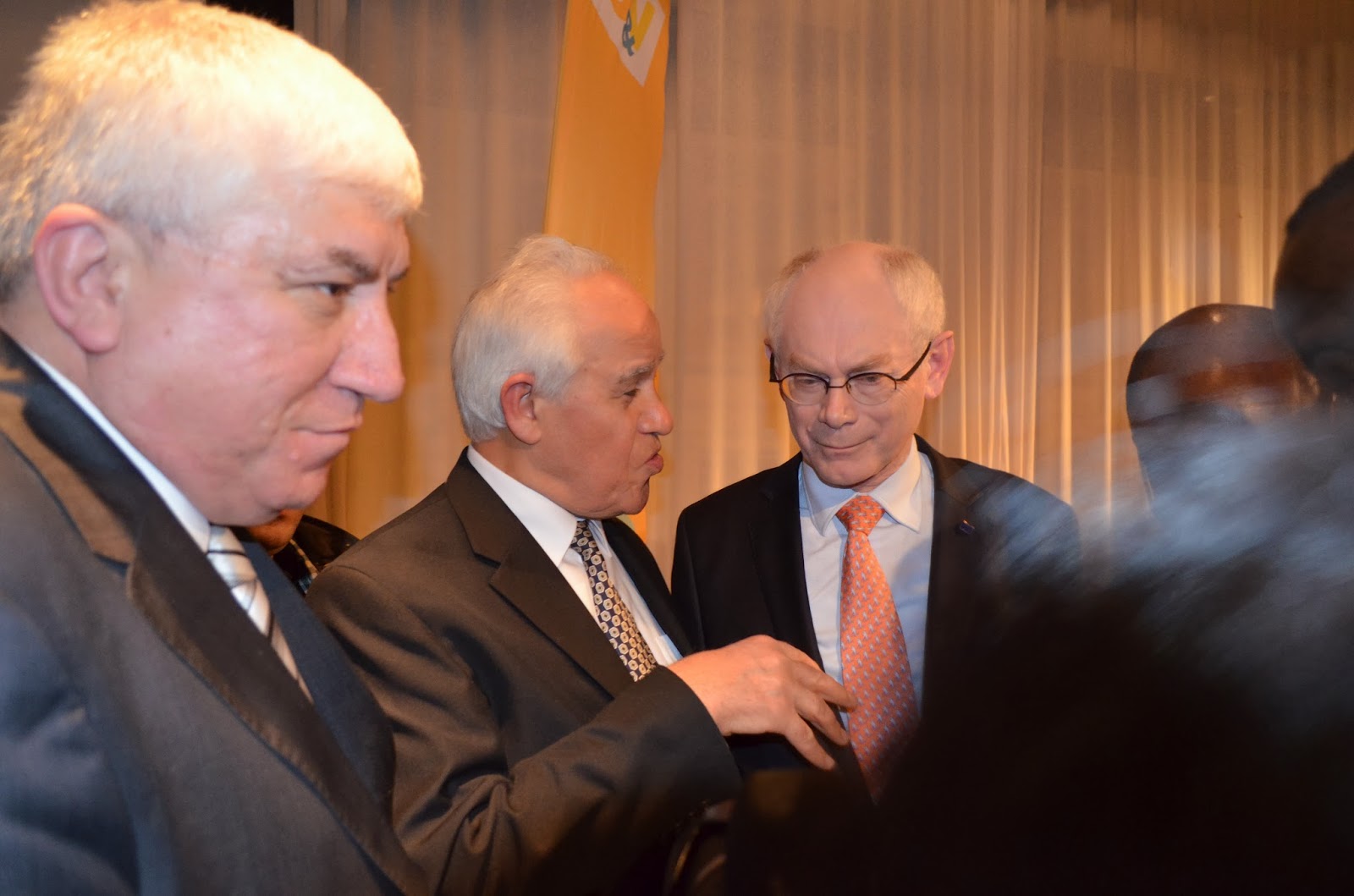
ITF EU Representative met with Mr. Herman Van Rompuy, President of the European Council

ITF EU representative received an invitation from Minister Brigitte Grouwels to attend a reception in Brussels on 7th February 2014.

The guest of honour was Mr. Herman Van Rompuy, President of the European Council.

Mr. Herman Van Rompuy, President of the European Council and Dr. Hassan Aydinli, ITF EU Representative and Member of DÜTAP (DÜNYA TÜRKLERİ AVRUPA PLATFORMU)

Mr. Steven Vanackere, Former Belgian Finance Minister and Vice-Prime Minister

Mr. Benjamin Dalle, Director Politics Coordination, Secretary of State's Office 

Mr. Herman Van Rompuy, President of the European Council

Dr. Hassan Aydinli and other members of DÜTAP received an invitation from Minister Brigitte Grouwels to attend a reception at Daarkom in Brussels.

The guest of honour was Mr. Herman Van Rompuy, President of the European Council.

At the reception Dr. Aydinli took the opportunity to inform the President of the European Council and other distinguished guests about the situation of the Turkmens in Iraq.


Musings On Iraq’s January 2014 Security Report Breakdown

Musings On Iraq’s January 2014 Security Report Breakdown


http://musingsoniraq.blogspot.be/2014/02/musings-on-iraqs-january-2014-security.html

There were a reported 1,031 security incidents in Iraq in January 2014. That averaged out to 33.2 attacks per day. In comparison, in January 2013 there were 564 attacks for an average of 18.1 per day. That was an 83% increase in one year’s time showing that the insurgency was reborn last year. The chart shows that there was a slight dip in attacks in the second half of the month, 461, compared to the first, 570. January 14 had the most attacks with 59 while January 29 only had 18.

Those 1,031 attacks led to 1,495 deaths and 2,876 wounded, which averaged out to 48.2 deaths and 92.7 wounded per day. January 15 was the deadliest day of the month with 110 deaths and 157 wounded. That was largely due to car bombings in Baghdad’s Shula, Shaab, Karrada,Husseiniya, Palestine Street, Mamil, and Sadr City, and Dujail, Salahaddin that left 35 killed and 101 wounded. Those along with the daily routine of shootings and IEDs led to the worst day of the month. In comparison on January 17 there were only 16 killed and 13 wounded.


Killed and Wounded Jan. 2014


ITF EU representative attended the Conference "The State of Freedom of Religion or Belief in the World" at the EU Parliament


ITF EU representative Dr Hassan Aydinli and the Director of Human Rights Without Frontiers (HRWF) Mr. Willy Fautré.


ITF EU Representative and Mr. Jean-Bernard Bolvin, Policy Officer, Human Rights Policy Instruments and Bilateral Cooperation European External Action Service (EEAS).


At a conference held in Brussels on February, 12 the European Parliament Working Group on Freedom of Religion or Belief (EPWG), co-chaired by MEPs Peter van Dalen (ECR) and Dennis de Jong (GUE/NGL), presented its first annual report on freedom of religion in the world. The report takes stock of developments regarding religious freedom and concludes that this human right is increasingly violated, around the globe. The report proposes to give the promotion of religious freedom a more prominent place in EU foreign policy. It furthermore makes recommendations for EU action in case of fifteen countries where the situation is particularly dire.

Namely: China, Egypt, Eritrea, India, Iran, Iraq, North Korea, Libya, Mali, Nigeria, Pakistan, Saudi Arabia, Syria, Tunisia, and Uzbekistan.


The report was presented at a conference jointly organised with the United States Commission on International Religious Freedom, who also presented their annual report. UN Special Rapporteur on Freedom of Religion or Belief, Dr. Heiner Bielefeldt, gave the keynote speech.


The conference welcomed the adoption of EU Guidelines on the promotion and protection of freedom of religion or belief, by the EU Member States last year. Participants agreed that this was a major step, however, the process of ensuring a thorough implementation has only just begun. Also, complementing measures were needed.


MEP Peter van Dalen said:

"Today is a sad day as right now many millions of people are bullied, discriminated, persecuted and even killed for their faith. I hope that our work may contribute towards improving this situation."


"We made several recommendations on specific countries. On Egypt for example, we would like the EU to unfreeze the aid pledged, but tie it to human rights conditions; Coptic Christians must be able to freely and safely practise their faith. On Pakistan, we demand that hate speech be scrapped from school books, in particular where they are subsidized by the EU! On India, we'd like to see the states who have introduced anti-conversion legislation, to repeal those provisions."


MEP Dennis de Jong said:

"I am grateful for the co-operation we developed with the EEAS on the EU Guidelines. However, we now need to follow this up through an informal dialogue on the toolkit which will serve as an instrument for embassies and EU delegations to implement the Guidelines."


"Similarly, we need to further develop our dialogue with the EEAS also on the countries of concern: we identified many such countries and we now have to focus on the instruments the EU and the Member States have to help to change the situation in these countries."


Dr. Heiner Bielefeldt said:

"I see an enormous practical potential in the EU Guidelines, in harnessing the existing capacities of the EU and its Member States to make Freedom of Religion or Belief a reality. I value the Working Group's strategic role in promoting the Guidelines and their efficient implementation. The European Parliament would be well advised to upgrade the working group to an intergroup."

Recommendations for Iraq:

After relative calm for some years, Iraq is experiencing a new peak of violence along sectarian lines. Although people from every ethnic or religious background are bein made victim, smaller religious minority groups are particularly vulnerable. Despite this volatility the EU and IRAQ have signed a Partnership and Cooperation Agreement. The EU must now make sure that the Human Rights provisions in this Agreement don't become a dead letter.