DEADLY BLASTS IN KIRKUK
mardi 19 février 2013

Bomb Attacks Kill at Least 37 in Iraq
Bomb Attacks Kill at Least 37 in Iraq
18 ŞUBAT 2013


BAGHDAD—Car bombs tore through shopping areas within minutes of each other in mainly Shiite neighborhoods of the Iraqi capital Sunday, killing at least 37 people and wounding more than 100.
The attacks come amid rising sectarian discord in Iraq and appear aimed at shaking Iraqis’ confidence in the Shiite-led government.
The explosions struck at the start of the local workweek and primarily targeted outdoor markets.
Violence in Iraq has fallen since the height of sectarian fighting in 2006 and 2007, but insurgents still frequently launch lethal attacks against security forces and civilians. It was the third time this month that attacks have claimed more than 20 lives in a single day.
The attacks began with the detonation of a parked car loaded with explosives in the sprawling Shiite district of Sadr City on Sunday morning. Two more parked cars later exploded elsewhere in the neighborhood.
Nima Khadum, a government employee, said the blasts shattered the windows of his Sadr City house. He said the air was heavy with smoke, while burning cars littered the street and the bodies of the dead and wounded lay nearby.
“The scene was a bloody one that brought to my mind the painful memories of the violent past,” he said. “I don’t see the benefit of security checkpoints that only cause traffic jams and don’t do anything to secure Baghdad. The government, with its failing security forces, bears full responsibility for the bloodshed today.”
Simultaneous explosions also hit the southeastern Baghdad neighborhood of al-Amin, where the force of the blasts left behind little except the mangled chassis of two cars.
An open-air market in Husseiniya, just northeast of the capital, and the Kamaliya area in Baghdad’s eastern suburbs were also hit.
Another car bomb exploded near street vendors and a police car in the central commercial district of Karradah.
Police and hospital officials provided the death toll, and said more than 130 people were wounded. They spoke on condition of anonymity because they weren’t authorized to brief reporters.
Casualties could have been even higher. Authorities carried out controlled explosions of two other car bombs they discovered in Husseiniya and Habibiya, near Sadr City, police said.
There was no immediate claim of responsibility for the attacks., but similar ones have been orchestrated by Sunni extremists, such as al Qaeda’s local affiliate. The group, known as the Islamic State of Iraq, favors large-scale, coordinated attacks. It considers Shiite Muslims to be heretics and accuses them of being too closely aligned with neighboring Shiite powerhouse Iran.
As sectarian strife mounts, protesters drawn overwhelmingly from Iraq’s Sunni community have been staging weekly demonstrations and sit-ins since late December to rally against the government, which is led by Shiite Prime Minister Nouri al-Maliki. The protesters have rejected calls for violence and distance themselves from extremist groups such as al Qaeda.
There are also concerns that Sunni insurgents could step up attacks ahead of provincial elections scheduled for April 20. The ballot would be the first countrywide vote since the U.S. troop withdrawal more than a year ago.
Mr. Maliki and the U.S. Embassy condemned the attacks. So did the United Nations envoy to Iraq, Martin Kobler, who said “all Iraqi leaders have a responsibility to stand up against these atrocious crimes.”
Later in the day, gunmen opened fire on a military post near the western city of Fallujah, killing one civilian and wounding five people, including two soldiers, Fallujah police said. The city and nearby Ramadi have been the heart of the Sunni protests.
The blasts came a day after a suicide bomber pretending to ask for help assassinated Brig. Gen. Ali Aouni, the head of the Iraq Defense Ministry’s intelligence academy, and three of his bodyguards in the northern city of Tal Afar.
Sunday’s attacks brought to more than 100 the number of people killed in violent attacks in Iraq since the start of the month. A total of 178 were killed in January attacks, according to an Associated Press count.
THE WALL STREET JOURNAL
The attacks come amid rising sectarian discord in Iraq and appear aimed at shaking Iraqis’ confidence in the Shiite-led government.
The explosions struck at the start of the local workweek and primarily targeted outdoor markets.
Violence in Iraq has fallen since the height of sectarian fighting in 2006 and 2007, but insurgents still frequently launch lethal attacks against security forces and civilians. It was the third time this month that attacks have claimed more than 20 lives in a single day.
The attacks began with the detonation of a parked car loaded with explosives in the sprawling Shiite district of Sadr City on Sunday morning. Two more parked cars later exploded elsewhere in the neighborhood.
Nima Khadum, a government employee, said the blasts shattered the windows of his Sadr City house. He said the air was heavy with smoke, while burning cars littered the street and the bodies of the dead and wounded lay nearby.
“The scene was a bloody one that brought to my mind the painful memories of the violent past,” he said. “I don’t see the benefit of security checkpoints that only cause traffic jams and don’t do anything to secure Baghdad. The government, with its failing security forces, bears full responsibility for the bloodshed today.”
Simultaneous explosions also hit the southeastern Baghdad neighborhood of al-Amin, where the force of the blasts left behind little except the mangled chassis of two cars.
An open-air market in Husseiniya, just northeast of the capital, and the Kamaliya area in Baghdad’s eastern suburbs were also hit.
Another car bomb exploded near street vendors and a police car in the central commercial district of Karradah.
Police and hospital officials provided the death toll, and said more than 130 people were wounded. They spoke on condition of anonymity because they weren’t authorized to brief reporters.
Casualties could have been even higher. Authorities carried out controlled explosions of two other car bombs they discovered in Husseiniya and Habibiya, near Sadr City, police said.
There was no immediate claim of responsibility for the attacks., but similar ones have been orchestrated by Sunni extremists, such as al Qaeda’s local affiliate. The group, known as the Islamic State of Iraq, favors large-scale, coordinated attacks. It considers Shiite Muslims to be heretics and accuses them of being too closely aligned with neighboring Shiite powerhouse Iran.
As sectarian strife mounts, protesters drawn overwhelmingly from Iraq’s Sunni community have been staging weekly demonstrations and sit-ins since late December to rally against the government, which is led by Shiite Prime Minister Nouri al-Maliki. The protesters have rejected calls for violence and distance themselves from extremist groups such as al Qaeda.
There are also concerns that Sunni insurgents could step up attacks ahead of provincial elections scheduled for April 20. The ballot would be the first countrywide vote since the U.S. troop withdrawal more than a year ago.
Mr. Maliki and the U.S. Embassy condemned the attacks. So did the United Nations envoy to Iraq, Martin Kobler, who said “all Iraqi leaders have a responsibility to stand up against these atrocious crimes.”
Later in the day, gunmen opened fire on a military post near the western city of Fallujah, killing one civilian and wounding five people, including two soldiers, Fallujah police said. The city and nearby Ramadi have been the heart of the Sunni protests.
The blasts came a day after a suicide bomber pretending to ask for help assassinated Brig. Gen. Ali Aouni, the head of the Iraq Defense Ministry’s intelligence academy, and three of his bodyguards in the northern city of Tal Afar.
Sunday’s attacks brought to more than 100 the number of people killed in violent attacks in Iraq since the start of the month. A total of 178 were killed in January attacks, according to an Associated Press count.
THE WALL STREET JOURNAL
lundi 18 février 2013
Iraq’s Oil Rift Deepens Over Exxon Move
ERBIL, Iraq (UPI) -17.2.2013 – Exxon Mobil, the world’s biggest oil company, is pushing ahead with its controversial drive to develop oil fields in Iraq’s independence-minded Kurdish enclave despite fierce opposition from Prime Minister Nouri al-Maliki’s central government in Baghdad.
The U.S. oil giant’s plan, and the growing defiance of the semiautonomous Kurdistan Regional Government in the northern city of Erbil, is a direct challenge to the authority of Maliki’s troubled coalition. It could also seriously upset Baghdad’s ambitious plans to rival Saudi Arabia as the world’s top producer over the next decade.
For now, all the signs are that the KRG and the central government, which haven’t seen eye to eye for years, are on a collision course. The gap is widening on a broader front as the Kurds increasingly side with rebel forces fighting in Syria and Baghdad supports the Iranian-backed regime of President Bashar Assad. “If Exxon Mobil starts drilling operations, Baghdad will have no option but to try and stop them,” the Middle East Economic Digest quoted a source in Erbil as saying.
“But they’ll have the KRG and the Peshmerga behind them.”
The Peshmerga, which means “those who face death,” are the Kurds’ battle-seasoned fighters who for decades fought a separatist war against Baghdad until Saddam Hussein was toppled in the 2003 U.S. invasion. Exxon’s feud with Baghdad flared in October 2011, when the U.S. company signed an agreement with the KRG to explore six blocks in Kurdistan, including three that lay in disputed territory along Kurdistan’s southern boundary.
Kurdistan sits on at least 45 billion barrels of crude, as well as substantial natural gas reserves. Baghdad declared the Exxon deal illegal, saying the KRG had no authority to make independent deals, and threatened to tear up Exxon’s 2009 production-sharing agreement for the huge West Qurna 1 field in southern Iraq.
Exxon, fed up with Baghdad’s stingy contracts and endless bureaucratic obstructions, stuck to its guns even though its actions have intensified the rift between Erbil and Baghdad and encouraged Kurdish expectations of independence. That threatens to splinter the federal state established after Saddam was toppled and to undermine the government’s drive to push oil production, recently raised to around 3 million barrels per day, to 10 million bpd later in the decade. National reconstruction depends on achieving that goal. Maliki, who’s facing growing unrest because of his drive to establish one-man rule since U.S. forces departed, even complained to U.S. President Barack Obama.
Washington’s worried Shiite Iran is establishing control of its long-time enemy, with its Shiite majority, and could intervene against the Kurds — whose independence aims it bitterly opposes — and Exxon and other international companies like Chevron, Total of France and Gazprom Neft of Russia that have also signed exploration deals with Erbil. Exxon Chief Executive Officer Rex Tillerson flew to Baghdad to meet Maliki in late January but apparently refused to quit Kurdistan. MEED reports Exxon “has now submitted several staff employment applications to the KRG, despite warnings from Baghdad not to pursue any upstream development.
“The KRG has allocated land for a base camp at Kani Kuchal in the disputed Qara Hanjer exploration and production block, which is near Chemchemaal gas field under development by the United Arab Emirates’ Crescent Petroleum and Dana Gas.” Maliki’s woes have been multiplied by Turkey, Iraq’s northern neighbor. It’s stepped in to aid the Kurds by offering to build oil and gas pipelines from Kurdistan to export terminals on the Mediterranean. The landlocked Kurds are already trucking oil exports northward, bypassing Baghdad’s state pipeline network to Turkey.Although Turkey’s dead set against giving its own restive Kurdish minority any measure of self-rule after a 30-year insurgency, the KRG’s deep distrust of Baghdad has produced a tactical alliance between energy-hungry Ankara and Erbil.
Baghdad has threatened to take legal action against oil companies exporting crude directly from Kurdistan. Maliki’s even sought to strike a deal with BP, which also has a big stake in southern Iraq, to upgrade the declining oil fields in Kirkuk, a region the Kurds claim. That’s incensed the Kurds, since the operation to boost production from the current 260,000 bpd to 580,000 bpd, would involve fields in contested areas.Both sides have heavily armed forces confronting each other along Kurdistan’s southern border. Oil could well be the spark to ignite a war.
dimanche 17 février 2013

Procès Pétrole contre nourriture : réquisitoire « clément » (!)
Dimanche 17 février 2013
Par Gilles Munier (bloc-note – 12/2/13)
Le 12 février dernier – 3ème semaine du procès « Pétrole contre nourriture » - le procureur a requis 35 000 euros d’amende contre moi. Je m’attendais à une peine de prison avec sursis, agrémentée d’une amende. Je ne suis pas satisfait pour autant, estimant – comme toutes les personnes impliquées dans cette affaire montée par la CIA et Israël - ne pas devoir être« puni » pour avoir violé une résolution criminelle des Nations unies. Mon avocat plaidera mardi prochain.
Amende de 35 000 euros également pour Michel Grimard, ancien président duMouvement Chrétien Vème République, organisateur de plusieurs conférences contre l’embargo - notamment au Sénat - et qui a livré en Irak, accompagné de parlementaires français, du matériel médical interdit par l’ONU.
Le procureur a fixé à 100 000 euros l’amende que devraient verser les ambassadeurs de France Serge Boidevaix (ancien secrétaire général du Quai d’Orsay) et Jean-Bernard Mérimée (ancien représentant de la France aux Nations unies).
L’amende requise contre l’homme d’affaires Claude Kaspereit, qui fut le premier Français à briser l’embargo aérien contre l’Irak – en compagnie de Jany Le Pen, présidente de SOS Enfants d’Irak –, est de 75 000 euros.
Selon les médias et les avocats de la défense, il s’agit d’un réquisitoire « clément ». Le parquet a demandé la relaxe de l’ancien ministre de l’Intérieur Charles Pasqua. On ne voit pas pourquoi il aurait été condamné, puisque son nom a été utilisé à Bagdad - à son insu - par son conseiller diplomatique pour se faire attribuer des « allocations pétrolières ». Ce dernier – Bernard Guillet – écope de la réquisition la plus lourde : 18 mois de prison dont 12 avec sursis. Comme il a déjà passé six mois à la prison de la Santé pour refus de verser la caution astronomique que lui avait fixé le juge Philippe Courroye, cela équivaut pour lui à 12 mois avec sursis. Mercredi prochain, n’ayant pas d’avocat, il assurera lui-même sa défense.
Une demande de relaxe a été demandée pour la journaliste et écrivaine franco-syrienne Hamida Na’ana, auteur d’un livre sur Tarek Aziz.
La société Total, accusée d’avoir versé des« surcharges » sur des comptes bancaires ouverts par le gouvernement irakien en Jordanie ou au Liban, se verrait réclamer 750 000 euros d’amende. Ses cadres,« complices », verseraient entre 10 000 et 20 000 euros d’amende… heureusement avec sursis. La substitut de procureur s’en est remis au tribunal pour ce qui concerne le sort de Christophe de Margerie, PDG de Total, à l’époque des faits responsable de la société pour le Moyen-Orient.
Reste à savoir maintenant si les juges du tribunal suivront ces réquisitions, les modifieront dans un sens ou dans un autre. Quoi qu’il en soit, mercredi soir, le jugement sera mis en délibéré. Le verdict tombera probablement dans deux ou trois mois.
Sur le même sujet lire aussi :
Procès « Pétrole contre nourriture » : condamné d’avance ?
Procès - 21 janvier 2013 : Gilles Munier sur le banc des accusés
Procès de la sale guerre d’Irak “Pétrole contre nourriture“
samedi 16 février 2013
THE GOVERNOR OF KIRKUK VISITED ITF TURKEY REPRESENTATION

The KYB (Kurdistan Patriots Union) mission in
Turkey on an official visit also visited the Iraqi Turkmen Front (ITF) Turkey
Representation.
After
meeting with the President of the Republic of Turkey Abdullah Gül, Prime
Minister Recep Tayyip Erdoğan and Minister of Foreign Affairs Ahmet Davutoğlu
within the framework of official contacts Governor of Kirkuk and KYB Foreign
Affairs Officer Dr. Necmettin Kerim and KYB Turkey Representative Behruz Galali
convened with ITF Turkey Representative Dr. Hicran Kazancı. The recent
political situation in Iraq and the developments in Kirkuk were discussed at
the meeting.
ITF
Turkey Representative Dr. Hicran Kazancı drew attention to the fact that a
majority of the progress and public works had developed after Dr. Necmettin
Kerim was appointed to the office of governor and thanked him for his efforts.
Kazancı expressed his pleasure at the visit of the mission to the ITF Turkey
Representation and wished a speedy recovery for Iraqi President Celal Talabani.
vendredi 15 février 2013
WikiLeaks is a Rare Truth-teller. Smearing Julian Assange is Shameful
WikiLeaks is a rare example of a newsgathering organisation that exposes the truth. Julian Assange is by no means alone.
By John Pilger
February 14, 2013 "Information Clearing House" - Last December, I stood with supporters of WikiLeaks and Julian Assange in the bitter cold outside the Ecuadorean embassy in London. Candles were lit; the faces were young and old and from all over the world. They were there to demonstrate their human solidarity with someone whose guts
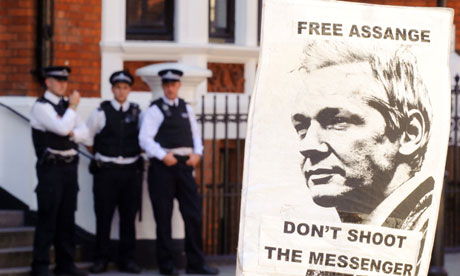 they admired. They were in no doubt about the importance of what Assange had revealed and achieved, and the grave dangers he now faced. Absent entirely were the lies, spite, jealousy, opportunism and pathetic animus of a few who claim the right to guard the limits of informed public debate.
These public displays of warmth for Assange are common and seldom reported. Several thousand people packed Sydney Town Hall, with hundreds spilling into the street. In New York recently, Assange was awarded the Yoko Ono Lennon Prize for Courage. In the audience was Daniel Ellsberg, who risked all to leak the truth about the barbarism of the Vietnam War.
Like the philanthropist Jemima Khan, the investigative journalist Phillip Knightley, the acclaimed film-maker Ken Loach and others lost bail money in standing up for Julian Assange. “The US is out to crush someone who has revealed its dirty secrets,” Loach wrote to me. “Extradition via Sweden is more than likely… is it difficult to choose whom to support?”
No, it is not difficult.
In the New Statesman last week, Jemima Khan, a philanthropist, ended her support for an epic struggle for justice, truth and freedom with an article on WikiLeaks’s founder. To Khan, the Ellsbergs and Yoko Onos, the Knightleys and Loaches, and the countless people they represent, have all been duped. We are all “blinkered”. We are all mindlessly “devoted”. We are all cultists.
In the final words of her j’accuse, Khan describes Assange as “an Australian L. Ron Hubbard”. She must have known such gratuitous abuse would make a snappy headline — as indeed it did across the press in Australia.
Commemorating poet Muhammed Mehdi BEYAT
MARTYRED MAN OF LETTERS MUHAMMET BEYAT WAS COMMEMORATED WITH A CEREMONY
12 ŞUBAT 2013
 The renowned man of letters and poet Muhammet Mehdi Beyat who lost his life in the suicide attack organized against the condolence assembly held in Tuzhurmatu on the 23rd of January was commemorated with a ceremony in the capital. The ceremony which was organized by the Iraqi Men of Letters and Authors Union Turkmen Cultural Office was attended by many poets and men of literature from Baghdad and Turkmeneli regions. The commemoration ceremony started with the recital of versus from the Koran and continued with the recital of the Fatiha for the soul of Beyat.
The opening speech of the ceremony was made by Fevzi Ekrem Terzioğlu, Officer of the Iraqi Men of Letters and Authors Union Turkmen Cultural Office. Terzioğlu indicated that the Turkmen held a significant part in the literature and culture of Iraq and pointed out major names such as Fuzuli, Nesimi and Mustafa Cevat as examples. Terzioğlu emphasized that the Turkmen had not only made their mark in the field of literature but also left major achievements and marks in other areas.
The head of the Iraqi Men of Letters and Authors Union also indicated that terror targeted all parts and explained that Beyat had made significant contributions to Iraqi literature.
Poems about Beyat were recited by the Turkmen men of letters who participated in the ceremony.
Inscription à :
Articles (Atom)
